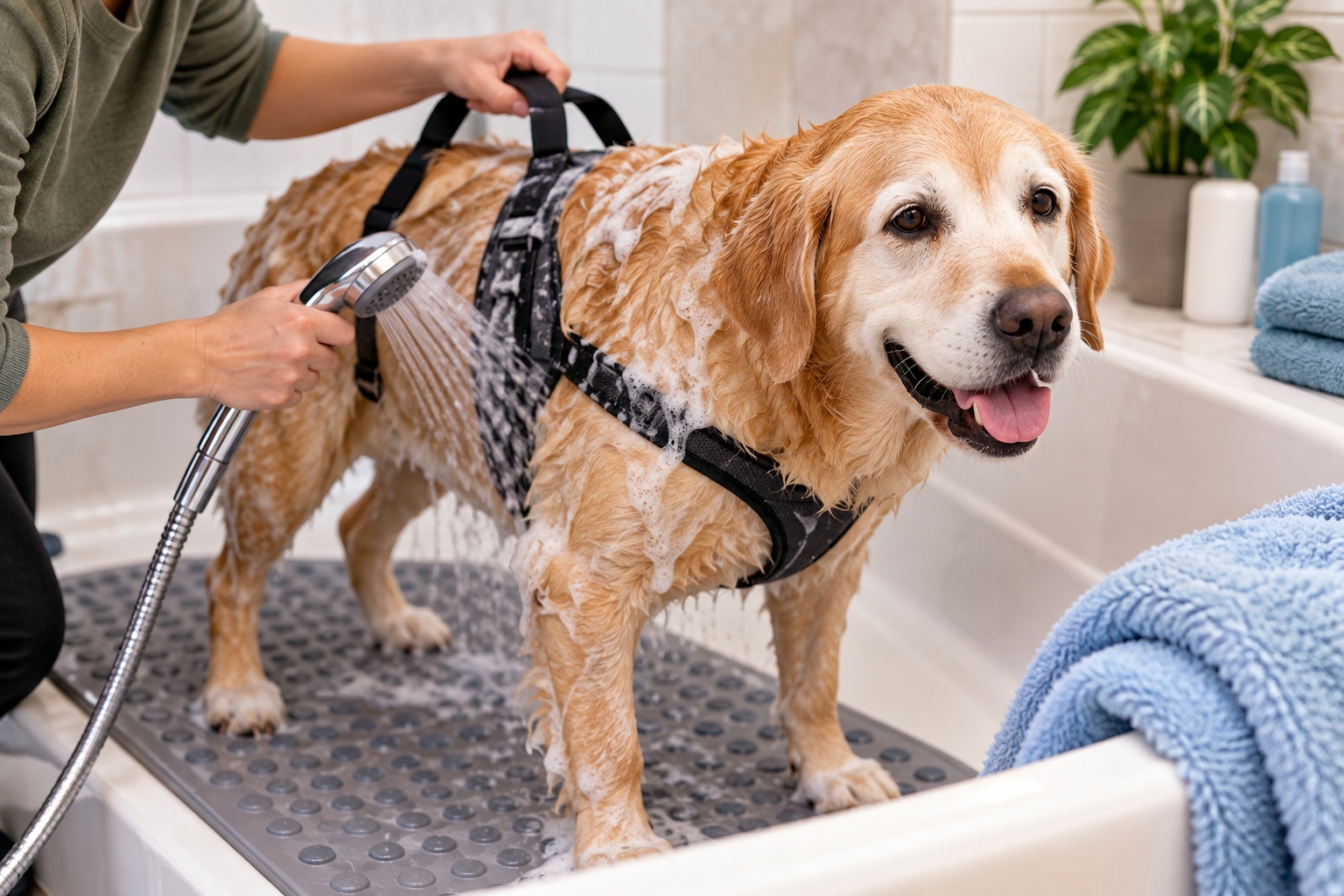
Quick Answer
To bathe a dog with mobility problems safely, give them firm non-slip footing, minimize unnecessary standing, support weak areas, and keep the bath short. Use lukewarm water, dog-safe shampoo, gentle handling, and plenty of towels. My regular safe dog bathing routine is the starting point, but dogs with arthritis, weakness, injury, or neurologic problems need extra support.
Quick mobility-friendly bath steps
- Prepare first: Put shampoo, towels, treats, and washing tools within arm’s reach.
- Add traction: Cover every slippery standing area with a secure non-slip mat.
- Support movement: Use an appropriate mobility harness or sling if your dog needs help standing.
- Wash gently: Use lukewarm water and avoid twisting, lifting, or repositioning sore joints unnecessarily.
- Keep it short: Wash efficiently so your dog doesn’t have to stand longer than necessary.
- Dry in place: Towel-blot your dog before asking them to walk across a wet floor.
Stop and get veterinary advice if needed
- Stop if your dog suddenly cries, collapses, cannot bear weight, struggles to breathe, or shows significantly more pain than usual.
A normal dog bath can become surprisingly difficult when your dog has weak legs, arthritis, balance problems, paralysis, or pain.
The goal changes too. I care less about creating a perfect grooming session and more about keeping the dog stable, comfortable, clean, and confident.
What Does Bathing a Dog With Mobility Problems Mean?
Bathing a dog with mobility problems means adapting the washing routine around the dog’s reduced ability to stand, balance, turn, step over obstacles, or recover from a slip.
The problem may involve arthritis, an orthopedic injury, age-related weakness, neurologic disease, recent surgery, or another medical condition.
- Arthritis: Joint pain can make standing and turning uncomfortable.
- Weak hind legs: The rear end may slide or collapse on wet surfaces.
- Balance problems: Sudden movement or water pressure may destabilize the dog.
- Neurologic disease: Paw placement and body awareness may be reduced.
- Post-surgical recovery: Movement may be restricted by a veterinarian.
- Senior weakness: Older dogs may tire faster and need more physical support.
Veterinary mobility guidance consistently emphasizes secure footing for dogs with arthritis, neurologic problems, and other movement limitations. The AAHA pain management guidelines specifically discuss environmental changes such as secure footing for injured or mobility-compromised pets.
That same principle matters even more in a wet bathroom.
How Should You Prepare the Bathing Area?
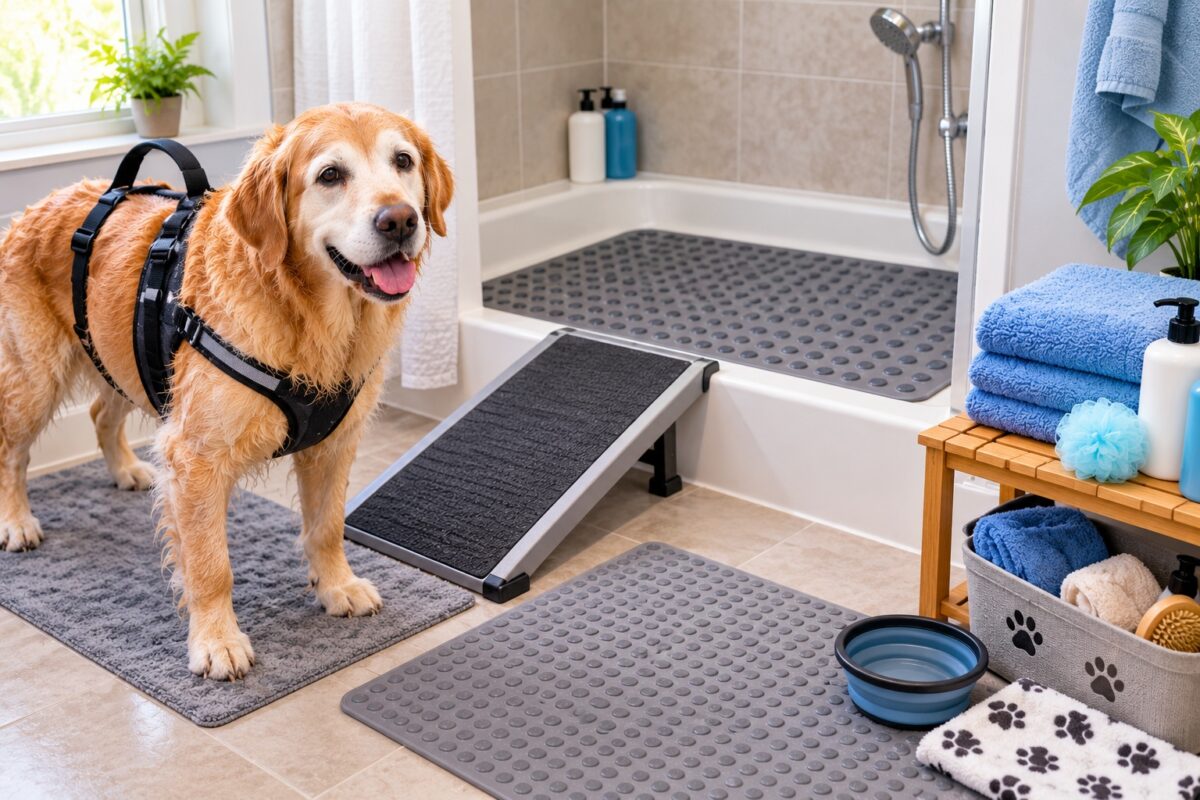
Prepare everything before bringing your dog into the bathing area. Once a mobility-limited dog is standing securely, you don’t want to leave them to search for shampoo or towels.
I try to create one continuous non-slip path from the room entrance to the washing area and back again.
- Large non-slip bath or shower mat
- Extra traction mat outside the tub
- Two or more absorbent towels
- Dog-specific shampoo
- Cup or gentle handheld sprayer
- Washcloth for the face
- Treats if your dog can have them
- Mobility sling or support harness when prescribed or appropriate
Check the floor before your dog enters. A small wet patch outside the tub can be as dangerous as a slippery tub floor.
VCA’s guidance for mobility-compromised dogs recommends adding traction to slick surfaces and considering supportive harnesses when dogs need assistance moving.
Should You Use a Bathtub, Shower, or Floor-Level Setup?
The safest location depends on how well your dog can step, stand, and balance.
Don’t automatically use a raised bathtub just because that’s where you’ve always bathed your dog.
| Mobility Level | Possible Setup | Main Concern | Helpful Support |
|---|---|---|---|
| Mild stiffness | Walk-in shower or low-entry tub | Slipping while turning | Full-length non-slip mat |
| Moderate weakness | Floor-level shower area | Fatigue and hind-end instability | Support harness or sling |
| Severe mobility loss | Spot cleaning or veterinarian-approved setup | Falls, pain, or unsafe transfers | Second person or professional help |
| Post-surgery | Only as cleared by the veterinarian | Incision and movement restrictions | Follow discharge instructions exactly |
For a dog who cannot enter a bathtub safely, forcing the transfer defeats the purpose of a careful bath.
A walk-in shower, floor-level washing area, or partial cleaning session may be safer.
How Do You Bathe a Dog With Mobility Problems Step by Step?
Keep the sequence predictable and efficient. The less unnecessary repositioning you do, the easier the bath usually becomes.
- Brush before adding water. Remove loose fur and easy tangles while your dog is dry. My guide on brushing before or after bathing explains why I prefer brushing first.
- Create secure footing. Press the bath mat firmly into place and confirm that it cannot slide under your dog’s weight.
- Help your dog enter without jumping. Use an accessible entrance, appropriate ramp, or veterinary-approved support device when needed. Never pull a painful dog into position by the collar or legs.
- Let your dog settle before starting. Give them several seconds to find a comfortable stance. Support weak areas before turning on the water.
- Use lukewarm water. Wet the body slowly from the shoulders backward. Keep the spray gentle and avoid sudden water pressure.
- Apply dog-specific shampoo. Massage with your fingertips rather than pushing hard over sore joints. Work in sections so you don’t keep turning the dog.
- Rinse thoroughly. Follow the same controlled direction through the coat. Check the chest, belly, legs, armpits, and tail for leftover shampoo.
- Remove water before moving. Gently squeeze long fur where appropriate, then blot the coat with towels while your dog still has secure footing.
- Help your dog exit slowly. Make sure the landing area is completely non-slip before the first paw leaves the washing area.
- Finish drying somewhere stable. My guide to drying a dog after a bath covers towel drying and safe airflow in more detail.
How Do You Support a Dog That Cannot Stand Well?
A dog with weak hind legs may need physical support throughout part of the bath. The support should stabilize the body without forcing a painful posture.
A mobility harness can be useful because it helps you support the dog’s weight while keeping your own hands available.
- Support the body: Help at the chest, pelvis, or other area recommended for your dog’s condition.
- Avoid limb pulling: Don’t lift a dog by one leg or reposition them by dragging a paw.
- Keep the spine comfortable: Avoid sharp twisting while turning the dog.
- Use two people when needed: One person can stabilize while the other washes.
- Follow medical restrictions: Post-surgical dogs may have specific movement limits.
VCA includes fabric slings and supportive harnesses among assistive options that may help dogs with osteoarthritis and mobility limitations. Your veterinarian or rehabilitation professional can recommend the right style for your dog’s condition.
Don’t improvise aggressive lifting techniques when your dog has a spinal, hip, knee, or surgical problem.
What If Your Dog Gets Tired During the Bath?
Fatigue is a signal to simplify the job. A mobility-compromised dog doesn’t need to remain standing just because the bath isn’t finished.
You can pause, support the dog in a comfortable position, or finish only the areas that truly need cleaning.
- Wash the dirtiest areas first.
- Keep shampoo and towels within reach.
- Avoid repeated standing and sitting.
- Use a cup instead of a loud sprayer if noise creates tension.
- Finish with spot cleaning if a full bath becomes too demanding.
Older dogs and dogs with painful joints may also hide discomfort. Texas A&M veterinary guidance notes that mobility changes such as stiffness, lameness, and difficulty rising can be signs of arthritis that deserve veterinary evaluation.
If your dog repeatedly struggles with bathing, discuss the problem with your veterinary team rather than assuming the behavior is stubbornness.
How Can You Reduce Slipping During and After the Bath?
Traction is one of the most important safety changes you can make. A dog that already struggles to balance has less room for error on wet tile or a smooth bathtub.
The American Animal Hospital Association also recommends environmental modifications that provide secure footing for arthritic, injured, or neurologically affected pets.
- Cover the full standing area rather than using a tiny mat.
- Check that suction cups or backing are firmly attached.
- Keep soap from building up under the dog’s paws.
- Place another non-slip surface outside the tub.
- Dry wet flooring before moving the dog.
- Keep nails appropriately trimmed for better traction.
Make the route back to the resting area safe too. The bath isn’t finished until your dog is dry and settled.
Should You Bathe a Dog With Arthritis?

Many dogs with arthritis can still be bathed, but the setup should reduce slipping, difficult transfers, prolonged standing, and unnecessary joint movement.
Arthritis is painful, so individual tolerance matters more than following one fixed bathing routine.
- Use an accessible washing location.
- Keep water comfortably lukewarm.
- Support weak areas when appropriate.
- Avoid forcing deep joint flexion.
- Keep the session efficient.
- Allow recovery afterward.
The AAHA mobility resources emphasize recognizing joint disease and managing mobility problems with individualized veterinary care.
If arthritis pain appears poorly controlled, talk with your veterinarian before making bath time another physical challenge.
When Should You Skip the Bath and Call Your Veterinarian?
A full bath isn’t always the right choice. Sometimes postponing it and asking for veterinary advice is safer.
- Sudden inability to stand or walk
- New severe limping
- Crying or snapping when moved
- Recent surgery without bathing clearance
- Open wounds or unprotected incisions
- New weakness or loss of coordination
- Difficulty breathing
- Repeated collapse
For mild dirt between baths, spot cleaning can reduce the physical demand of a full wash.
If fear is also making the process harder, see my guide for a dog scared of bath time before attempting another stressful session.
Useful Bathing Gear for Dogs With Mobility Problems
If you’re building a safer setup, I would focus on traction and support before buying complicated grooming equipment.
🏆 Best for Mobility Support
Help ‘Em Up Mobility Harness
★★★★★
This full-body lifting harness provides front and rear support for dogs with reduced mobility. I like this type of system when a dog needs controlled assistance standing or moving, but the dog’s veterinarian should guide use after injury or surgery.
🛁 Best for Traction
Yimobra Original Non-Slip Bathtub Mat
★★★★☆
This large bath mat uses multiple suction cups and drainage holes on suitable smooth tub surfaces. For a mobility-limited dog, I value broad coverage because all four paws need dependable grip, not just the front half of the tub.
🌿 Gentle Shampoo Pick
earthbath Oatmeal & Aloe Fragrance Free Shampoo
★★★★☆
This dog shampoo is fragrance-free and formulated with colloidal oatmeal and aloe. I prefer a straightforward dog-specific formula when the goal is to wash efficiently without adding an overpowering scent to an already stressful grooming session.
Frequently Asked Questions
How do you bathe a dog that cannot stand?
Use a secure floor-level washing area and support the dog only in ways appropriate for their medical condition. Keep the dog on a padded, non-slip surface and reduce unnecessary repositioning. A severely weak or non-ambulatory dog may need help from a veterinarian, rehabilitation professional, or experienced groomer.
Can I use a sling while bathing my dog?
A properly fitted mobility sling or full-body support harness may help some dogs stay stable. However, the correct support location depends on the dog’s condition. Ask your veterinarian before using a sling after surgery, spinal injury, or when your dog has significant pain.
How can I clean an elderly dog without giving a full bath?
Use damp washcloths, dog-safe grooming wipes, or targeted rinsing for dirty areas such as the paws and rear end. Spot cleaning is often easier for senior dogs who fatigue quickly. Dry each cleaned area thoroughly and keep the dog on non-slip flooring.
How often should a dog with mobility problems be bathed?
There is no special fixed schedule based only on mobility. Bath frequency still depends on coat, skin, dirt, odor, lifestyle, and veterinary treatment. The main difference is that each bath should be adapted to the dog’s physical limitations and recovery needs.
What should I do if my dog slips during the bath?
Stop washing and stabilize your dog before doing anything else. Check whether they can bear weight normally and whether they show pain, weakness, or distress. Contact your veterinarian if mobility suddenly worsens, your dog cannot stand normally, or the fall may have caused an injury.
What Should You Remember Before the Next Bath?
A dog with mobility problems doesn’t need a complicated grooming routine. They need dependable footing, calm handling, physical support when appropriate, and fewer unnecessary movements.
Prepare everything first. Keep the bath short, dry your dog before moving them, and never force a painful dog through a difficult transfer.
If your dog’s mobility has recently changed, make the veterinary visit the priority. Once you understand the cause, you can build a bathing routine around what your dog can safely and comfortably do.