

What is the Difference Between Dog Clippers and Trimmers?

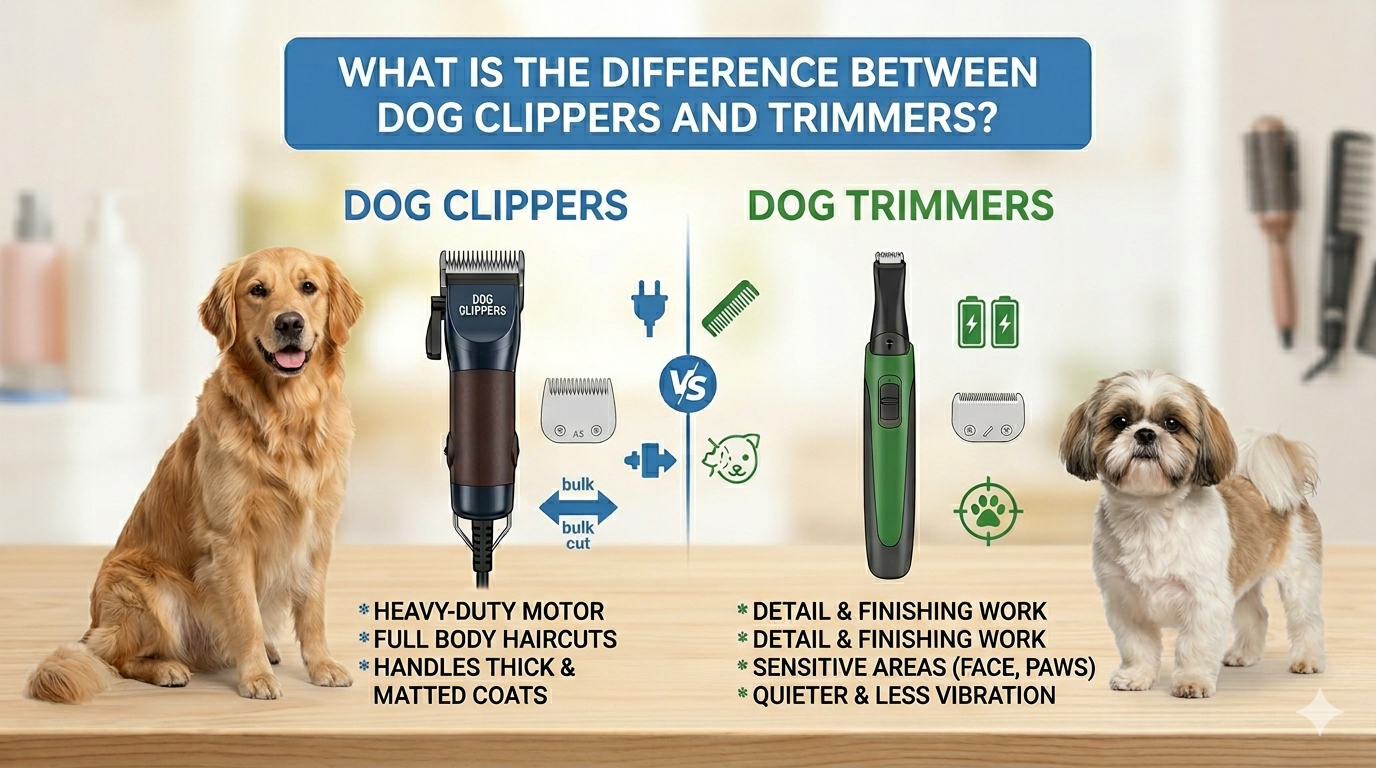
Dog clippers and dog trimmers are different tools. Clippers have powerful motors and wide blades for cutting large areas of fur all over the body. Trimmers are smaller, lighter, and more precise. You use trimmers for tight, delicate spots like the face, ears, and paws. Most groomers need both — they work together, not instead of each other.
You’re standing in the pet store staring at two very similar-looking tools. One says “clipper.” The other says “trimmer.” The price tags are different. The box descriptions are confusing. And your dog needs a haircut.
I’m Ashraful, a dog grooming enthusiast who’s tested dozens of grooming tools over the years. Here’s the thing — picking the wrong tool doesn’t just waste money. It can pull your dog’s coat, heat up on their skin, or leave patches you didn’t expect. Let me break this down so you know exactly what to grab and why.
- Clippers are for bulk cutting — full-body grooming on large areas of dense fur.
- Trimmers are for detail work — ears, face, paws, and sanitary zones.
- Clippers have bigger, more powerful motors. Trimmers run quieter and lighter.
- Most dogs need both tools for a complete, professional-looking groom.
- Top brands for both tools include Wahl, Andis, and Oster.
What Is a Dog Clipper and What Does It Actually Do?
A dog clipper is a heavy-duty grooming tool. It’s built to cut through thick, dense fur fast and efficiently. Think of it as the power saw of dog grooming.
Clippers run on stronger motors — typically between 3,000 and 4,500 strokes per minute (SPM). That extra power lets the blade glide through double coats, long fur, and even light mats without stalling. They’re designed for serious work.
Most professional clippers use a detachable A5-style blade system. You can swap blades to change the cut length — from a close shave on a #40 blade to a longer trim on a #4 or #5. This flexibility makes clippers the backbone of any full groom.
For dogs over 25–30 pounds, always use a full-size clipper for body work. Smaller tools can stall, overheat, and pull — which stresses the dog out fast.
Clippers also come in corded and cordless versions. Corded models give you unlimited run time and consistent power. Cordless ones offer freedom of movement — great for wiggly dogs. Many professional groomers keep one of each.
What Is a Dog Trimmer and When Should You Use One?
A dog trimmer is a smaller, lighter precision tool. It’s designed for the areas where clippers are too big and too aggressive. The face, ears, paws, eye area, and sanitary zones — these all need a trimmer’s gentle touch.
Trimmers use narrower blades. That narrower width gives you far more control in tight spots. You can get close to the skin around the eye without risk. You can clean up between paw pads without nicking sensitive skin. Clippers simply can’t do that safely.
One big advantage of trimmers? They run quieter. Many trimmers use low-vibration motors specifically designed to keep nervous dogs calm. A dog that panics at clipper noise will often tolerate a trimmer with no problem at all.
For puppies or noise-sensitive dogs, always introduce trimmers first. The quieter motor makes the first grooming experience far less scary — and sets the tone for every session after that.
Trimmers are also the finishing tool. After you clip the body, trimmers smooth out the blend lines. They tighten up the edges. They turn a decent home groom into something that looks professionally done.
Dog Clippers vs Dog Trimmers: The Key Differences at a Glance
Here’s where it gets interesting. Both tools cut fur. Both use blades and motors. But their design, power, and purpose are completely different. This table breaks it down clearly.
| Feature | Dog Clipper | Dog Trimmer |
|---|---|---|
| Motor Power | High — 3,000–4,500+ SPM | Lower — designed for precision |
| Blade Width | Wide — covers large areas fast | Narrow — built for tight spots |
| Best For | Full body, thick coats, mats | Face, ears, paws, sanitary areas |
| Noise Level | Louder due to stronger motor | Quieter, less vibration |
| Size & Weight | Larger and heavier | Compact and lightweight |
| Blade System | Detachable A5-style or 5-in-1 | Fixed or 2-blade detachable |
| Cost | Generally higher | Generally lower |
| Skill Required | Moderate | Higher — more precision needed |
Which Dogs Need a Clipper, Which Need a Trimmer, and Which Need Both?
The right tool depends on your dog’s coat type, breed, and what you need to do. Here’s how to match the tool to the job.
Use Clippers For These Dogs and Situations
Clippers are the right choice whenever you need to remove a significant amount of fur. That means full-body trims, shave-downs, or managing a heavy or matted coat.
- Large breeds with dense coats — Golden Retrievers, Labrador Retrievers, Bernese Mountain Dogs
- Double-coated breeds — Huskies, Chow Chows, Samoyeds (note: most groomers advise against shaving double coats — consult your vet first)
- Heavily matted dogs — clippers can safely remove mats that brushes can’t break
- Full breed cuts — Poodles, Shih Tzus, Bichon Frises needing a complete style
- Pre-surgery shaving — veterinarians use professional clippers to prepare surgical sites
Never use human hair clippers on a dog. Dog fur is coarser and thicker than human hair. Human clippers will pull instead of cut — causing pain and distress. Dog clippers have stronger motors and blade spacing built specifically for canine coats.
Use Trimmers for These Areas and Situations
Trimmers shine in the spots where precision matters most. They’re the right call whenever the area is small, sensitive, or close to something delicate.
- Face and muzzle — especially around the eyes, nose, and lip lines
- Ears — inside the ear canal opening and around the ear flap edges
- Paw pads — the fur between pads traps debris and can cause infections if left long
- Sanitary zones — keeping hygiene areas clean and mat-free
- Blending and finishing — smoothing the transition between clipped and natural fur lengths
Corded vs Cordless: Does It Matter for Clippers and Trimmers?
Both clippers and trimmers come in corded and cordless versions. The right choice depends on how you groom and where you groom.
Corded clippers give you unlimited, consistent power. They don’t lose motor strength over a long session. Professional groomers working on large dogs often prefer corded models for this reason. The Wahl KM series and Andis AGC2 are two of the most respected corded clippers in the industry.
Cordless clippers offer freedom of movement. You don’t have a cord pulling back against you as the dog squirms. Most quality cordless clippers now offer 60–90+ minutes of run time per charge — enough for most home grooms.
For home groomers with one dog, a quality cordless clipper paired with a compact trimmer covers almost everything. For professional groomers or those managing large and multiple dogs, a corded clipper is the smart choice for sustained power. Keep one corded and one cordless if budget allows.
The Best Brands for Dog Clippers and Trimmers in 2025
Three brands dominate the professional dog grooming world. Each has a loyal following — and for good reason.
Wahl — Best Balance of Power and Ease
Wahl (a U.S. company founded in 1919) is the most widely used clipper brand among professional and home groomers. The Wahl KM series offers heavy-duty motors, low vibration, and a design that reduces wrist fatigue over long sessions. The Wahl Bravura is one of the most popular cordless 5-in-1 options for both clipping and trimming smaller dogs.
Andis — Best for Quiet Operation and Versatility
Andis (a Wisconsin-based company with 100+ years in grooming) produces clippers praised for quiet, smooth operation. The Andis AGC2 2-Speed is a top pick for sensitive dogs because of its low noise output. Andis also makes excellent mini trimmers like the BravMini+ — a favorite for poodle feet, ear openings, and lip lines.
Oster — Best for Heavy-Duty Professional Use
Oster clippers are workhorses. The Oster A5 Turbo 2-Speed is famous in veterinary clinics for surviving years of hard use. Oster blades use a cryogenic treatment process that extends sharpness and durability well beyond standard blades. If you need raw power for very thick coats or daily professional volume, Oster is a natural choice.
Wahl Professional Animal KM2 2-Speed Pet, Dog, and Horse Clipper Kit (#9757-200)
The Wahl KM2 is a professional-grade corded clipper trusted by groomers worldwide — it powers through all coat types with 2 speeds, low vibration, and a detachable #10 blade that swaps in seconds.
How to Choose Between a Clipper and a Trimmer as a First-Time Buyer
Here’s the honest answer most articles skip. If you only buy one tool, get a quality 5-in-1 clipper. A 5-in-1 clipper covers five blade lengths in one unit — from close shaving to longer finishing lengths. It handles both bulk clipping and light detailing on small to medium dogs. The Wahl Arco and Andis Vida are popular 5-in-1 options.
But if your dog has a thick or dense coat, a dedicated full-size clipper becomes necessary fast. Thin 5-in-1 motors stall on heavy fur. A dedicated clipper like the Wahl KM2 won’t.
Once you have a clipper, the next purchase is a dedicated trimmer for face, ears, and paws. Mini trimmers like the Wahl BravMini or the Andis BravMini+ are small, affordable, and quiet — perfect additions once your main clipper workflow is set.
- Identify your dog’s size and coat type — light, medium, or heavy/dense.
- Small or medium dog with a light coat? A 5-in-1 clipper handles most needs.
- Large dog or thick coat? Start with a full-size 2-speed professional clipper.
- Add a dedicated mini trimmer for ears, face, and paws once the clipper is sorted.
- Stick to Wahl, Andis, or Oster — avoid unknown budget brands that stall and overheat.
Common Mistakes People Make When Using Clippers and Trimmers on Dogs
Even with the right tools, a few rookie mistakes can turn a good groom into a stressful one. Here are the ones I see most often.
Mistake 1 — Using a Clipper on Wet Fur
Wet fur clogs blades fast. Always groom a clean, completely dry coat. Blow-dry after bathing before you pick up a single blade. This keeps the clipper running smoothly and makes the cut cleaner.
Mistake 2 — Not Oiling the Blades
Dry blades heat up quickly. A hot blade on skin causes discomfort and even burns. Apply one drop of clipper oil on each side of the blade and three drops along the top before every session. Let it run for 10 seconds, then wipe the excess with a dry cloth.
Mistake 3 — Using the Same Tool for Everything
Using a full-size clipper around the eyes or a small trimmer on a Husky’s back both lead to problems. The right tool in the right area isn’t just about results — it’s about your dog’s safety and comfort.
Mistake 4 — Ignoring Blade Temperature
Blades get hot during extended sessions. Check blade temperature regularly by pressing it gently to your inner wrist. If it feels too warm for your skin, it’s too warm for your dog. Keep a blade coolant spray nearby, or have a second blade to swap in while the first cools down.
A blade that feels hot to your touch will burn your dog’s skin. Clipper burn is a real injury — it causes skin irritation, redness, and pain. Always monitor blade temperature and cool down often, especially during long sessions.
Do You Really Need Both a Dog Clipper and a Dog Trimmer?
For most dogs — yes. The short answer: clippers do what trimmers can’t, and trimmers do what clippers shouldn’t try. They’re complementary tools, not alternatives.
A professional groomer at a salon always uses both in the same session. The clipper handles the body, legs, and tail. The trimmer handles everything delicate. That combination is what produces the clean, polished finish you see in grooming photos.
That said, if you have a small, light-coated dog and only groom occasionally, a good 5-in-1 clipper can do a reasonable job alone. But the moment you try to tidy up your dog’s face with a full-size clipper, you’ll understand exactly why trimmers exist.
Here’s a useful rule of thumb: if the area you’re grooming is bigger than your palm, reach for the clipper. If it’s smaller than your palm, reach for the trimmer. That single habit will improve every home groom immediately.
How to Maintain Your Dog Clippers and Trimmers So They Last for Years
Good grooming tools are an investment. Treat them right and they’ll last for years. Neglect them and even premium clippers fail in months.
- Oil the blades before every use — not just after. This prevents heat and friction from the start.
- Clean after every session — remove all fur from the blade teeth with a cleaning brush. Built-up hair causes blades to pull.
- Use blade coolant spray — it cools, cleans, lubricates, and disinfects in one step. Keep a can at your grooming station.
- Sharpen blades regularly — dull blades pull instead of cut. Most professional blade sharpening services charge $5–$10 per blade. Brands like Oster and Wahl also offer factory sharpening services.
- Store properly — keep blades clean and dry, ideally in a case. Never store oiled blades wrapped in cloth — that traps moisture.
For a comprehensive guide on clipper and trimmer blade care, the American Kennel Club’s grooming resource center offers trusted advice from professional groomers.
The Veterinary Practice article on clippers vs trimmers is also an excellent reference for understanding the professional grooming standards behind these tools.
Choosing the right tools makes every grooming session faster, safer, and far less stressful — for both you and your dog. Now let’s tackle the questions people ask most.
Frequently Asked Questions
Can I use dog clippers as a trimmer?
You can use a clipper in some areas a trimmer handles, but it’s not ideal. Clippers have wider, more aggressive blades that are hard to control in tight spaces like ears or eye areas. A trimmer’s narrower blade gives you the precision and safety those delicate zones need. For best results, use the right tool for each area.
What is the difference between dog clippers and scissors for grooming?
Clippers and scissors both cut fur, but they work differently. Clippers use motorized blades that cut quickly and evenly over large areas. Scissors let you cut by hand with full manual control — ideal for detailed shaping, blending, and finishing specific coat styles. Most full grooms use clippers for the bulk work and scissors for the final touches.
Are dog trimmers good for thick coats?
No — trimmers aren’t built for thick coats. Their smaller motors and narrower blades will stall, heat up, and potentially pull the fur. For thick or heavy coats, always use a full-size clipper. Reserve trimmers for the face, ears, paws, and other fine detail areas even on large or heavy-coated dogs.
How often should I replace dog clipper blades?
With proper care — regular oiling, cleaning, and professional sharpening — a good blade can last 1 to 2 years or more for home use. Signs it’s time to replace or sharpen: the blade pulls instead of cuts, it heats up faster than normal, or the cut looks uneven. Sharpening extends blade life significantly before replacement is needed.
Can I use a human hair clipper on my dog?
No — human hair clippers should never be used on dogs. Dog fur is thicker and coarser than human hair, and human clippers lack the motor power and blade spacing to handle it. They’ll pull the fur, cause discomfort, and likely overheat quickly. Always use clippers made specifically for pets.
What’s the best dog trimmer for sensitive or anxious dogs?
Look for a trimmer with a low-vibration motor and quiet operation. The Andis BravMini+ and Wahl BravMini are both highly rated for nervous dogs because of their reduced noise and vibration. Introducing the trimmer while it’s turned off first — letting the dog sniff and adjust — also makes a big difference in acceptance.
Do professional groomers use clippers or trimmers?
Professional groomers use both in every session. Clippers handle the body work — bulk removal, coat shaping, and breed-specific cuts. Trimmers handle the finishing — face, ears, paws, and blending. Using both tools is what produces the clean, polished result you see in professional dog grooming.
