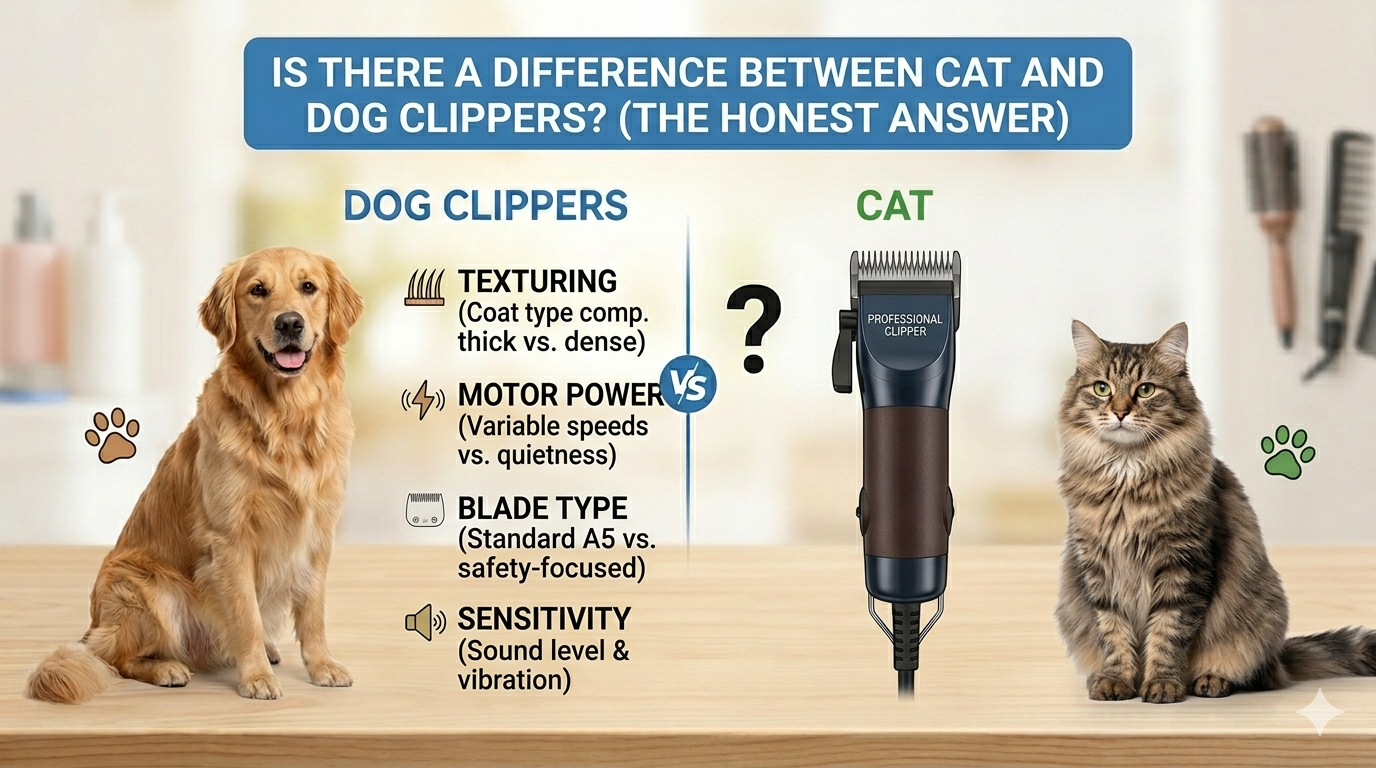
Yes, there is a difference between cat and dog clippers — but it’s not always huge. Dog clippers use more powerful motors and wider blades to cut through thick, dense fur. Cat clippers are quieter and gentler for finer, more sensitive coats. That said, many high-quality pet clippers work safely on both. Choosing the right one depends on your pet’s coat type and temperament.
You’re holding clippers in one hand and staring at your pet. And you’re wondering: “Can I use these on both my cat and dog, or do I need two separate tools?” It’s a fair question — and a lot of pet owners get confused here.
I’m Ashraful, a pet grooming enthusiast who has spent years testing grooming tools on everything from long-haired Persians to thick-coated Golden Retrievers. The short answer? There are real differences. But they’re more about coat type and noise sensitivity than the species itself. Let me break this down for you.
- Dog clippers run faster and stronger — up to 14,000 strokes per minute — to cut through dense fur.
- Cat clippers are quieter and lighter because cats have finer coats and are more noise-sensitive.
- Using dog clippers on a cat can cause skin nicks; cats have thinner, more delicate skin than dogs.
- Many A5-style professional clippers are rated for both cats and dogs — brands like Andis and Wahl make these.
- For home grooming, a quiet, multi-speed cordless clipper works well for both pets if you choose carefully.
What’s the Core Difference Between Cat and Dog Clippers?
Here’s the thing — the biggest difference isn’t the label on the box. It’s the motor speed, blade design, and noise level. Let’s look at each one.
Motor Power and Speed
Dog clippers run at higher speeds. Professional dog clippers operate at 8,000 to 14,000 strokes per minute to slice through thick, double-layered coats without pulling. Cat clippers run slower and lighter, because cats don’t typically need that much power.
Human hair clippers, for comparison, run at only 5,000 to 7,000 strokes per minute — which is why they struggle on any pet fur at all.
Blade Design
Dog clippers often use skip-tooth blades. These have wider gaps between teeth to feed coarse, thick fur through without jamming. Cat clippers use finer, closer-set blades — because cat fur is thinner and denser.
Here’s where it matters: if you use a dog blade on a cat’s fine coat, it can chew and grab the fur instead of cutting cleanly. A dull or wrong blade tugs at a cat’s skin, which can cause real discomfort.
Noise and Vibration
Cats are generally more noise-sensitive than dogs. Cat-specific clippers are engineered to run at or below 50 decibels — roughly the sound of quiet conversation. Dog clippers, especially heavy-duty corded models, can run louder.
This matters practically. A nervous cat exposed to a loud clipper will become harder to groom over time. Bad first experiences stick.
If your cat is anxious, run the clippers near them without touching for a few days first. Let them get used to the sound before any actual grooming starts. Pair this with treats and you’ll have a much easier session.
Can You Use Dog Clippers on a Cat?
You can — but with caveats. Dog clippers work on cats, especially long-haired breeds prone to matting. But you need to use a lower speed setting and choose a quieter model. The risk is the blade and skin mismatch.
Cats have thinner and more sensitive skin than dogs. Dog blades designed for resilient dog skin can nick or irritate a cat’s delicate coat. A sharp blade meant for a long-coated dog could genuinely hurt a cat if applied carelessly.
So it’s not impossible — professional groomers do it regularly with A5-style clippers. But the average home groomer should be cautious. If you’re not experienced, it’s safer to use a clipper rated specifically for cats or for both species.
Never use a long-coat dog blade on a cat without checking the blade size first. Blades meant for thick dog fur are sharp and less precise. They can cause painful nicks on a cat’s thin skin, especially around the belly or inner legs.
Can You Use Cat Clippers on a Dog?
This one’s trickier. Cat clippers are lighter-duty tools. If your dog has a fine, short coat — think a Dachshund or Beagle — cat clippers might manage a trim. But for thick-coated breeds like Golden Retrievers, German Shepherds, or Poodles, cat clippers will struggle.
The motor isn’t built to push through dense fur for extended periods. You risk overheating the clipper and pulling your dog’s coat rather than cutting it cleanly. That’s uncomfortable for the dog and frustrating for you.
The rule of thumb: never use a lighter tool for a heavier job. You can sometimes use a more powerful tool gently on a delicate animal — but going the other way doesn’t work.
What About Nail Clippers — Are Those Different Too?
Nail clippers are a separate topic, but worth covering here. According to professional groomer Caitlin Kucsan, most cat and dog nail clippers can be used interchangeably. The main practical difference is size — cat nails are smaller and less hard, so the scissor-style clipper tends to work better for cats.
For dogs, especially larger breeds, guillotine or plier-style clippers give more cutting force. Dog nails are rounder and denser than human nails, so you need the right tool there too. Never use human nail clippers on pets — the shape mismatch can crush the nail instead of cutting it.
Dog clippers = stronger motor, skip-tooth or wide blades, higher SPM, built for thick fur. Cat clippers = quieter motor, fine blades, lighter body, designed for thin sensitive skin. Many pro-grade clippers like Andis and Wahl work on both — but the blade choice and speed setting matter a lot. For home use, a quiet multi-speed clipper rated for both pets is your best all-around choice.
Cat vs Dog Clippers: Side-by-Side Comparison
| Feature | Dog Clippers | Cat Clippers |
|---|---|---|
| Motor Speed (SPM) | 8,000–14,000 | Lower, gentler |
| Blade Type | Skip-tooth or wide | Fine-tooth, narrow |
| Noise Level | Can be louder | 50dB or quieter |
| Body Size | Larger, heavier | Compact, lightweight |
| Best For | Thick, dense, double coats | Fine, thin, sensitive coats |
| Cross-Use? | Usable on cats with care | Limited on thick dog coats |
What Are A5 Clippers and Why Do They Work on Both Pets?
Here’s where it gets interesting. Professional groomers use A5-style clippers — and these are designed to handle both cats and dogs. An A5 clipper accepts interchangeable blades from all major brands like Andis, Oster, and Wahl, in sizes from #3 (over 1cm) all the way to #50 (under 1mm).
The Andis AGC Super 2-Speed Brushless Clipper, for example, is rated for cats, dogs, and horses. Its brushless motor runs quieter and cooler than traditional motors — which matters a lot for anxious cats. Groomers doing lion cuts on Persian cats use this type of clipper regularly.
The key with A5 clippers is the blade you choose. For cats, a sharp #10 or #15 blade works well for most coat types. For dogs with thick coats, skip-tooth blades in sizes #3 to #7 handle the heavy work. Keep separate blades for each pet — a dog’s coat dulls blades faster than a cat’s will.
If you groom both a cat and a dog at home, set aside a dedicated blade just for your cat. Dog fur — especially thick double coats — dulls blades faster. A dull blade on a cat’s fine fur will grab instead of cut, causing discomfort.
How to Choose the Right Clipper for Your Pet
You don’t need to overthink this. Here are the questions that actually matter.
What Kind of Coat Does Your Pet Have?
Thick, heavy, or double-coated dogs need real power. Look for a two-speed or multi-speed clipper with a rotary motor. Short or fine-coated pets — including most cats — can be groomed with a lighter, quieter tool.
How Noise-Sensitive Is Your Pet?
If your cat bolts at any sound above a whisper, prioritize clippers rated at 50dB or below. Cordless models tend to run quieter. The oneisall brand consistently gets praised for ultra-quiet operation at home — and it works on both cats and smaller dogs.
Are You Grooming One Pet or Two?
If you have both a cat and a dog, an A5-style pro clipper with interchangeable blades is the best long-term investment. Buy separate blade sets for each pet. This saves money versus buying two entirely separate clipper units.
- Identify your pet’s coat type — fine, medium, thick, or double-layered.
- Check your pet’s noise sensitivity — anxious pets need sub-50dB clippers.
- Decide if you need one clipper for both cats and dogs — if yes, go A5-style.
- Choose cordless for flexibility; corded for longer, non-stop grooming sessions.
- Always check that replacement blades are available before buying any model.
Clippers vs Trimmers: Do You Need Both?
Most pet owners think “clippers” and “trimmers” mean the same thing. They don’t. Clippers are the heavy-duty tools for full-body coat work. Trimmers are smaller, lighter precision tools for faces, paws, ears, and underbellies.
Professional groomers at ABK Grooming describe it well: clippers are the paint roller, trimmers are the fine brush. For a complete groom on either a cat or dog, you ideally want both. But for basic home maintenance — just keeping things tidy and mat-free — a single good multi-speed clipper handles most of the work.
What Happens If You Use the Wrong Clippers?
It depends on the direction of the mistake. Using cat clippers on a thick-coated dog means the motor overheats, the blades jam, and the cut comes out uneven and patchy. The dog experiences uncomfortable tugging.
Using powerful dog clippers on a cat — especially with the wrong blade — risks real skin damage. Cats have thinner skin that nicks more easily. Their coats are also denser and finer, so a skip-tooth dog blade can catch and pull rather than glide. Skin irritation, nicks, and a traumatized, grooming-resistant cat are the common results.
The good news is that avoiding these problems is simple — choose the right tool, or choose a quality dual-rated clipper that handles both.
According to Great Pet Care, professional groomer Caitlin Kucsan notes that many cat and dog nail clippers can be used interchangeably — but always opt for smaller-sized clippers for cats, as their nails are much less dense than a dog’s.
Best Clipper for Both Cats and Dogs: Our Top Pick
After looking at Amazon’s best sellers for both cat and dog grooming clippers, one product consistently leads the pack for home use.
oneisall Quiet Cat Clippers for Matted & Long Hair, 2-Speed Cordless Pet Shaver Grooming Kit for Cats, Small Dogs & Animals
This low-noise, 2-speed cordless clipper is rated for both cats and small dogs — it runs quietly enough for noise-sensitive cats and has enough motor power for medium coats. The waterproof design makes cleanup easy after every grooming session.
Tips for Safer Grooming at Home
Good grooming is about more than the right tool. Here’s what makes the biggest difference in practice.
- Always brush before clipping. Tangles and mats make clipping harder and more painful for your pet.
- Check blade heat every 10 to 15 minutes. If the blade feels hot to the touch, pause and let it cool — or switch to a backup blade.
- Use the lowest speed first. Start slow, especially near sensitive areas like the face, ears, and underbelly.
- Keep sessions short with anxious pets. End on a positive note with treats, even if you only finished half the groom.
- Oil your blades regularly. A drop of clipper oil keeps blades cool, sharp, and smooth — extending tool life significantly.
Brands like Wahl (an American grooming brand founded in 1919), Andis, and Oster have been the trusted standard in professional pet grooming for decades. Their replacement blades and accessories are widely available — which matters when you’re looking for long-term value from your clippers.
According to Veterinary Practice, veterinarians also use clippers for surgical prep — shaving specific areas before procedures. For this reason, a good quality A5-style clipper that runs cool is valuable in any multi-pet household.
Conclusion
There is a real difference between cat and dog clippers — but it’s mainly about motor strength, blade design, and noise level. Dogs need more power; cats need more gentleness. The good news is you don’t need two separate sets of clippers if you buy smart.
A quiet, multi-speed clipper with interchangeable blades handles both pets safely at home. Just match the blade to the coat, keep it sharp, and go slow. Your pets will thank you — and so will your grooming budget. As always, I’m Ashraful, and I hope this helps you groom with more confidence.
Frequently Asked Questions
Can I use the same clippers for my cat and dog?
Yes, if you choose a quality multi-speed clipper rated for both species — such as an A5-style model from Andis or Wahl. Use separate blades for each pet, since dog fur dulls blades faster than cat fur does.
Why are cat clippers quieter than dog clippers?
Cats are more sensitive to noise and vibration than most dogs. Cat clippers are engineered to run at 50dB or lower to prevent stress during grooming. Loud clippers can cause long-term grooming anxiety in cats.
What happens if I use dog clippers on my cat?
Using a powerful dog clipper with the wrong blade on a cat can cause skin nicks, irritation, and painful fur pulling. Cats have thinner skin than dogs. If you do use dog clippers on a cat, choose a quieter model, use a fine blade, and set the lowest speed.
Are cat and dog nail clippers the same?
They can often be used interchangeably, but smaller scissor-style clippers work best for cats since their nails are thinner and less dense. For larger dogs, guillotine or plier-style nail clippers provide the cutting force needed without crushing the nail.
What blade size should I use for grooming a cat?
For most cat coat types, a #10 or #15 blade on an A5-style clipper works well. A #30 blade is useful for matted coats. Always keep a sharp blade dedicated to your cat — sharing it with dog grooming will dull it faster.
Do professional groomers use different clippers for cats and dogs?
Many professional groomers use the same A5-style clipper body for both animals but switch out the blades. The motor and housing are the same; the blade choice is what changes based on the animal’s coat type and skin sensitivity.
What’s the best quiet clipper for grooming both cats and small dogs at home?
A cordless, multi-speed clipper running at or below 50dB is ideal for home use with both pets. Look for models with a waterproof design and a fine-tooth blade included — these handle cat fur cleanly and can manage lighter dog coats without stress.