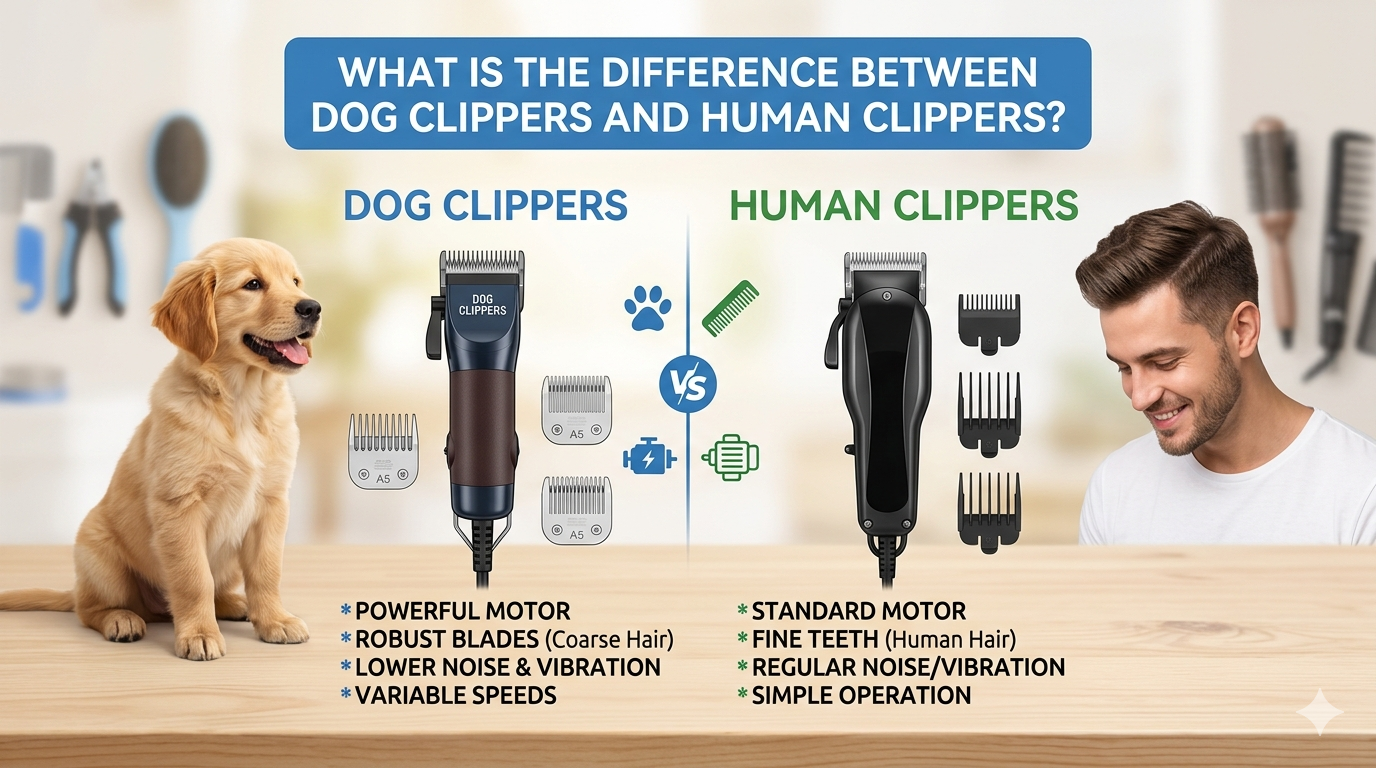
Dog clippers and human clippers look alike, but they’re built very differently. Dog clippers have stronger motors, wider blades, and lower noise levels to handle thick, dense fur. Human clippers use finer, shorter blades designed for thin hair close to the skin. Using the wrong type on the wrong subject can cause pain, injury, or a bad cut.
You grab your hair clippers. Your dog needs a trim. You think — why not just use the same tool?
I’m Ashraful, and I’ve been grooming dogs at home for over eight years. Trust me — I made that mistake early on. It didn’t go well. My dog yelped, the blade grabbed her fur, and we both ended up frustrated.
Here’s what I learned: dog clippers and human clippers are built for completely different jobs. Let me break down exactly why they’re different, and why it matters for you and your pet.
- Dog clippers have wider, sharper blades built for thick, multi-layered fur — human clipper blades are too fine.
- Dog clippers run quieter and cooler to protect your pet’s sensitive hearing and skin.
- Human clippers can pull, snag, and hurt your dog — never use them on pets.
- Dog clippers can technically cut human hair, but the results are rough and uneven.
- Always match the right tool to the right job for safety, comfort, and a clean result.
What Are Dog Clippers Designed to Do?
Dog clippers are built for one purpose: cutting dense, layered pet fur. Dog fur is not like human hair. It’s thicker, denser, and grows in multiple layers.
A single human hair follicle produces one strand. A dog’s follicle produces 3 to 7 hairs at once. That means dog clippers need a lot more cutting power just to move through the coat smoothly.
Brands like Wahl (an American grooming brand founded in 1919) and Andis (a professional clipper manufacturer based in Wisconsin) engineered their dog clippers with heavier motors and wider blade openings specifically to handle this. Their professional-grade dog clippers reach up to 5,000 strokes per minute — far beyond what most human clippers can do.
What Are Human Clippers Designed to Do?
Human clippers are designed for thin, single-strand hair close to the scalp. They use fine-toothed blades spaced very tightly together. That spacing works perfectly on human hair.
But that same tight spacing? It’s a disaster on dog fur.
When fine human clipper blades hit a thick dog coat, they don’t cut — they grab. The fur gets caught between the tight teeth and pulls. That’s painful for your dog and damaging to the blade.
Human clippers also run for much shorter periods. A typical haircut takes 10 to 15 minutes. The clippers run, then cool down before the next customer. Dog grooming can take 45 to 90 minutes on a full coat. Human clipper motors aren’t built for that kind of runtime.
How Are the Blades Different?
This is the biggest difference between dog and human clippers. The blades are not interchangeable.
Here’s a direct comparison:
| Feature | Dog Clippers | Human Clippers |
|---|---|---|
| Blade width | Wider (up to 2 inches+) | Narrower (fits head contours) |
| Tooth spacing | Wider gap for dense fur | Fine, closely spaced teeth |
| Blade size (standard) | No. 10 (leaves 1/16 inch) | No. 000 (leaves 0.2mm) |
| Blade heat management | Engineered to stay cool | Not designed for long runs |
| Detachable blades | Usually interchangeable | Often fixed or limited |
| Skip-tooth option | Yes — for matted coats | Yes — for texturizing |
Dog clippers also come with skip-tooth blades. These have wider-spaced teeth that cut through mats and tangles without pulling. Human skip-tooth blades do the opposite — they’re used to add texture to human hair, not to fight dense fur.
When choosing a dog clipper blade, remember: the higher the blade number, the shorter the cut. A No. 10 blade leaves about 1.5mm of fur. A No. 3 blade leaves around 13mm. Start longer and trim shorter if needed.
How Are the Motors Different?
Motor design is where dog and human clippers really split apart. And it comes down to three things: power, noise, and runtime.
Power: Dog fur is much tougher to cut than human hair. Dog clippers use more powerful drive mechanisms to push the blade through thick coats without stalling. Some professional dog clippers like the Andis UltraEdge Super 2-Speed feature a rotary motor built for all coat types and breeds.
Noise: Dogs can hear frequencies between 40 Hz and 65,000 Hz. Humans only hear up to about 20,000 Hz. That means a clipper that sounds “quiet” to you can feel extremely loud and distressing to your dog. Dog clipper motors include baffles and vibration dampeners to reduce sound and vibration. Many quality dog clippers stay under 60 decibels.
Runtime: Human clippers are designed for short sessions. Dog clippers run for 45 to 90 minutes at a time, sometimes longer. They use specially designed motors and housings that disperse heat so the clipper doesn’t overheat in your hand — or burn your dog’s skin.
Human clippers can overheat during long grooming sessions. An overheated blade pressed against a dog’s skin can cause burns. Dog skin is thinner and more sensitive than human skin — don’t risk it.
Can You Use Human Clippers on a Dog?
The short answer is no. You should not use human clippers on a dog.
Here’s what actually happens when you try:
- The fine blade teeth snag on the thick fur instead of cutting through it.
- The blade pulls at the skin, causing pain and stress.
- For puppies, this creates a traumatic first grooming experience that can cause fear for life.
- The motor overheats faster because it’s not built for the density of dog fur.
- The cut comes out uneven and patchy.
Wahl Professional, one of the most trusted names in clippers worldwide, cautions that even their professional human clippers aren’t designed for animal fur. The blade geometry is simply wrong for the job.
The one exception? Some professional dog groomers use human clippers on very fine-coated dog breeds — like Yorkshire Terriers — which have hair similar in texture to human hair. But even then, it’s not ideal.
Can You Use Dog Clippers on Human Hair?
Technically, yes — you can use dog clippers on human hair. It’s not dangerous. But you won’t love the result.
Dog clipper blades cut from further away from the skin. The standard No. 10 blade leaves 1.5mm to 1.8mm of hair. That’s fine for a dog’s body — but it’s much longer than the close fade or tight trim most people want from a human clipper.
The result tends to look rough and uneven. Dog clippers also don’t come with the variety of attachment combs that human clippers do. You lose a lot of precision and style options.
So while it won’t hurt you, you’re better off using the right tool for the job.
Dog clippers on humans: works, but gives a rough result. Human clippers on dogs: dangerous — pulls fur, causes pain, overheats. Always use species-specific clippers for best results.
What About Noise and Comfort for Your Dog?
Your dog’s comfort matters as much as the cut itself. A bad grooming experience early in life can make dogs fear clippers forever.
Good dog clippers are engineered to stay quiet. Many quality models run at 50 to 60 decibels — about the level of a normal conversation. Human clippers, by contrast, often run louder because noise wasn’t a key design priority for the human market.
Dog clippers are also usually cordless. A cord near a nervous dog is a tripping hazard for both of you. Cordless clippers give you freedom of movement and keep the grooming session safer.
Here’s a useful breakdown of what to look for in a dog-specific clipper:
- Noise level: Under 60 decibels for noise-sensitive dogs
- Vibration: Low vibration reduces stress and fatigue for you and your dog
- Cordless design: Safer and more flexible during grooming
- Battery life: At least 60 to 90 minutes for larger breeds
- Variable speed: Lower speeds for sensitive areas like paws and face
Before the first grooming session, let your dog sniff the clippers while they’re off. Then turn them on nearby without touching your dog. Let them get used to the sound before you start cutting. This one step can prevent years of grooming anxiety.
What Kind of Coat Does Your Dog Have? It Changes Everything.
Not all dogs have the same fur. Your clipper choice should match your dog’s coat type. Here’s a quick guide:
| Coat Type | Examples | Clipper Recommendation |
|---|---|---|
| Short, smooth coat | Beagle, Boxer | Light-duty cordless clipper |
| Long, silky coat | Yorkie, Cocker Spaniel | Medium-duty with fine blade |
| Thick, double coat | Husky, Golden Retriever | Heavy-duty with skip-tooth blade |
| Curly or woolly coat | Poodle, Bichon Frisé | Variable-speed with multiple blades |
| Wiry or terrier coat | Schnauzer, West Highland | Strong motor, wide-spaced blade |
Dogs with double coats — like Huskies or Golden Retrievers — have both a soft undercoat and a coarser outer coat. That combination defeats human clipper blades almost instantly. You need a heavy-duty dog clipper with a motor strong enough to push through both layers without jamming.
What’s the Best Dog Clipper for Home Grooming?
If you’re ready to groom your dog at home, you need a real dog clipper — not a human one. Here’s one of the most trusted options on the market:
Wahl Professional Animal Bravura Pet, Dog, Cat, and Horse Corded/Cordless Clipper Kit (#41870-0423)
This professional-grade clipper from Wahl handles all coat types, runs quietly, and works both corded and cordless — making it a top choice for at-home dog grooming.
How to Groom Your Dog Safely at Home
- Brush your dog’s coat fully before you start — remove all tangles and mats first.
- Let your dog sniff and inspect the clippers while they’re off.
- Turn on the clippers nearby and give your dog time to adjust to the sound.
- Start with a larger guard comb to stay safe — you can always go shorter.
- Clip in the direction of hair growth, using smooth and steady strokes.
- Use the lowest speed setting near paws, ears, and the face.
- Check the blade temperature every 5 minutes — if it feels warm, let it cool down or switch blades.
- Reward your dog with praise and treats throughout the session.
First-time groomers often skip the brush-out step. That’s a mistake. Mats and tangles cause the blade to snag mid-cut, which hurts the dog and damages the clipper blade. Always brush first.
For more guidance on dog coat care, the American Kennel Club’s grooming guide covers coat types and professional grooming techniques in detail.
Dog Clippers vs Human Clippers: Side-by-Side Comparison
| Feature | Dog Clippers | Human Clippers |
|---|---|---|
| Motor power | Higher — handles thick fur | Lower — built for thin hair |
| Noise level | Engineered to be quieter | Often louder |
| Blade spacing | Wide — cuts dense coats | Fine — grabs dog fur |
| Heat management | Built for long sessions | Overheats during long use |
| Cord vs cordless | Usually cordless | Often corded |
| Attachment combs | Up to 2 inches in length | Generally 1 inch or less |
| Variable speed | Yes — up to 5,000 SPM | Yes — usually 2 speeds |
| Safe for dogs? | Yes | No |
| Safe for humans? | Yes — but rough results | Yes |
Which Brands Make the Best Dog Clippers?
A few brands consistently stand out for quality and reliability:
- Wahl — Founded in 1919 in Sterling, Illinois. Makes both professional and consumer dog clippers. Trusted by groomers worldwide for over 100 years.
- Andis — Based in Sturtevant, Wisconsin. Known for rotary motors and the popular UltraEdge line, which handles all breeds and coat types.
- Oster — A legacy grooming brand with strong professional clippers used in salons and shows. Their A5 clipper is a classic.
- oneisall — A newer brand popular for affordable, low-noise cordless clippers ideal for home grooming.
For professional groomers, Andis pet clippers are widely considered among the best heavy-duty options available.
Here’s the bottom line: The difference between dog clippers and human clippers isn’t just cosmetic. It’s about safety, performance, and your dog’s wellbeing. Use dog clippers on dogs. Use human clippers on humans. The right tool makes the whole experience better for everyone — including your dog.
Common Mistakes to Avoid When Grooming Your Dog
- Using human clippers: They grab, pull, and hurt. Never do this.
- Skipping the brush-out: Mats cause the blade to snag. Always brush first.
- Ignoring blade heat: A hot blade burns skin. Touch-test every few minutes.
- Going too short too fast: Start long. You can always clip shorter.
- Grooming a scared dog without prep: Calm them first. Rushing leads to accidents.
- Forgetting to oil the blade: Dry blades pull more and wear out faster. Oil before each session.
Oil your dog clipper blade before every grooming session and after every 10 to 15 minutes of use. Dry blades heat up faster and pull at the fur. A drop of clipper oil on each side of the blade goes a long way.
If you’re ever unsure about grooming a heavily matted or very thick-coated dog, consult a professional groomer first. They can de-mat and shape the coat — then you can maintain it at home going forward.
Conclusion
Dog clippers and human clippers look similar, but they’re made for completely different jobs. Dog clippers have wider blades, quieter motors, and better heat management — everything your dog’s thick fur and sensitive hearing need. Human clippers have fine teeth and weaker motors that simply weren’t built for pet fur.
Use dog clippers on your dog. Use human clippers on yourself. It’s that simple. Your dog will thank you for it every grooming session. I hope this breakdown from me, Ashraful, helps you groom with confidence — safely and effectively.
Frequently Asked Questions
Can I use my hair clippers on my dog?
No. Human hair clipper blades are too fine and closely spaced for dog fur. They grab and pull instead of cutting cleanly, causing pain and stress to your dog. Always use clippers designed specifically for pets.
Can dog clippers be used on human hair?
Yes, technically — but the results will be rough and uneven. Dog clipper blades cut further from the skin and don’t offer the precision attachments that human clippers do. You’ll get a usable trim, but not a clean one.
Why are dog clippers quieter than human clippers?
Dogs hear at much higher frequencies than humans and are far more sensitive to sound. Dog clippers include noise-dampening baffles and vibration reducers to keep sessions calm and stress-free for your pet.
What blade should I use on my dog?
Start with a No. 10 blade for general grooming — it leaves about 1.5mm of fur and works on most coat types. Use a skip-tooth blade for thick or matted coats, and a fine blade for smooth finishing cuts.
How often should I groom my dog with clippers?
Most dogs benefit from clipping every 6 to 8 weeks. Fast-growing coats like Poodles or Shih Tzus may need trimming every 4 to 6 weeks. Short-coated breeds may only need occasional touch-ups.
Do dog clippers overheat?
Quality dog clippers are engineered to run cool for extended sessions. However, any clipper blade can heat up over time. Touch-test the blade every 10 minutes and apply clipper oil or use a cooling spray if it feels warm.
What’s the difference between corded and cordless dog clippers?
Corded dog clippers offer consistent power without battery limits — ideal for thick coats and long sessions. Cordless clippers offer more flexibility and safer movement around nervous dogs. Many professional models, like the Wahl Bravura, work both ways.