
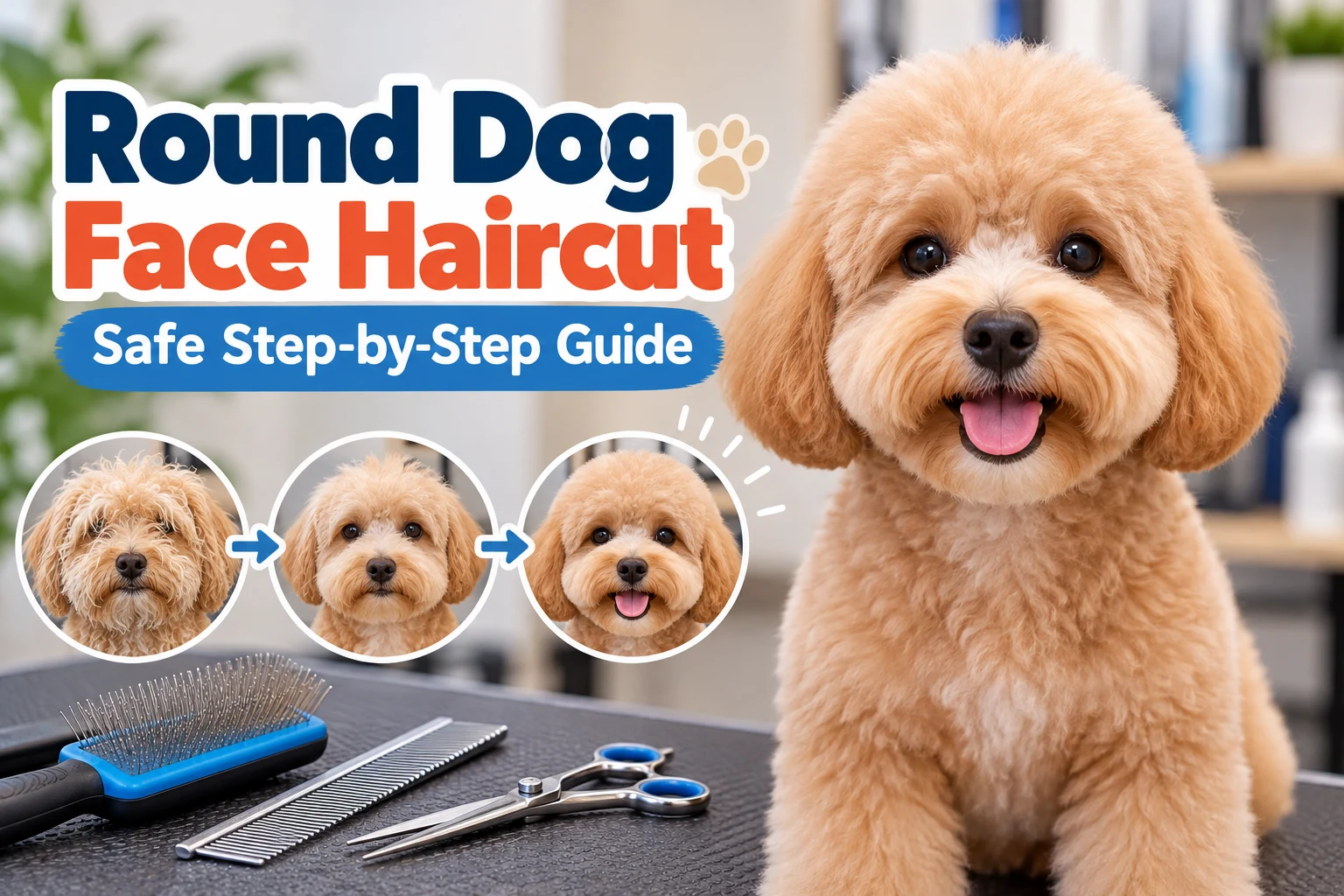
Quick Answer
A round dog face haircut creates a soft, circular appearance by blending the cheeks, chin, muzzle, and upper head. It works especially well on fluffy-coated dogs, including Poodles, Bichon Frises, and many Doodle mixes. For safety, beginners should maintain the shape with brushing and leave close facial scissor work to a trained groomer. Follow the AKC’s home grooming safety advice before attempting any trimming.
7 steps for a rounded appearance
- Check the coat: Identify tangles, mats, irritation, and sensitive areas.
- Prepare the fur: Clean, dry, and gently brush the facial coat.
- Plan the outline: Identify the desired circular shape without hiding the eyes.
- Shape the cheeks: Have an experienced groomer blend excess bulk evenly.
- Blend the chin: Maintain a natural curve beneath the muzzle.
- Balance the head: Match both sides without exposing delicate skin.
- Check comfort: Confirm clear vision, free breathing, and natural mouth movement.
A beautifully rounded face can make a fluffy dog look like a living teddy bear. However, the best haircut combines appearance with comfort and careful handling.
In this guide, I’ll explain the shape, suitable coat types, essential tools, and safe grooming techniques. You’ll also learn which tasks belong in professional hands.
What Is a Round Dog Face Haircut?
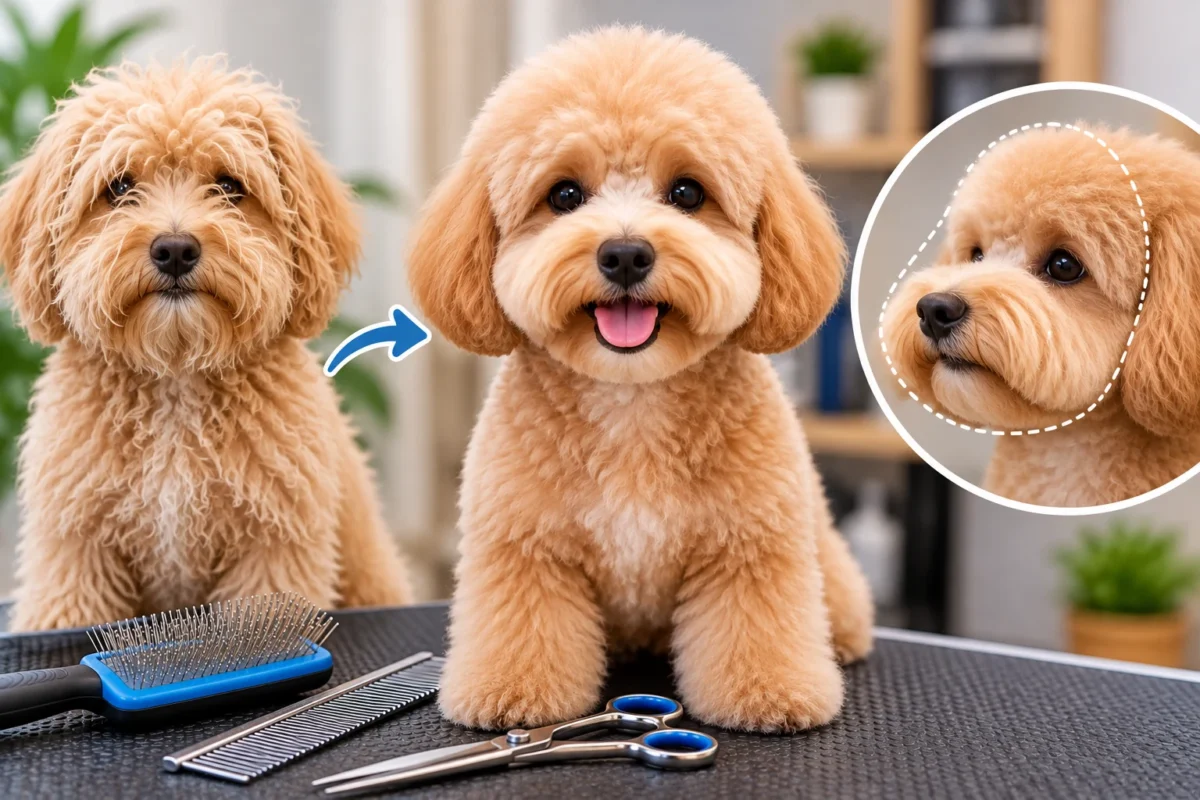
A round dog face haircut is a grooming style that creates a balanced, circular outline around a dog’s head. Groomers blend the cheeks, chin, forehead, and muzzle to produce a soft, fluffy finish.
The style is closely related to the popular teddy bear cut. However, a round face specifically describes the shape of the head rather than the entire haircut.
What Makes a Dog’s Face Look Round?
The rounded appearance comes from balanced hair volume across the face. The overall silhouette should appear smooth rather than square, pointed, or uneven.
- Full cheeks: Fluffy sides soften the head’s outline.
- Rounded chin: Balanced hair beneath the muzzle completes the circle.
- Soft forehead: Properly blended hair connects the top and sides.
- Natural muzzle: Enough facial hair remains to avoid a sharply pointed appearance.
- Clear eyes: Hair stays outside the dog’s normal field of vision.
- Smooth transitions: The face blends naturally into the ears and neck.
The goal isn’t a mathematically perfect circle. A comfortable, breed-appropriate shape usually looks more natural.
Which Dog Breeds Look Best With a Round Face Haircut?
Dogs with fluffy, curly, or continuously growing hair often suit rounded facial styles. Their coats provide the volume needed to create a soft outline.
Still, coat texture and individual facial anatomy matter more than breed labels alone.
Poodles
Poodles have curly coats that can hold a sculpted shape. A rounded face offers an alternative to traditional clean-face grooming.
Toy, Miniature, and Standard Poodles may all wear this style. The proportions should match each dog’s head.
Bichon Frises
Bichon Frises are particularly associated with rounded head grooming. Their dense, soft coats can create a cloudlike silhouette.
Professional styling helps maintain a balanced outline without compromising eye visibility.
Shih Tzus and Maltese
Shih Tzus and Maltese can wear rounded facial trims when sufficient hair remains around their cheeks. Their straighter coat textures may produce a softer, less sculpted result.
Dogs with prominent eyes or short muzzles require special caution. Their comfort must determine the haircut’s shape.
Goldendoodles and Maltipoos
Many Doodle mixes have wavy or curly coats that suit teddy bear styling. Their facial coat density can vary significantly between individuals.
A groomer should assess the actual coat before choosing a rounded outline.
What Tools Do You Need for a Round Dog Face Haircut?
Safe grooming starts with suitable equipment. Facial trimming requires greater precision than brushing or maintaining the body coat.
For beginners, I recommend focusing on gentle preparation rather than attempting sharp-tool work near the eyes.
| Tool | Main purpose | Safety consideration |
|---|---|---|
| Small slicker brush | Lifts and separates fluffy hair | Use light pressure and avoid the eyes |
| Metal grooming comb | Checks for tangles and evenness | Never force through tight mats |
| Curved grooming shears | Shapes the outer rounded silhouette | Professional use recommended around the face |
| Blending shears | Softens obvious haircut lines | Avoid moving skin and sensitive facial areas |
| Dog-safe cleaning cloth | Removes light facial debris | Avoid rubbing the eyeball |
| Non-slip grooming surface | Helps provide stable footing | Never leave the dog unattended |
Curved scissors can help trained groomers create rounded contours. However, their shape doesn’t eliminate the risk of accidental injury.
A comb, gentle brush, and good lighting are the most useful starting tools for home maintenance.
How Do You Prepare Your Dog for a Round Face Haircut?
Proper preparation makes the facial coat easier to assess and style. It also helps identify problems that should stop the grooming session.
1. Examine the Facial Coat
Check the cheeks, chin, ears, and muzzle for tangles or compacted mats. Look for irritated skin and unusual swelling.
Do not cut through mats attached tightly to facial skin. Ask a professional groomer or veterinarian for appropriate help.
2. Clean the Face Gently
Use a soft, slightly damp cloth to remove superficial debris. Keep moisture and cleaning products away from the eyes and nostrils.
The ASPCA’s dog grooming guidance explains why protecting the eyes and ears matters during facial cleaning.
3. Dry and Brush the Hair
Facial hair should be clean and dry before its shape is evaluated. Gently brush outward using short, controlled movements.
Finish with a comb to check whether the coat moves freely. Stop whenever brushing causes pulling or discomfort.
4. Help Your Dog Become Comfortable
Introduce grooming tools gradually while rewarding calm behavior. Start with brief sessions and allow breaks.
A dog that repeatedly turns away, freezes, growls, or struggles isn’t ready for facial trimming. Never force the process.
How Do You Create a Round Dog Face Haircut Safely?

The safest approach separates home preparation from professional cutting. Beginners can brush, inspect, and maintain a rounded coat, while a groomer handles precise facial shaping.
These seven stages explain the professional shaping process and what owners should check.
Step 1: Assess the Natural Head Shape
Start by observing the dog from the front and both sides. Notice the position of the eyes, ears, chin, and nose.
A broad head may need a different outline than a narrow muzzle. Avoid copying another dog’s haircut without considering anatomy.
Step 2: Establish the Desired Round Outline
Identify a gentle curve from the forehead through the cheeks and beneath the chin. The coat should form a balanced silhouette.
Professional groomers consider coat density before choosing how much hair to retain. Skin and eye safety always take priority.
Step 3: Shape the Cheek Area
The cheeks create much of the rounded effect. Experienced groomers remove excess bulk gradually while preserving enough hair for fullness.
Abruptly shortening one side can create an uneven appearance. For home maintenance, use brushing to restore volume instead of scissors.
Step 4: Blend the Chin and Muzzle
The chin forms the bottom of the rounded outline. Its contour should connect naturally with the cheeks.
Professional trimming must preserve normal eating, drinking, panting, and mouth movement. Avoid cutting around moving lips or facial folds at home.
Step 5: Balance the Forehead and Upper Head
Hair on top of the head should transition into the cheek outline. Excessive forehead volume can make the face look tall rather than round.
Never compromise visibility to preserve a dramatic fluffy look. A groomer can adjust the fringe without placing sharp tools dangerously close to the eyes.
Step 6: Blend the Ears Into the Style
The ears influence the final silhouette. Some dogs look rounder when the ear hair blends softly into the cheeks.
Others need a more distinct ear outline. Professional groomers must identify the ear leather beneath the hair before trimming.
Step 7: Check Symmetry, Comfort, and Movement
View the finished haircut from the front and both sides. Small differences in natural facial anatomy are normal.
- Both eyes remain clearly visible.
- Hair doesn’t obstruct the nose or mouth.
- The dog can pant and eat normally.
- No hair pulls tightly against the skin.
- The cheeks look balanced without excessive bulk.
- The dog appears comfortable after grooming.
Don’t chase perfect symmetry through repeated cutting. A comfortable, slightly imperfect haircut is preferable to an unsafe correction.
Round Dog Face Haircut vs. Teddy Bear Cut: What’s the Difference?
A round face haircut focuses on the dog’s head shape. A teddy bear cut usually describes a coordinated grooming style involving the face and body.
| Feature | Round face haircut | Teddy bear cut |
|---|---|---|
| Main focus | Face and head silhouette | Overall haircut, including face |
| Facial appearance | Distinct circular outline | Soft, rounded, plush appearance |
| Body length | Can vary independently | Usually coordinated with the face |
| Best suited to | Fluffy facial coats | Many fluffy or curly coat types |
| Maintenance | Regular facial brushing and trims | Face and body coat maintenance |
The terms sometimes overlap in grooming salons. Bring reference photos and explain which parts of the haircut matter most.
What Are the Most Common Round Dog Face Haircut Mistakes?
Most appearance problems come from uneven proportions or inadequate coat preparation. Safety mistakes can have much more serious consequences.
1. Cutting Too Close to the Eyes
Scissors near the eyes can cause serious injuries if a dog moves unexpectedly. This is one of the strongest reasons to choose professional facial trimming.
2. Removing Too Much Cheek Hair
Over-shortened cheeks make a rounded face look narrow or pointed. The groomer should work conservatively and reassess the outline.
3. Ignoring the Chin Shape
A flat or sharply trimmed chin can interrupt the circular silhouette. The chin should complement the muzzle without restricting movement.
4. Cutting Through Matted Hair
Facial mats can pull sensitive skin into the cutting area. Never use scissors to slice through tight mats.
The AKC’s professional grooming standards emphasize equipment safety, humane handling, and appropriate precautions.
5. Trimming a Moving or Frightened Dog
Sudden head movement makes precision trimming dangerous. Stop immediately when your dog becomes distressed.
6. Prioritizing Looks Over Function
A stylish fringe isn’t worth impaired vision. Likewise, excess muzzle hair shouldn’t trap food or obstruct normal breathing.
How Can You Maintain a Round Dog Face Between Haircuts?
Consistent coat maintenance helps preserve the rounded appearance. Brushing and careful cleaning are generally safer home tasks than facial cutting.
Use a Gentle Brushing Routine
Check longer facial hair frequently for tangles. Curly or dense coats may need daily attention, depending on their condition.
- Choose an appropriately sized grooming brush.
- Work carefully around the cheeks and outer muzzle.
- Use a comb to check for hidden tangles.
- Avoid repeatedly brushing the same sensitive spot.
- Reward calm cooperation and stop when necessary.
Keep the Face Clean
Wipe away minor food residue and surface dirt with a suitable damp cloth. Dry the area gently afterward.
Redness, persistent eye discharge, or discomfort deserves veterinary attention rather than cosmetic trimming.
Schedule Professional Maintenance
Many fluffy-coated dogs benefit from professional grooming every four to eight weeks. This is only a planning range, not a rule for every dog.
Coat growth, matting, health, and haircut length determine the actual schedule.
When Should You Avoid Trimming Your Dog’s Face at Home?
Avoid home facial cutting whenever safe control or clear visibility is uncertain. Sensitive areas leave little room for mistakes.
- Severe matting: Tangled hair sits tightly against facial skin.
- Eye problems: Redness, discharge, swelling, or squinting is present.
- Uncontrolled movement: The dog jerks, bites, or repeatedly pulls away.
- Skin irritation: The face has sores, wounds, or unexplained lumps.
- Prominent eyes: The dog’s anatomy increases the risk of accidental contact.
- Limited experience: The owner cannot confidently identify the safe cutting boundaries.
Consult a veterinarian for medical concerns and a qualified groomer for complex trimming. The AKC S.A.F.E. grooming program offers information about professional grooming safety.
What Grooming Products Help Maintain a Rounded Dog Face?
A rounded haircut depends heavily on clean, untangled facial hair. These three real grooming products serve different maintenance needs.
The suitability scores below are editorial assessments of intended use, not verified customer-review ratings.
Best for Fluffy Coats
Chris Christensen Big G Slicker Brush
★★★★☆ 4.5/5 suitability
The Big G features long, densely arranged pins designed for longer, fuller coats. I would shortlist the appropriate smaller size for maintaining fluffy cheeks, while keeping it away from delicate eye areas.
Best for Checking Tangles
Chris Christensen Buttercomb #000
★★★★☆ 4.5/5 suitability
This medium/fine grooming comb is useful for checking whether brushed hair separates freely. It is my practical pick for identifying missed tangles before they turn into uncomfortable mats.
Best for Shorter Coats
Chris Christensen Mark Slicker Brush
★★★★☆ 4/5 suitability
The Mark range uses shorter pins than the Big G series and offers different brush sizes. I would consider a small, suitable version for dogs whose shorter coats don’t need long-pin brushing.
Affiliate disclosure: This article contains Amazon affiliate links. Qualifying purchases may earn a commission at no additional cost to the buyer.
Frequently Asked Questions About Round Dog Face Haircuts
Can you give any dog a round face haircut?
No. A round face haircut works best when the dog’s coat has enough length and volume to hold the shape. Dogs with naturally short, smooth facial coats generally cannot achieve the same fluffy look without artificial styling.
Is a round face haircut the same as a teddy bear cut?
Not exactly. A round face haircut focuses on shaping the head and facial hair. A teddy bear cut usually coordinates the rounded face with a soft, relatively even body haircut. Groomers may use both terms for similar styles.
How often should a round dog face haircut be trimmed?
Many dogs may need professional facial maintenance approximately every four to eight weeks. Faster coat growth, tangling, or obstructed vision can require earlier attention. Ask your groomer to recommend a schedule based on your dog’s coat and comfort.
Can I use clippers to make my dog’s face round?
Clippers can help trained groomers manage certain facial areas, but they don’t automatically create a rounded finish. Close work around eyes, lips, ears, and facial folds can cause injury. Beginners should avoid facial clipper work without professional instruction.
How do I keep my dog’s round face fluffy?
Use gentle, regular brushing and keep the facial coat clean and dry. Check for tangles rather than repeatedly brushing through resistance. Professional maintenance helps preserve the outline while ensuring the eyes, nose, and mouth remain unobstructed.
Final Thoughts: Is a Round Dog Face Haircut Right for Your Dog?
A round dog face haircut can create an appealing, soft teddy bear appearance. The best results depend on coat texture, balanced proportions, and careful grooming.
Focus on clean, comfortable facial hair instead of an exaggerated shape. For precision cutting, choose a qualified groomer who understands your dog’s anatomy and behavior.
Bring a reference photo to your next grooming appointment and ask for a rounded face with clear eyes, a natural muzzle, and softly blended cheeks. That simple request can help your groomer understand your goal.


