

Quick Answer
To trim dog muzzle hair safely, brush and comb the facial coat, identify the whiskers and sensitive skin, and carefully shorten only the excess hair using rounded-tip grooming scissors. Keep the scissors away from the eyes, nostrils, and moving lips. Work in small sections, stop whenever your dog moves, and leave close trimming to a professional groomer.
Long hair around a dog’s mouth can collect food, trap moisture, and make the face look untidy. A gentle muzzle trim can help maintain a cleaner, more comfortable facial coat without requiring a complete haircut.
However, the muzzle is one of the most delicate grooming areas. The skin around the lips is flexible, dogs may lick grooming tools unexpectedly, and important sensory whiskers grow among the ordinary facial hairs.
This guide explains how to trim a dog’s muzzle conservatively at home, what equipment to use, which areas to avoid, and when professional assistance is the safer choice.
What Does It Mean to Trim a Dog’s Muzzle?
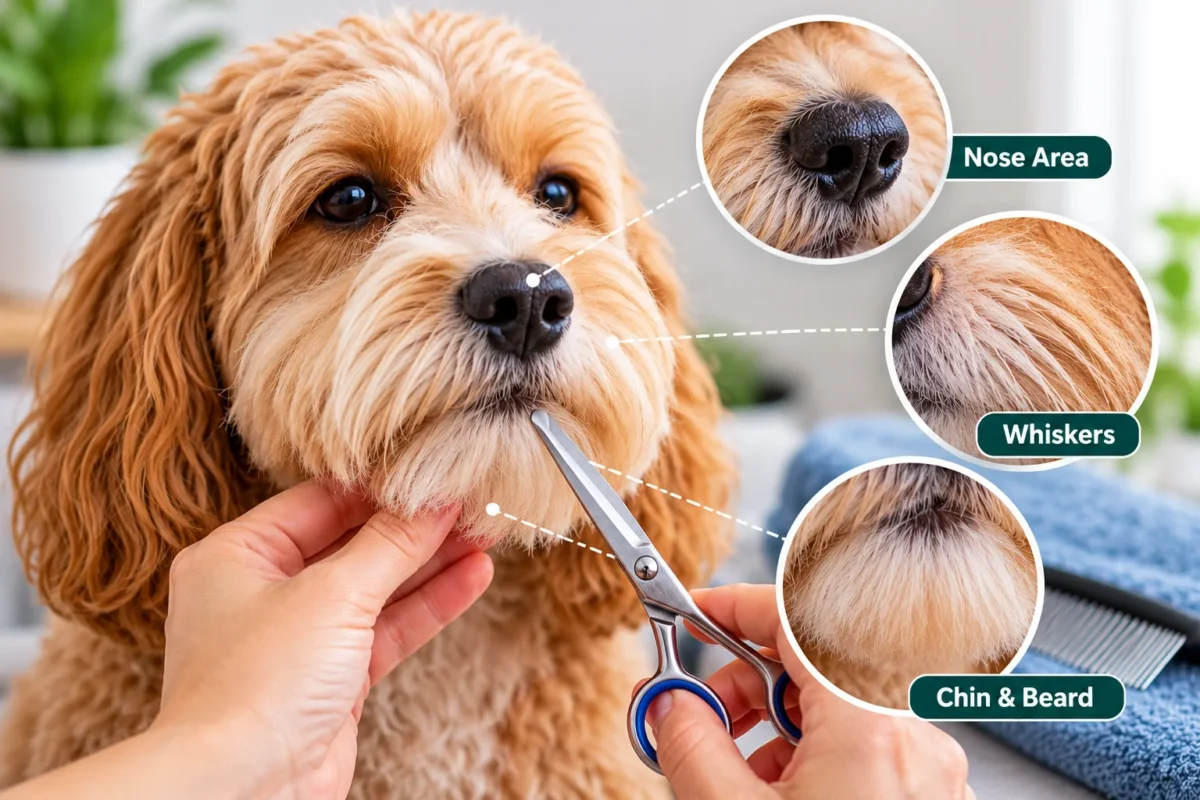
Trimming a dog’s muzzle means shortening the ordinary fur surrounding the nose, cheeks, mouth, and chin to maintain a neat appearance and reduce excessive hair around the lips.
The muzzle includes sensitive structures that should not be treated like the hair covering a dog’s back or legs. The nose, whisker follicles, lips, and nearby eyes require additional care.
A basic maintenance trim may involve:
- Shortening loose facial fur that hangs below the chin.
- Neatening longer hair along the outer cheeks.
- Reducing ordinary coat hair that collects food around the beard.
- Lightly shaping the facial outline without cutting close to the skin.
- Leaving whiskers, eyelashes, and sensitive facial structures undisturbed.
The appropriate result depends on the dog’s breed, coat texture, facial anatomy, and tolerance for grooming.
For example, a long-haired Shih Tzu may need occasional facial maintenance, while a short-coated Labrador usually requires no muzzle haircut at all.
What Tools Do You Need to Trim Dog Muzzle Hair?
For a small home maintenance trim, a simple selection of suitable dog grooming tools is generally preferable to a collection of sharp or unfamiliar equipment.
- Rounded-tip grooming scissors: Useful for carefully shortening exposed, accessible facial fur after appropriate instruction.
- Small grooming comb: Helps separate ordinary coat hair and reveal tangles or hidden skin folds.
- Soft facial brush: Removes loose hair and gently prepares the coat.
- Non-slip grooming surface: Helps prevent unexpected slipping or loss of balance.
- Good lighting: Makes the whiskers, lip margins, and surrounding skin easier to distinguish.
- Small dog treats: Reward calm behavior and help develop positive grooming associations.
Specialized facial clippers or thinning shears may be useful in experienced hands, but they are not necessary for every owner. A smaller tool is not automatically safe near moving lips or eyes.
Avoid ordinary pointed household scissors, oversized clippers, dull blades, and tools that pull the hair.
The American Kennel Club’s home grooming guidance advises owners to seek proper instruction before attempting clipping and other sensitive grooming procedures.
How Do You Prepare Your Dog for a Muzzle Trim?
Preparation involves making sure the coat is clean and dry, checking for skin problems, and confirming that your dog can remain relaxed while the face is handled.
Check the Hair and Skin
Gently examine the muzzle for tangles, dried food, redness, swelling, cuts, or painful areas.
Use a comb to distinguish loose fur from skin folds, lip edges, and whiskers. Never assume that a dark line beneath the coat is simply another section of hair.
If you discover tight matting against the lips or skin, do not cut underneath it. A professional groomer can assess whether the area can be safely cleared.
Help Your Dog Feel Comfortable
Allow your dog to investigate the grooming tools before beginning. Reward calm behavior when you gently touch the cheek, chin, or outer muzzle.
Practice brief handling sessions without cutting any hair. A dog that repeatedly pulls away, growls, freezes, or tries to bite is not ready for facial trimming.
Do not force the dog’s mouth closed, apply pressure to the throat, or physically overpower a frightened animal.
How to Trim a Dog’s Muzzle Safely: 8 Steps
These steps are intended for a minor tidy-up of accessible outer facial hair on a calm, cooperative dog. They are not instructions for shaving the muzzle or performing a close breed-specific clip.
- Position your dog comfortably. Choose a well-lit, quiet area with a secure, non-slip surface. Keep your dog at a comfortable height without leaving them unattended on an elevated table.
- Brush and comb the muzzle. Remove loose debris and gently untangle the ordinary facial fur. Stop if brushing reveals painful matting.
- Identify the whiskers and lip margins. Look closely at the longer, stiffer sensory hairs. Avoid cutting or pulling them. Check where the moving lips and underlying skin begin.
- Choose a small section of loose outer hair. Begin with longer beard or cheek hair that extends clearly away from the skin. Avoid the nostrils, lip folds, mouth corners, and area directly beneath the eyes.
- Separate the excess fur carefully. Use the comb to lift a manageable section. Keep a clear view of the entire cutting area and avoid placing scissors where the comb conceals the skin.
- Shorten the exposed ends gradually. With your dog completely still, make small, controlled cuts away from the face. Do not insert scissors into the mouth, cut across skin folds, or attempt to create a close shaved finish.
- Check the shape from both sides. Comb the hair back into its natural position. Assess whether further trimming is necessary rather than repeatedly cutting to achieve perfect symmetry.
- Finish and reward your dog. Remove loose clippings with a soft brush, check for irritation, and reward cooperative behavior. Stop while the dog is still comfortable.
Safety Warning
Never continue cutting while your dog is turning its head, licking the scissors, resisting restraint, or showing distress. Put the tool down immediately. Hair directly against the lips, nostrils, or eyes should be handled by an appropriately trained professional.
Should You Use Clippers or Scissors on a Dog’s Muzzle?
For a small amount of accessible outer muzzle hair, rounded-tip grooming scissors may offer adequate control. Clippers are more appropriate for certain structured grooming styles, but their safe use around the face requires training.
The differences matter because the muzzle has curved surfaces, flexible lips, and sensitive skin.
| Tool | Potential Use | Important Limitation |
|---|---|---|
| Rounded-tip scissors | Minor outer beard and cheek tidying | Can still cut skin or lips if the dog moves |
| Small facial trimmer | Selected facial grooming by trained handlers | Blade contact, vibration, and sudden movement create risks |
| Full-size dog clippers | Professional coat shaping where appropriate | Often unsuitable for inexperienced detail work around lips |
Neither tool guarantees safety. The dog’s behavior, handler’s training, visibility, and distance from delicate structures matter more than tool size alone.
If the trim requires clipping very close to the skin, it is generally better to consult a qualified groomer.
Which Parts of a Dog’s Muzzle Need Extra Protection?
The most sensitive areas are the whiskers, nose, lip folds, mouth corners, and the region near the eyes. Each presents a different grooming risk.
Whiskers
Whiskers are specialized sensory hairs, also called vibrissae. They help dogs detect nearby objects and changes in their surroundings.
Unlike ordinary coat hair, whiskers are associated with highly sensitive follicles. They should not be pulled or deliberately shortened merely for cosmetic symmetry.
Veterinary-reviewed information from PetMD explains the sensory function of dog whiskers and recommends preserving them.
Lips and Mouth Corners
The lip margins can shift suddenly when a dog pants, licks, or opens its mouth. Skin folds may also be hidden beneath longer hair.
Do not pull the lips outward to create a cutting surface. If hair is tightly attached to a fold or tangled against the skin, ask a professional groomer to remove it.
Nostrils and Eyes
Keep grooming tools away from the nostril openings and delicate eye area. A muzzle tidy-up does not require putting scissors against the nose or near an eyelid.
Hair interfering with vision or irritating the eyes deserves prompt assessment, but cutting extremely close to the eye is best left to someone trained in safe facial grooming.
How Should You Trim Different Dog Muzzle Styles?
Different coat types require different maintenance approaches. A safe trim should respect the dog’s natural coat rather than trying to reproduce every popular grooming style at home.
Long, Rounded Muzzles
Poodles and some doodle-type dogs may have dense facial hair shaped into rounded or longer styles.
Lightly combing and trimming loose outer ends may help preserve the existing outline. Creating a closely shaved muzzle, however, requires more precise blade handling and is better performed by a professional.
Bearded Muzzles
Schnauzers and other bearded breeds can collect food or moisture in the longer hair beneath the mouth.
Regular cleaning and combing are often more important than shortening the beard. Trim only clearly separated, excess outer hair if your dog tolerates the process.
Short or Flat Muzzles
Dogs such as Pugs and Bulldogs usually do not need cosmetic muzzle clipping. Their facial folds and shorter noses make close grooming particularly inappropriate for an inexperienced owner.
Focus on appropriate fold hygiene and seek veterinary guidance if you notice persistent moisture, odor, redness, or irritation.
What Dog Muzzle Trimming Mistakes Should You Avoid?
The most common avoidable problems arise from rushing, poor visibility, using inappropriate tools, or continuing when the dog is uncomfortable.
- Cutting too close: A shorter muzzle is not necessarily cleaner or more comfortable.
- Ignoring whiskers: Do not treat sensory hairs as ordinary stray fur.
- Trimming tangled hair: Mats can conceal skin, increasing the risk of accidental injury.
- Using sharp household scissors: Pointed blades increase the danger during unexpected head movement.
- Continuing through fear: Struggling and defensive behavior are signals to stop.
- Overworking the same area: Repeated passes can irritate the skin and reduce the dog’s tolerance.
- Copying professional styles without training: Close muzzle clips demand specialized handling skills.
For a first home grooming attempt, a slightly uneven but safe result is better than repeatedly cutting toward delicate skin to achieve an exact shape.
When Should You Stop Trimming and Contact a Professional?
Stop immediately when the dog shows significant distress, the skin cannot be seen clearly, or the intended cut requires working against a sensitive facial structure.
A professional groomer is generally the better choice when your dog has severe matting, a history of sudden head movements, substantial grooming anxiety, or a breed-specific style that requires close clipping.
Contact a veterinarian when you notice:
- Bleeding or a cut involving the lips, nose, or nearby skin.
- Persistent redness, swelling, discharge, or signs of infection.
- Eye irritation or an injury involving the eye.
- Pain when the face or muzzle is touched.
- Unusual sores, lumps, or painful skin folds.
If an eye injury occurs, avoid further grooming and seek veterinary attention promptly. Do not apply random creams, disinfectants, or eye products without appropriate guidance.
Experienced professionals can also help develop a gradual handling plan for dogs that struggle during face grooming.
How Can You Keep a Dog’s Muzzle Clean Between Trims?
Regular gentle cleaning, brushing, and checking the facial coat can reduce the need for frequent cutting.
After meals, inspect the beard and surrounding coat for trapped food. Wipe away surface debris with a soft, slightly damp cloth suitable for your dog’s skin, avoiding the eyes and nostrils.
Dry the coat gently afterward, especially beneath the chin and in naturally damp facial areas. Use an appropriate comb to remove small tangles before they become difficult to manage.
Check the muzzle periodically for odor, irritation, new lumps, or persistent staining. If a dog repeatedly develops wet, inflamed, or uncomfortable skin around the mouth, grooming alone may not resolve the underlying problem.
Practical Tip
Make facial grooming a short, positive routine. A dog that calmly accepts brushing, gentle handling, and a muzzle inspection may need fewer stressful grooming sessions than one whose face is only handled during haircuts.
Frequently Asked Questions About Dog Muzzle Trimming
Can you trim a puppy’s muzzle hair?
Yes, a puppy may eventually need facial hair maintenance, but start with gentle handling and brushing rather than immediately using scissors. Have a professional demonstrate any cutting needed near sensitive facial areas.
Does trimming dog muzzle hair hurt?
Cutting ordinary hair shafts does not normally cause pain, but pulling tangled hair, nicking skin, touching sensitive follicles, or using hot clipper blades can cause discomfort or injury.
Can you trim your dog’s muzzle while it is sleeping?
No. A sleeping dog may wake or jerk its head unexpectedly. Groom only when your dog is awake, comfortable, and voluntarily cooperating.
Should you wash a dog’s muzzle before trimming?
If the fur is dirty or sticky, gentle cleaning followed by thorough drying can make it easier to inspect and comb. Never begin cutting while hidden tangles or wet clumps obscure the skin.
How often should a dog’s muzzle be trimmed?
There is no universal schedule. Frequency depends on coat growth, breed, hygiene needs, and the chosen style. Inspect and clean the muzzle regularly, and trim only when excess hair genuinely needs attention.
What should you do if you accidentally cut a whisker?
Do not pull the remaining hair or attempt to trim the other whiskers to match. An accidentally cut whisker can regrow, although regrowth takes time. Contact your veterinarian if the follicle or surrounding skin is injured.
Final Thoughts
Learning how to trim dog muzzle hair safely begins with recognizing which areas should not be cut. Small adjustments to loose outer fur may be manageable for a calm dog and a properly instructed owner, but close work around the lips, eyes, nostrils, and whiskers carries unnecessary risks without professional training.
Prioritize comfort, good hygiene, and a positive grooming experience over a perfectly shaped haircut. If a trim becomes difficult or your dog is uncomfortable, professional grooming is the safer next step.


