
Quick Answer
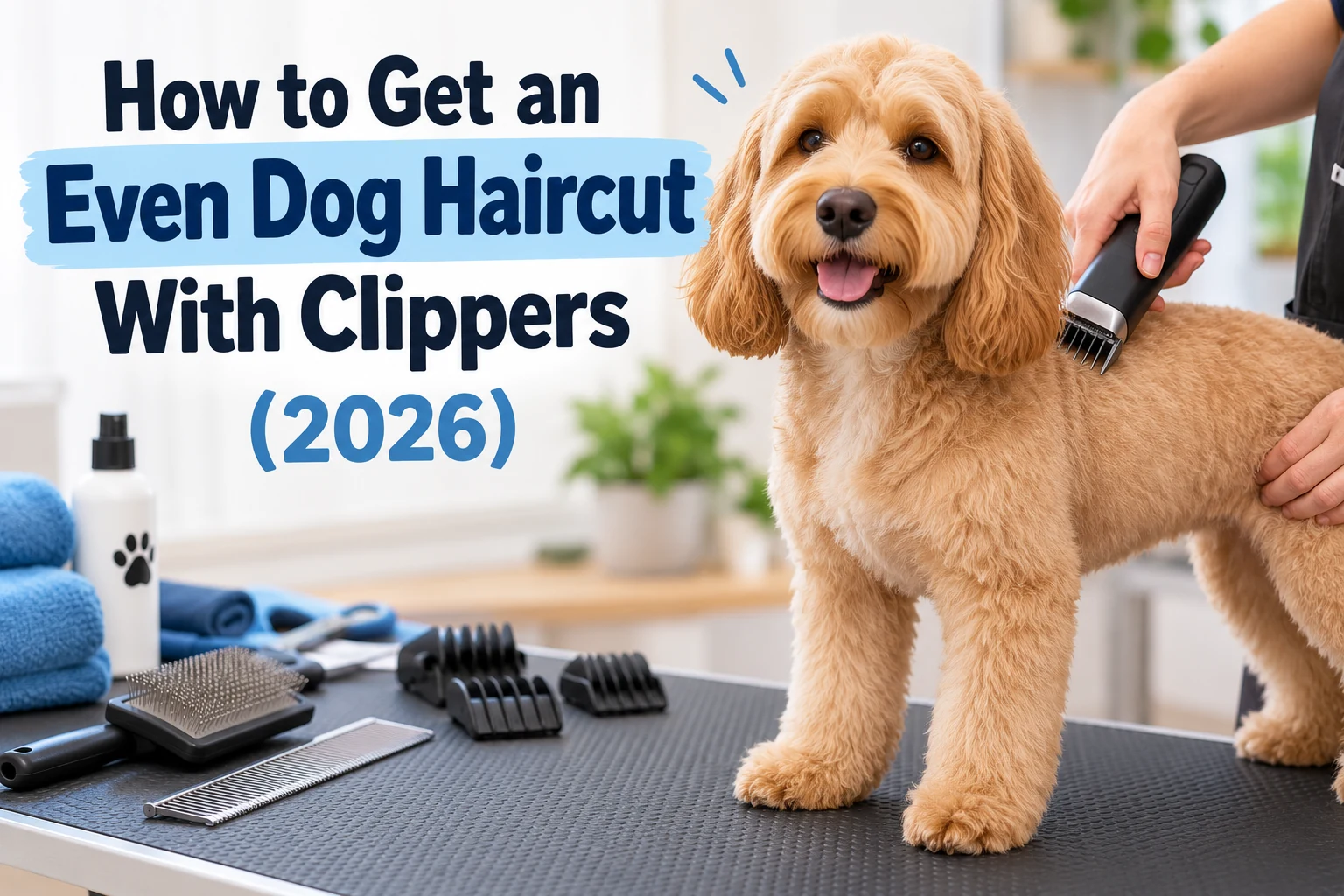
To get an even dog haircut with clippers, start with a clean, completely dry, tangle-free coat. Choose a suitable guard comb, clip slowly in the direction of hair growth, and overlap your strokes slightly. Keep the clipper flat against the coat, use consistent pressure, and comb the fur between passes to identify uneven areas. Only attempt home clipping if your dog’s coat type and behavior make it safe.
An uneven dog haircut usually comes from inconsistent clipper angles, poorly prepared fur, or changing cutting lengths between sections. Even small changes in pressure can leave visible lines, patches, and ridges.
The solution is to work systematically rather than repeatedly shaving the same area. These eight steps explain how to create a more consistent finish while keeping your dog comfortable.
What Do You Need for an Even Dog Haircut?
For a uniform haircut, use grooming equipment appropriate for your dog’s coat rather than relying on clippers alone.
- Dog grooming clippers: Select clippers capable of cutting through your dog’s coat without pulling.
- Compatible guard combs: These help maintain a consistent cutting length.
- Slicker brush: Useful for lifting and separating fur before clipping.
- Metal grooming comb: Helps detect hidden tangles and uneven sections.
- Dog shampoo: Removes debris and buildup before clipping.
- Dog-safe drying equipment: Helps prepare longer coats for a smooth finish.
- Clipper blade oil: Maintains blade operation according to manufacturer instructions.
- Stable, nonslip grooming surface: Helps prevent sudden movement or slipping.
A guard comb is particularly helpful for beginners because it reduces unintended variations in cutting length. However, guards are not a substitute for safe technique, and they should not be forced through tangles.
How to Get an Even Dog Haircut With Clippers: 8 Steps
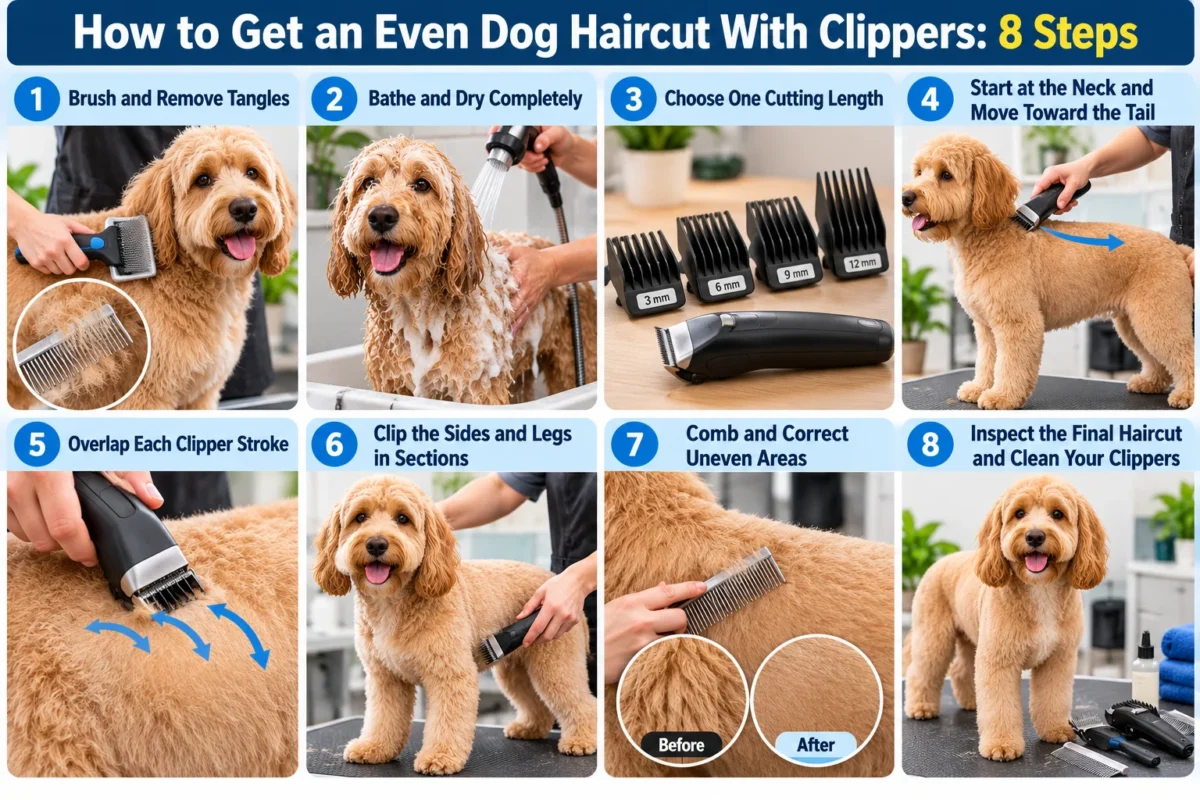
Use the following method for dogs whose coats are suitable for clipping. If your dog is severely matted, has irritated skin, or cannot tolerate the equipment, arrange professional grooming instead.
Step 1: Brush and Remove Tangles Before Clipping
Brush the coat thoroughly, working through small sections from the ends of the hair toward the roots. Follow with a metal comb to identify tangles hidden beneath the surface.
Pay particular attention to the chest, behind the ears, legs, and areas where the harness rubs.
Clippers and guard combs cannot move evenly through tangled fur. They may ride over knots, skip sections, or pull uncomfortable hair.
Check: The comb should move through each area without catching before you attempt a longer guarded trim.
Never force clippers through tight mats or cut mats away with ordinary scissors. Mats close to the skin need professional attention.
Step 2: Bathe and Dry the Coat Completely
Wash your dog with an appropriate dog shampoo, rinse thoroughly, and dry the coat completely before clipping.
Dirty, greasy, or damp fur can feed inconsistently through clipper blades. It may also make the coat lie in uneven clumps.
For longer coats, use a suitable dog dryer on a safe setting while gently brushing. Follow the manufacturer’s drying instructions and prevent excessive heat exposure.
Once dry, comb the coat again to make sure there are no remaining tangles.
Grooming Tip
For fluffy or curly coats, drying and brushing the hair into a consistent position before clipping often makes it easier to achieve a smooth, balanced finish.
Step 3: Choose One Consistent Cutting Length
Select a guard comb that leaves slightly more hair than your intended final length.
Starting longer gives you room to make adjustments without accidentally removing too much fur.
Use the same attachment across the main body when you want a uniform length. Change attachments only when intentionally transitioning to another area or style.
Remember that the actual finished length depends on the clipper, compatible blade, guard comb, coat texture, and cutting direction.
Always follow your clipper manufacturer’s compatibility and safety instructions.
Step 4: Start at the Neck and Move Toward the Tail
Once your dog is comfortable with the sound and vibration, begin on a broad, relatively flat area such as the upper back.
Move from the base of the neck toward the tail, following the natural direction of hair growth.
Keep the clipper blade or attached guard aligned with the contour of the body rather than tipping its cutting edge into the skin.
Use smooth, controlled movements without forcing the clipper through the coat.
Finish one manageable section before moving to the next. This makes it easier to track where you have already cut.
Step 5: Overlap Each Clipper Stroke Slightly
Overlap neighboring passes slightly so narrow strips of longer fur are not left between them.
For example, after completing one stroke along the back, position the next pass so it covers a small part of the previously clipped area.
Maintain the same:
- Guard-comb attachment
- Cutting direction
- Clipper angle
- Gentle, controlled pressure
- Steady movement speed
Do not press harder to cut stubborn patches. If the clipper repeatedly misses hair, stop and check the coat preparation, attachment, and blade condition.
Excessive pressure and repeated passes can irritate the skin.
Step 6: Clip the Sides and Legs in Sections
After finishing the back, move gradually along the shoulders, sides, and outer portions of the legs.
Follow the direction in which the hair naturally lies. That direction may change around the shoulders, hips, and leg joints.
Keep your dog standing comfortably on a nonslip surface. Avoid pulling legs into unnatural positions to reach difficult areas.
When transitioning between the body and legs, use smooth movements that follow the coat’s contours.
Do not attempt close trimming around the armpits, groin, skin folds, paw pads, or genitals without proper instruction. These areas are easily injured and are best handled by a trained groomer if you are inexperienced.
Step 7: Comb the Coat and Correct Uneven Areas
Once the main haircut is complete, turn off the clippers and comb the coat in its natural direction.
Then gently lift the hair with the comb to reveal missed sections.
Check the haircut from several angles, including both sides and directly above the dog’s back.
Look for:
- Longer tufts of fur
- Visible clipper tracks
- Uneven transitions near the shoulders
- Patches where fur lies differently
- Areas missed during the first pass
Correct isolated longer sections using the original attachment and cutting direction, provided the skin remains comfortable.
Avoid repeatedly cutting the entire coat just to fix a few small differences.
Step 8: Inspect the Final Haircut and Clean Your Clippers
Brush loose hair from the coat and inspect the finish in even lighting.
Check your dog’s skin for redness, scratches, or signs of discomfort.
Allow your dog to move normally and observe whether any clipped areas appear irritated.
After grooming, switch off and unplug the clippers or follow the cordless model’s safety procedure. Remove trapped hair, clean the blade, and oil it according to its manufacturer’s instructions.
Consistent clipper maintenance helps reduce pulling and improves future cutting performance.
Why Does Your Dog’s Haircut Look Uneven?
Uneven patches do not always mean you selected the wrong blade. The cause is often a combination of coat preparation and cutting technique.
| Problem | Possible Cause | What to Do |
|---|---|---|
| Visible clipper lines | Inconsistent angle or missed strips | Use smooth, slightly overlapping strokes |
| Long patches remain | Tangles or poorly lifted hair | Comb and safely recheck the area |
| Different cutting lengths | Changed guard or cutting direction | Use a consistent attachment and technique |
| Clippers pull hair | Dull, clogged, or unsuitable equipment | Stop and inspect the equipment |
| Cutting becomes inconsistent | Hair buildup or reduced clipper performance | Clean and maintain the blade |
If a patch remains uneven despite proper preparation, stop rather than repeatedly cutting closer. A professional groomer can help correct the finish without unnecessarily shortening the coat.
Should You Clip With or Against the Direction of Hair Growth?
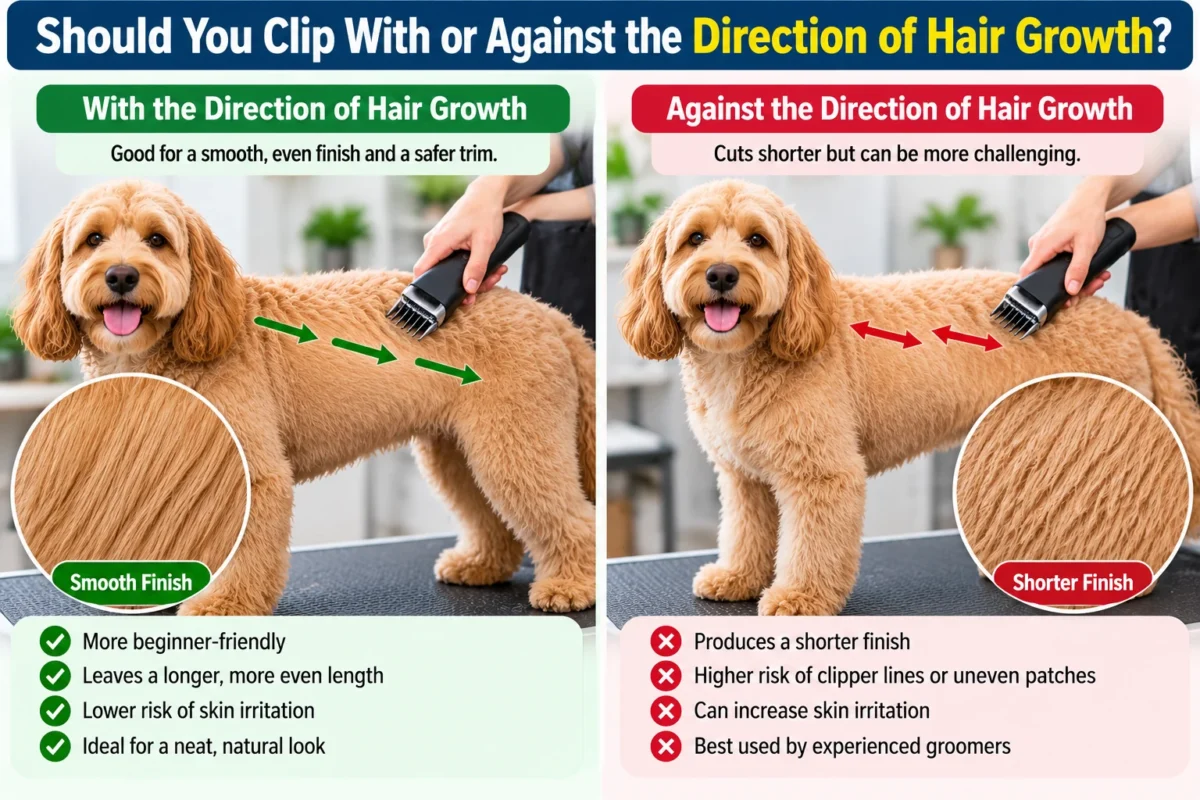
For most beginner body trims, clipping with the natural direction of hair growth offers a more predictable, conservative result.
Clipping against the grain generally produces a shorter finish with the same blade or attachment. It can also increase the risk of removing more hair than intended.
Professional groomers may use different directions for particular coat types and styles, but those techniques require an understanding of how the hair and equipment interact.
If your goal is a simple, even home haircut, start with the grain and maintain the same technique throughout comparable coat sections.
How Do You Prevent Clipper Lines and Patchy Fur?
Preventing uneven results is easier than correcting a haircut after too much fur has been removed.
- Prepare the coat: Remove tangles before selecting a guard comb.
- Work in good lighting: Shadows can hide longer patches.
- Keep strokes consistent: Avoid rapidly changing direction or angle.
- Do not rush: Let the cutting blade work without excessive pressure.
- Use the same attachment: Maintain a consistent length across matching body areas.
- Comb between passes: Lift missed hairs before making limited corrections.
- Check blade temperature: Pause if the blade becomes warm or uncomfortable.
The most useful finishing technique is to alternate between combing and careful visual inspection rather than repeatedly running the clippers over the entire dog.
What Are the Biggest Mistakes When Clipping a Dog’s Hair?
The most consequential mistakes can affect both haircut quality and your dog’s safety.
- Clipping a wet or tangled coat: This makes consistent cutting difficult and can cause pulling.
- Using excessive pressure: Pressing the blade toward the skin increases injury risk.
- Starting too short: A very short cut leaves little room for corrections.
- Ignoring coat type: Some double-coated dogs should not receive routine close body clipping.
- Forcing clippers through mats: Tight mats can conceal vulnerable skin.
- Ignoring signs of stress: Sudden movement increases grooming risk.
- Working with hot blades: Excessive blade heat can irritate or burn the skin.
Safety Warning
Not every dog should receive a clipped body haircut. For double-coated breeds, routine close clipping may damage the coat’s protective function or affect regrowth. Always confirm appropriate grooming practices for your dog’s breed and coat. If you notice cuts, sores, or significant irritation, stop clipping and contact your veterinarian.
The American Kennel Club’s home grooming guidance emphasizes using appropriate tools and professional instruction for potentially dangerous trimming tasks.
Additionally, Petco’s dog clipper grooming guide explains why coat preparation, cutting direction, and appropriate guard combs matter.
How Can You Tell When a Dog Haircut Is Even?
A well-finished haircut should appear balanced when viewed from several directions, without obvious isolated patches or abrupt length changes.
Use these final checks:
- Compare the left and right sides of the body.
- Look for longer fur along the shoulders and hips.
- Comb the coat and check whether previously hidden tufts appear.
- Inspect transitions between the back, chest, and legs.
- Check that the dog remains comfortable and the skin is not irritated.
An even haircut does not necessarily mean every hair must be identical in length. Natural body contours and different coat-growth patterns can change the apparent finish.
The practical goal is a neat, consistent shape achieved without sacrificing your dog’s comfort.
Frequently Asked Questions
1. Can beginners give dogs an even haircut with clippers?
Beginners can learn basic body trimming on suitable, cooperative dogs using proper equipment and instruction. Start with a longer guard comb and simple sections. Professional help is safer for difficult coats, severe matting, or sensitive areas.
2. What guard-comb length is best for an even dog haircut?
There is no universal best length. It depends on coat type, desired hairstyle, and clipper compatibility. Beginners should generally start with a longer compatible attachment before considering a shorter finish.
3. Why do my dog clippers leave lines in the fur?
Clipper lines can result from missed strips, inconsistent blade angle, changing cutting directions, or inadequate coat preparation. Comb the hair, then make gentle overlapping passes using the same attachment and technique.
4. Can you fix a patchy dog haircut without shaving it shorter?
Sometimes. If patches contain longer, uncut hair, careful combing and targeted trimming may improve the result. If sections have already been cut too short, allowing the fur to regrow is safer than shortening the entire coat unnecessarily.
5. Should you brush a dog before and after using clippers?
Yes. Brushing and combing before clipping help eliminate tangles and prepare the hair for consistent cutting. Gentle combing afterward can reveal missed tufts and uneven sections.
6. When should you stop clipping and visit a professional groomer?
Stop if your dog becomes highly distressed, clippers repeatedly pull the hair, or you encounter tight mats, delicate areas, or skin problems. A trained groomer can evaluate a safer approach. Contact a veterinarian for wounds or significant irritation.
Final Thoughts
Getting an even dog haircut with clippers requires preparation, consistent technique, and patience. A clean, dry, tangle-free coat gives the clippers a better chance to cut uniformly, while steady overlapping strokes help prevent visible lines and missed patches.
Start longer, work carefully, and check your progress with a comb. If your dog’s coat or behavior makes home clipping unsafe, choose professional grooming rather than risking an injury for a more even appearance.


