Quick Answer
To comb a dog properly, choose a smooth-tipped comb suited to the coat, start with clean, dry, untangled sections, and use short, gentle strokes in the direction the hair grows. Part longer fur so you can check near the roots without scraping the skin. Begin with wider teeth, never pull through resistance, and leave tight or painful mats to a professional.
A dog can look freshly brushed yet still have knots under the top layer. Combing finds those trouble spots, especially on long, curly, or thick coats. The goal is a comfortable, separated coat, not a rushed full-body session.
What Do You Need Before Combing Your Dog?
For most long-haired or tangle-prone dogs, a metal grooming comb with smoothly finished teeth and wide and narrow sections is a practical choice. Check the tips with your fingers: they should feel smooth, not sharp or damaged. Teeth must be long enough for the coat, but they should not be driven into the skin.
A slicker or pin brush may be needed first; short, smooth hair may suit a rubber grooming mitt better. The American Kennel Club’s guide to grooming brushes explains why tool choice should follow coat type rather than one universal recommendation.
- Combination grooming comb: Wide teeth for the first gentle pass, closer teeth for checking prepared fur.
- Coat-appropriate brush: Useful for lifting loose hair before combing longer or denser coats.
- Good lighting and non-slip footing: Help you see the coat and keep the dog steady without restraint.
- Small treats: Reward calm cooperation and give the dog a positive reason to participate.
Inspect the skin before beginning. If you find sores, swelling, a painful lump, or a tightly packed mat, do not run the comb over it.
How to Comb a Dog Properly: 7 Gentle Steps
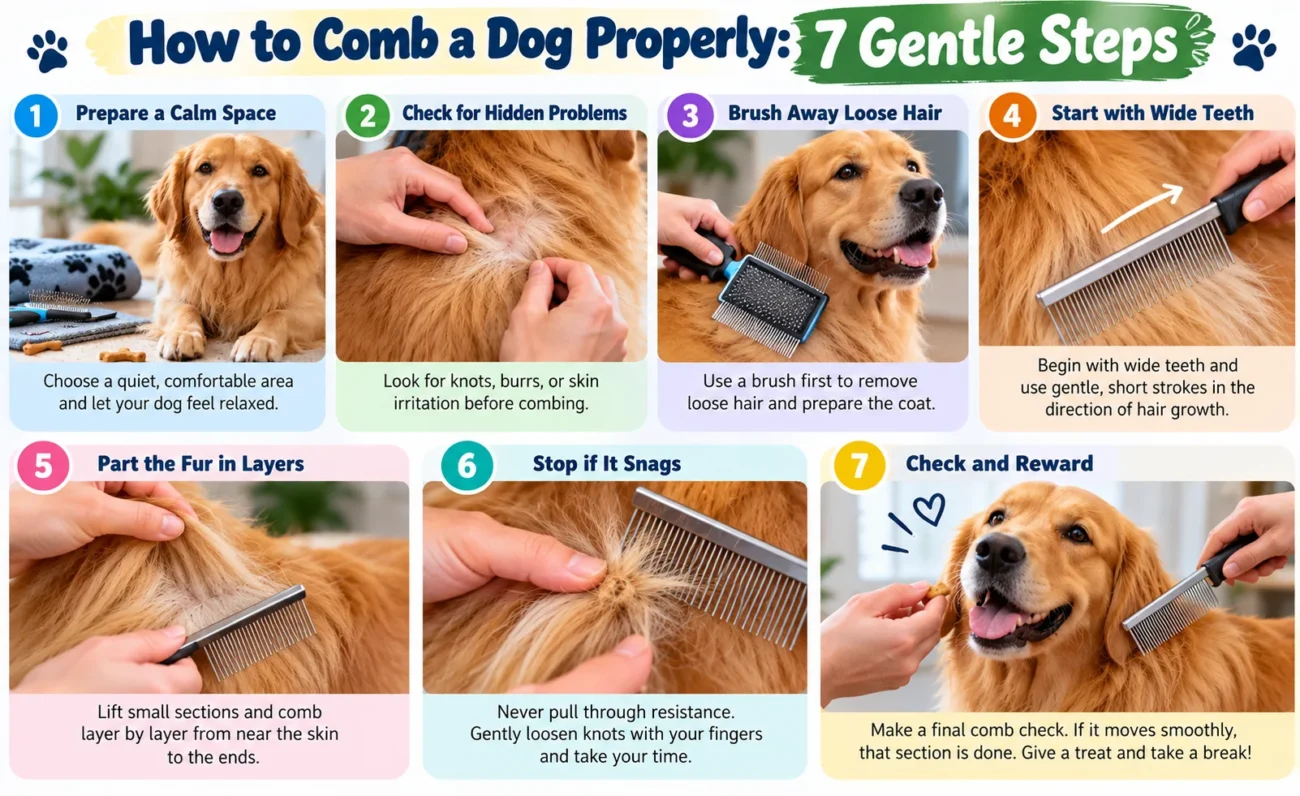
This sequence works best on a relaxed, awake dog. If your dog is learning, complete just one small section per session.
- Prepare a calm space. Pick a quiet, well-lit area with stable footing. Let your dog investigate the comb, then touch an easy body area briefly and reward calm behavior. Do not surprise a sleeping dog with grooming.
- Check for hidden problems. Feel through the fur with your fingers before combing. Look behind the ears, under the collar, and around the legs for knots, burrs, or tenderness. Avoid any patch of inflamed or broken skin.
- Brush away loose surface hair if necessary. On curly, long, or dense coats, gently brush each area with a suitable tool first. Follow the direction of hair growth and use light pressure. A brush prepares the coat; the comb checks what the brush may have missed. For the brushing portion, follow this step-by-step dog brushing guide.
- Start with wide teeth on an easy section. Begin along a shoulder or the upper back rather than the ears, face, or belly. Let the comb enter the coat at a comfortable angle. Use short strokes in the direction the hair naturally lies, not hard downward pressure.
- Part long fur into thin layers. Lift a small section with one hand so you can see where hair emerges from the skin. With the other hand, comb the exposed layer from near the base toward the ends. Work across the section methodically, then release another layer. The teeth should pass through hair without scraping the skin.
- Stop when the comb snags. Never jerk the tool through resistance. Take it out gently, separate the hair with your fingers, and assess whether it is a loose knot or a compacted mat. Support the hair close to the skin while you gently work a minor knot from its free ends inward. Stop if it will not loosen comfortably.
- Check the finished section and reward. Once the hair is prepared, make an easy pass from near the roots toward the tips. If the comb moves without tugging, that section is done. Give your dog a break and a reward before starting elsewhere.
Key Insight
Two motions are easy to confuse: a normal comb check moves through already-prepared hair from near the roots toward the tips, while a small knot is loosened carefully from its free ends toward the roots. Neither requires pulling on the skin.
How Should You Adjust the Technique for Different Coats?
Match the tool to coat length, texture, and density; judge results by comfort rather than how much fur comes out.
| Coat type | Helpful approach | Watch for |
|---|---|---|
| Short, smooth | Often use a soft brush or rubber mitt instead | Metal teeth rubbing exposed skin |
| Long or silky | Hold and comb narrow layers, then check feathering | Snags behind ears and legs |
| Curly or wavy | Gently slicker-brush, then check with a metal comb | Hidden knots near the base |
| Thick double coat | Use suitable longer teeth in small sections | Packed loose undercoat and overworking |
For long-haired dogs, pay particular attention to the feathering behind the legs and along the tail. Our long-haired dog brushing walkthrough explains the broader upkeep those coats need. Dogs with mixed textures may need different tools for different body areas.
Where Do Dogs Hide Tangles That a Comb Can Find?
Knots are often concealed in places where fur rubs against itself, movement, or equipment. Combing only the back can miss the areas that actually need attention.
- Behind the ears: Fine, soft hair tangles easily; steady the ear and work very gently.
- Under collars and harnesses: Repeated friction can compress long or fluffy fur.
- Armpits and inner legs: These move constantly and may be sensitive to handling.
- Chest, belly, and groin: Separate hair carefully and avoid dragging the comb across thin skin.
- Back legs and tail: Feathering can trap shed hair, outdoor debris, and small knots.
Check these places with your fingertips first. Around eyes, ear openings, and private areas, do not insist on using a full-size comb if you cannot control it safely. Some delicate grooming is better handled by a professional.
What Should You Do if the Comb Gets Stuck?
Stop moving the comb immediately. If the tangle is loose and the dog is comfortable, hold the hair between the knot and the skin, then tease a few strands apart with your fingers. Use the widest teeth only after the hair starts separating. A dog-safe detangling product may help on suitable coats when used as directed, but it cannot make a painful mat safe to pull apart.
A mat is not simply a difficult knot. Dense felted hair close to the skin can trap irritation and cause pain when pulled. The veterinary advice in PetMD’s guide to handling matted fur explains why severe matting may need professional removal instead of extended home detangling.
Warning
Never cut a mat close to your dog’s skin with household scissors or force comb teeth beneath it. Skin can be pulled into the knot and injured. Ask a qualified groomer or veterinarian to assess tight, widespread, or painful matting; contact a veterinarian if the skin is inflamed or wounded.
How Often Should You Comb Your Dog?
Comb often enough that small tangles do not turn into mats. For easily tangled long, silky, or curly coats, a daily check of friction areas may be worthwhile. Medium coats may need several checks a week, while smooth short coats may not need regular metal-comb work at all.
Notice how quickly snags return. If the comb catches behind the ears between sessions, check that area more frequently. During shedding, avoid repeatedly scraping the same patch. A coat-specific starting schedule appears in our guide on how often to brush your dog.
Should You Comb Before or After a Bath?
Check for tangles and manageable knots before bathing. Wetting a tightly tangled coat can make later grooming harder. After the bath, dry the coat appropriately and make a gentle comb check if its texture and condition call for one. Do not use dry-coat grooming tools aggressively on soaking-wet hair.
If you are planning a full grooming day, use the sequence in our guide to brushing before or after a dog bath. For a dog with skin problems or large mats, assess those issues before adding shampoo and water.
How Can You Tell When Combing Is Too Rough?
Repeated flinching, skin redness, freezing, growling, or trying to escape are reasons to pause. Your dog may be anxious, your pressure excessive, or the skin sore.
If resistance is new or limited to one spot, inspect the area rather than assuming the dog is misbehaving. Seek veterinary advice when you find a wound, swelling, discharge, strong tenderness, or persistent itch. A professional groomer can help demonstrate an appropriate tool and technique for a dog whose healthy coat repeatedly tangles.
Which Common Combing Mistakes Should You Avoid?
Avoid starting with fine teeth on unprepared fur, tugging at snags, combing only surface hair, or dragging teeth across skin. Do not extend a session just to reach the tail.
For a nervous dog, make the next session easier: show the comb, touch a non-sensitive area, make one gentle pass, and reward. Add another stroke only when your dog stays relaxed. A small amount of successful grooming repeated consistently is a better foundation than a long battle.
Related Product
Wide-and-Fine-Tooth Dog Grooming Comb
A smooth-tipped combination comb can check a prepared long or curly coat with its wide side first, then its finer side.
As an Amazon Associate, we earn from qualifying purchases.
Frequently Asked Questions
Can I use a human comb on my dog?
A smooth, wide-toothed human comb may work for a brief pass through loose, untangled hair. A purpose-made dog comb is usually easier to match to coat depth. Avoid sharp edges, broken teeth, and narrow combs that catch or scrape.
Should I start with the wide side or fine side of a grooming comb?
Start with the widely spaced teeth on a prepared coat. Use the finer side only when the section moves freely; its purpose is to find smaller snags, not force them apart.
Can you comb a puppy?
Yes. Introduce a soft, suitable tool gently while the puppy is awake and comfortable. One light stroke followed by a reward is enough at first. Extend sessions gradually as handling becomes familiar.
Is a flea comb the same as a grooming comb?
No. A flea comb has closely spaced teeth designed to help detect fleas and flea dirt. It is not a substitute for a general comb that moves through long, dense, or tangled coats.
What if my dog’s coat is too short to comb?
Use a rubber grooming mitt or soft bristle brush instead. Combing is not required when the teeth cannot enter the coat without rubbing the skin.
Can I use a comb right after clipping my dog?
Only if the skin is comfortable and the remaining coat is long enough to comb gently. Avoid recently irritated or nicked areas, and follow the groomer’s aftercare instructions if mats were removed.
Conclusion
Knowing how to comb a dog properly means recognizing both the right technique and the moment to stop. Choose a tool that suits the coat, prepare longer fur with gentle brushing, and check narrow sections from near the roots toward the ends. If you meet a small knot, separate it patiently rather than pulling through it. Painful mats, skin irritation, and sudden sensitivity deserve professional attention.
Keep the sessions comfortable and consistent. Over time, brief comb checks in high-friction areas can help you notice trouble before it becomes a difficult grooming problem.