

Quick Answer
If your dog bites when using clippers, stop the grooming session immediately. Biting may be a defensive response to fear, pain, uncomfortable handling, clipper noise, vibration, or a previous bad experience. Do not punish or force the dog to continue. Check for discomfort, seek veterinary help when pain or injury is possible, and rebuild comfort with slow, reward-based practice before attempting another trim.
What Should You Do the Moment Your Dog Tries to Bite?
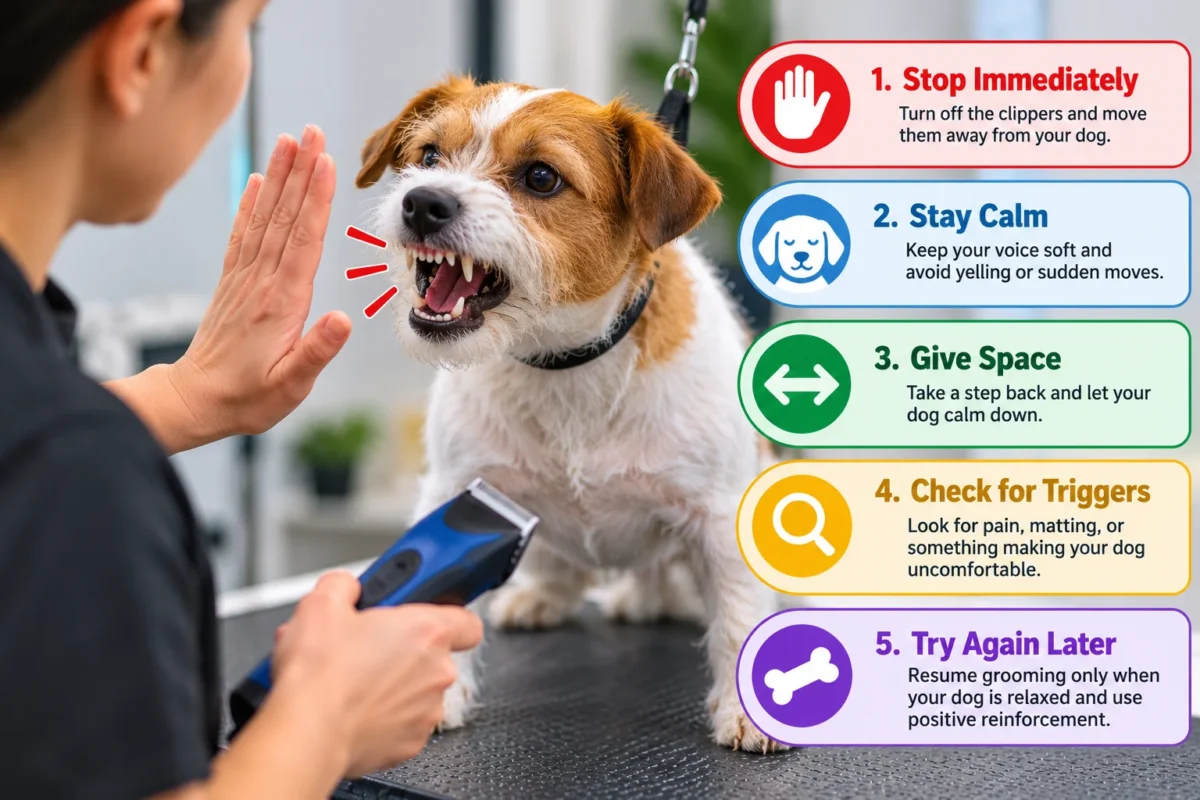
Turn off the clippers and calmly create space. Keep your face and hands away from the dog’s mouth, and let the dog move to a safe, quiet place. If another person is helping, ask them to stop holding the dog. Trying to finish “just one more patch” can turn a warning into an injury.
Do not scold a growl, pin the dog down, hold the muzzle shut, or grab the collar to force compliance. These responses can make the experience more frightening and can increase the chance that future warnings escalate quickly.
- Pause the trim. Switch off and put down the clippers before adjusting your position.
- Give the dog an exit. Step away and reduce noise, touch, and handling.
- Assess from a safe distance. Look for bleeding, limping, skin irritation, excessive licking, or obvious discomfort without forcing an examination.
- Make a plan before trying again. If the dog lunged, made contact, or has repeatedly tried to bite, arrange veterinary and qualified behavior support rather than restarting alone.
If a bite breaks your skin, wash the wound promptly with soap and running water and seek medical advice, especially for punctures, hand bites, or uncertainty about rabies or tetanus protection. A dog bite is a human medical concern as well as a grooming problem.
Why Does a Dog Bite When Clippers Come Out?
There is no single explanation. The important clue is when the reaction starts: when your dog sees the tool, hears its motor, feels it touch the coat, or has a particular body area handled.
Fear of sound or vibration
Some dogs tolerate an unplugged clipper but become alarmed as soon as the motor starts. Others accept the sound at a distance yet react when vibration reaches the skin. Those are different training challenges, and combining them too early may overwhelm the dog.
Pain, snagging, or a sensitive area
A blunt, dirty, incorrectly seated, or damaged blade may pull hair. Mats can tug on skin, and a hot blade can cause discomfort. Ears, paws, armpits, groin, and areas with sore skin can be particularly challenging. Even gentle clipping may trigger a reaction if an underlying joint, skin, or ear problem makes handling painful.
A sudden change in a previously cooperative dog deserves special attention. The Merck Veterinary Manual’s discussion of canine behavior problems emphasizes ruling out pain and physical health problems when evaluating aggression.
Restraint or remembered experiences
Being held still may feel threatening even when the tool itself is not the main issue. A past cut, painful mat removal, rushed grooming visit, or repeated forced handling can teach a dog to anticipate trouble. The bite may be an attempt to make an unpleasant event stop, rather than a sign of a generally hostile temperament.
How Can You Tell What Is Triggering the Bite?
Notice the earliest point at which your dog stiffens, pulls away, stops accepting food, or tries to leave. Those clues can help you avoid repeating the trigger while you arrange a safer approach.
| What happens | Possible issue | Safer next step |
|---|---|---|
| Dog retreats when clippers appear | Learned fear of the tool | Practice brief, switched-off exposure at a distance |
| Dog startles at motor sound | Noise sensitivity | Work on quiet, distant sound separately |
| Dog reacts at first blade contact | Vibration, pulling, or pain | Stop, inspect equipment, and consider a vet check |
| Dog snaps only near one location | Local sensitivity or pain | Do not persist; have that area assessed |
| Dog reacts when held tightly | Distress about restraint | Stop restraint and seek cooperative-handling support |
These patterns suggest possible triggers; they do not diagnose the cause. Several triggers can exist at once. If you cannot observe safely without provoking another snap, stop testing at home.
How Do You Help a Dog Become Comfortable With Clippers?
For dogs with mild fear and no recent serious biting, gentle desensitization and counterconditioning may help. That means introducing an easy version of the trigger and pairing it with something the dog enjoys. The American Veterinary Society of Animal Behavior recommends reward-based methods rather than aversive training.
These are training sessions, not grooming sessions. Start far below the point where the dog becomes worried, and end while the dog is still relaxed. For a dog with an established bite history, ask a veterinary behavior professional to guide the process.
- Show the switched-off clippers. Set them at a comfortable distance, provide a favorite treat, and put them away. Repeat until the dog stays relaxed.
- Introduce the motor from afar. With your dog free to move away, briefly turn the tool on at a distance. Pair calm observation with rewards. Do not move closer simply because the dog remains still.
- Practice voluntary handling separately. Reward the dog for choosing to approach, stand on a mat, or briefly offer a body area for touch. Stop if the dog withdraws.
- Combine steps gradually. Only after both sound and gentle handling are comfortable should you introduce brief, low-intensity contact using a switched-off clipper.
- Reintroduce actual clipping cautiously. Begin with an easy, non-sensitive area and a tiny amount of coat, but only when the dog remains relaxed and the blade is safe. A single comfortable second is more useful than a rushed full haircut.
If your dog freezes, pants unusually, turns away, refuses previously wanted treats, growls, or snaps, the exercise has become too difficult. Increase distance or stop for the day. A dog who is unable to eat is not automatically aggressive, but may be too stressed to learn comfortably.
Training Tip
Letting the dog choose to step away is part of the plan, not a training failure. Predictable breaks can help prevent the clippers from becoming a signal that escape is impossible.
What Equipment Problems Should You Check Before Trimming Again?
Behavior training will not solve a painful mechanical problem. With the clippers switched off and disconnected from power where appropriate, check the manufacturer’s instructions for blade installation, cleaning, lubrication, and safe use.
- Blade temperature: A blade that feels uncomfortably hot to you should never contact the dog. Allow it to cool; do not assume a cooling product makes a hot blade safe.
- Sharpness and alignment: Bent teeth, poor alignment, or dull cutting surfaces can drag or pinch.
- Mats and dirt: Dense tangles can hold skin close to the blade. Do not insert sharp tools into tight mats near the skin yourself.
- Motor sound: Rattling, unusual noise, and extra vibration can create both equipment and sensory problems.
- Fit for the coat: Forcing a clipper through heavy or tangled hair raises the risk of pulling and repeated contact.
Do not test blade sharpness or heat against your dog’s skin. If you are uncertain whether the tool is working properly, ask an experienced groomer or service technician to inspect it.
Should You Use a Muzzle to Groom a Dog That Bites?
A properly fitted basket muzzle can reduce bite risk in a professionally planned situation, but it does not make a distressed dog comfortable with clipping. Muzzle training should be gradual and reward-based, and a dog must be able to pant appropriately. Never use a muzzle as permission to restrain a frightened dog and continue a full haircut.
A dog that is already lunging or panicking should not be wrestled into a muzzle. Ask your veterinarian or a qualified behavior professional how to teach voluntary muzzle use and plan any essential grooming. Professional supervision is especially important if the dog has injured someone.
Safety Warning
Never use sedation, human medicines, or leftover pet medication to complete home grooming unless a veterinarian has prescribed a specific plan for that dog. Also avoid improvising tight restraints that could cause choking or injury.
When Should You Stop Home Grooming and Get Professional Help?

Contact your veterinarian if the biting started suddenly, your dog seems painful, a cut or skin problem is visible, or handling a particular area reliably causes a reaction. A medical examination helps distinguish a behavioral problem from discomfort that training alone cannot fix.
Seek a veterinarian experienced in behavior, a board-certified veterinary behaviorist, or a qualified reward-based trainer working with your veterinarian if bites recur, the dog lunges with little opportunity to retreat, or the fear is escalating. A groomer who advertises force-free or fear-aware handling may help coordinate a plan, but severe bite risk can require a veterinary setting.
If the coat is severely matted or hygiene is becoming a health problem, do not wait for home training to resolve everything. Contact the veterinary team promptly to discuss safe, medically supervised grooming options. Some dogs need medication or procedural sedation administered under veterinary direction; suitability depends on their health and behavior.
What Mistakes Make Clipper-Related Biting Worse?
- Ignoring a growl: Growling provides information. Punishing it does not remove the underlying fear.
- Holding the dog down: Physical restraint may intensify panic and place the handler near the teeth.
- Trying to finish quickly: Speed does not compensate for a dog already beyond its comfort threshold.
- Increasing exposure too fast: Going from seeing a tool to a running blade on the skin combines several difficult steps.
- Assuming every bite is stubbornness: Pain, sensitivity, and earlier experiences may be involved.
- Using treats to lure the dog into unwanted contact: Rewards should support safe voluntary participation, not distract a dog while a feared procedure happens without warning.
Keep a brief record of the trigger, body area, noise level, handling, and your dog’s reaction. This can help a professional identify a starting point without repeatedly exposing the dog to a situation that causes biting.
Frequently Asked Questions
Can a dog that bites during grooming learn to tolerate clippers?
Some dogs make meaningful progress with pain assessment, careful management, and gradual reward-based training. The pace and achievable goal vary, especially when a dog has a history of serious bites.
Are quieter clippers enough to stop biting?
Not necessarily. Quieter tools may help a noise-sensitive dog, but they do not eliminate fear of touch, restraint, vibration, or pain. Identify the specific trigger before relying on a new tool.
Why does my dog bite only when I trim the paws?
Paws may be sensitive to handling, and a dog may have nail, pad, skin, or joint discomfort. Stop forcing paw access and ask a veterinarian to evaluate any persistent or sudden sensitivity.
Should I give my dog a treat after it growls?
Do not punish the growl. Create distance and lower the difficulty. In a planned training exercise, rewards are paired with exposures that remain comfortable, rather than using food to push through visible distress.
Can I use scissors instead of clippers for a biting dog?
Scissors are not automatically safer. A moving, frightened dog can be cut, especially near skin folds or mats. Have an experienced professional assess which grooming method and setting are safest.
How long will it take to retrain my dog?
There is no reliable fixed timeline. Some dogs improve with repeated short sessions, while others need extended professional support. Progress means relaxed, voluntary participation—not simply the absence of a bite.
The Safest Way Forward
When a dog bites during clipping, the priority is to prevent another frightening or painful experience—not to finish the haircut. Stop, look for possible discomfort, address equipment problems, and seek veterinary support when biting is repeated or injury is possible. Patient, reward-based steps give your dog a better chance to accept necessary grooming safely.


