
Quick Answer
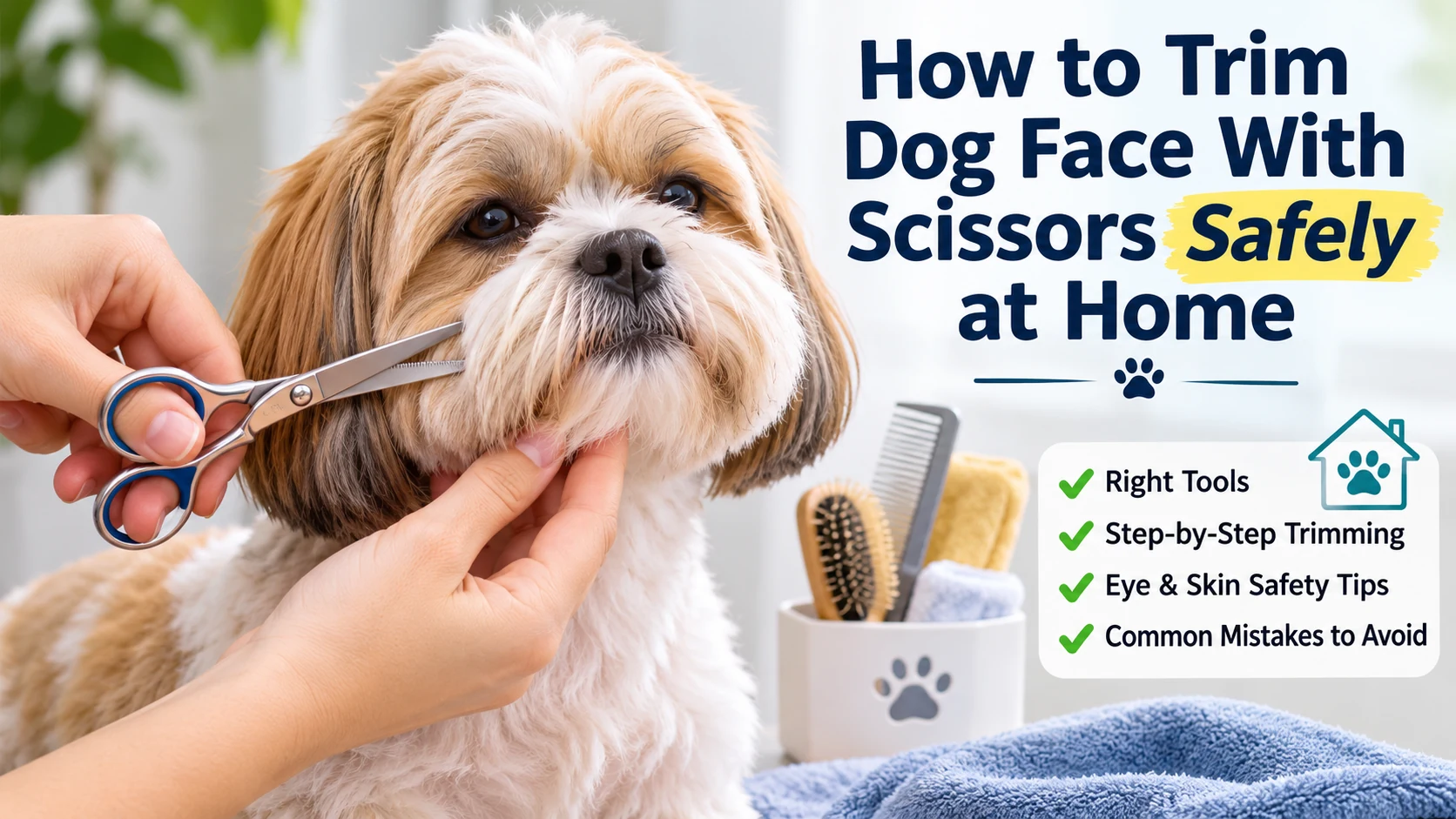
To trim a dog’s face with scissors safely, start with clean, dry, detangled fur and a calm dog. Use small, rounded-tip grooming scissors, comb loose hair away from the face, and make tiny cuts only where the hair and skin are clearly visible. Never point scissors toward the eyes, cut tight mats, or continue if your dog moves unpredictably. Have a professional groomer demonstrate facial trimming before attempting sensitive areas.
A dog’s facial hair can grow over the eyes, collect food around the mouth, or make routine cleaning difficult. A small tidy-up may help, but trimming near the eyes, lips, and ears carries more risk than cutting ordinary body fur.
The goal is not to create a perfectly symmetrical haircut in one session. It is to remove a little excess hair without compromising your dog’s comfort or safety.
Is It Safe to Trim Your Dog’s Face With Scissors?
Facial trimming with scissors can be appropriate for a calm, cooperative dog when the person trimming has been taught safe handling techniques. However, the face is a high-risk grooming area, especially around the eyes.
The American Kennel Club’s home grooming guidance recommends using small, blunt-ended scissors or appropriate clippers only after receiving instruction from a groomer, breeder, or veterinary professional.
Whether home trimming is sensible depends on your dog’s behavior, coat condition, and how close the unwanted hair sits to sensitive structures.
- Lower-risk situation: A few long, clearly separated hairs extend from the outer cheeks of a relaxed dog.
- Higher-risk situation: Hair needs cutting immediately beside an eyelid or lip.
- Professional grooming situation: Your dog struggles, snaps, has tightly matted facial hair, or needs extensive reshaping.
Short sessions and minimal trimming are better than trying to finish an elaborate haircut while your dog becomes restless.
What Tools Do You Need to Trim a Dog’s Face?
Start with a small set of tools designed for controlled grooming. Household scissors, oversized shears, and improvised cutting tools are poor choices for delicate facial work.
| Tool | Purpose | Precaution |
|---|---|---|
| Rounded-tip grooming scissors | Small facial touch-ups | Keep blades away from eyes and skin |
| Fine-tooth grooming comb | Separating loose facial hair | Never pull through tight tangles |
| Soft brush | Removing loose dirt and tangles | Avoid scraping sensitive facial skin |
| Non-slip surface | Providing secure footing | Never leave a dog unattended on a raised table |
| Small treats | Rewarding calm cooperation | Offer them when scissors are safely lowered |
Rounded tips reduce the danger associated with sharp points, but they do not make moving scissors harmless. Even safety scissors can cut eyelids, lips, or skin.
How Should You Prepare Your Dog Before Trimming?
Prepare the coat, grooming space, and your dog’s behavior before picking up the scissors. A clean, dry coat makes the hair easier to separate and lets you see what needs attention.
- Choose a quiet location. Avoid distractions, loud noises, and slippery floors.
- Check the face. Look for redness, discharge, cuts, swelling, tangles, or irritated skin.
- Clean dirty areas gently. Use a damp, dog-safe cloth and avoid getting products into the eyes.
- Dry the fur. Damp hair can clump together and obscure the intended cutting line.
- Brush and comb carefully. Separate loose hair without pulling facial skin.
- Practice without cutting. Reward your dog for calmly accepting a comb and gentle facial handling.
For a complete cleaning routine before grooming, see our dog bathing guide for safe home preparation. There is no need to give a full bath immediately before every minor facial tidy.
Preparation Tip
Practice touching and combing your dog’s cheeks for a few seconds at a time. Reward relaxed behavior. Introduce scissors separately, with blades closed, before considering any cutting.
How to Trim a Dog’s Face With Scissors Step by Step
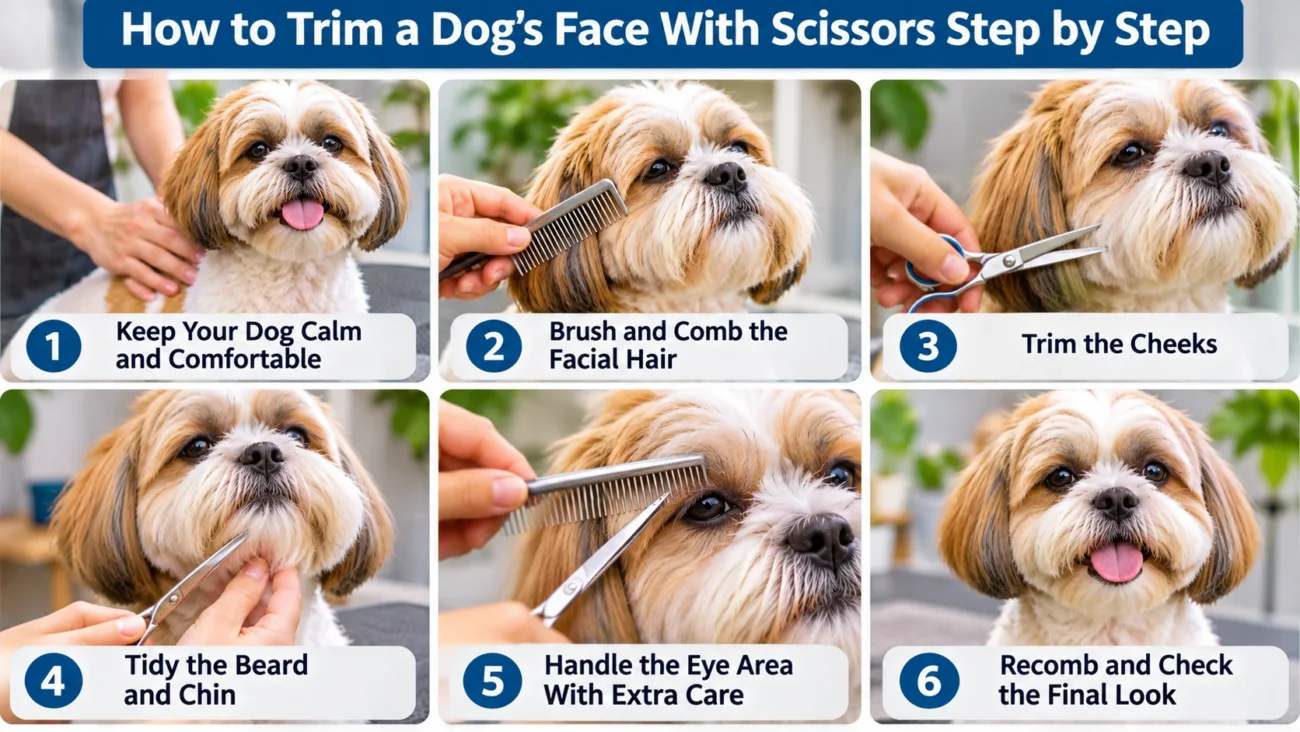
For an owner who has received a practical demonstration from a groomer, the safest home approach is a conservative trim of loose, accessible hair. These steps are not instructions for cutting directly against eyelids or other sensitive facial structures.
Step 1: Check That Your Dog Can Remain Calm
Let your dog stand or sit comfortably on secure footing. Ask a second familiar adult to offer reassurance if necessary, without restraining the dog forcefully.
Watch for repeated head turning, stiff posture, growling, attempts to escape, or sudden jerking. If these occur, put the scissors down and end the session.
Step 2: Comb the Facial Hair Into Its Natural Position
Comb the cheeks, beard, and loose muzzle fur gently. This helps distinguish ordinary longer hairs from tangles and reveals the natural shape of the face.
Do not force a comb between the eye and nearby skin. If fur is stuck together, determine whether it needs cleaning or professional detangling first.
Step 3: Start With the Outer Cheeks
The outer cheeks are generally a more practical starting point than the corners of the eyes. Identify a small section of loose hair extending beyond the natural facial outline.
Keep the cutting area clearly visible and well away from skin. Use minimal snips rather than cutting a large section at once. Recomb and check the result before removing more length.
Step 4: Tidy Loose Beard and Chin Hair
Comb the beard downward and identify excess hair extending beyond the desired shape. If the dog is still and the hair is safely separated, trim only the exposed ends.
Avoid the lips, mouth corners, and moving tongue. Never place fingers or scissors inside the mouth to complete a facial haircut.
Step 5: Assess Hair Around the Eyes
Hair obstructing vision may need attention, but cutting directly beside an eye requires professional skill. For beginners, combing the fringe into a comfortable position is safer than trying to trim against an eyelid.
Do not position scissor points toward the eye or attempt to cut hairs attached to crusted discharge. Ask a groomer to demonstrate the correct method for your dog’s individual facial structure.
Step 6: Recomb and Check the Result
After a few snips, close and lower the scissors. Recomb the facial fur and assess both sides from a comfortable distance.
Stop once excess hair is under control. Slightly uneven fur is far preferable to an injury caused by repeated attempts to make everything identical.
How Should You Handle Hair Around the Eyes, Muzzle, and Ears?
Each facial area presents different hazards. Recognizing these differences helps you decide what belongs in a simple home tidy and what should be left to a groomer.
Around the Eyes
The eyes and eyelids are exceptionally vulnerable to scissors. Rounded-tip shears are not a substitute for controlled technique, and a sudden movement can cause a serious injury.
The AKC’s guide to cleaning dogs’ eyes
Around the Muzzle
The muzzle has loose skin, mobile lips, and sensory whiskers. Trim only clearly accessible ordinary coat hair that extends beyond the desired outline.
Do not deliberately cut whiskers for cosmetic neatness. They provide sensory information, and distinguishing whiskers from surrounding coat hair can be difficult during a rushed trim.
Around the Ears
Ear edges are thin and can be hidden by long fur. Avoid trimming close to the ear leather without professional instruction, particularly when the ear moves or folds.
Hair growing inside the ear canal should not be pulled or cut with ordinary scissors. Consult a groomer or veterinarian about whether it needs attention at all.
Safety Warning
Never use scissors to remove tightly matted facial hair or cut immediately against eyelids, lips, or ear edges. Skin can be pulled into a mat or hidden beneath fur. Stop immediately if your dog struggles or shows pain.
What Are the Most Common Face-Trimming Mistakes?
Most avoidable problems come from rushing, poor visibility, or attempting more than the dog can comfortably tolerate.
- Using pointed household scissors: Sharp tips create additional puncture hazards around the face.
- Cutting large sections at once: This makes unintended cuts harder to prevent and correct.
- Trimming while the dog struggles: Sudden head movement changes the position of sensitive skin immediately.
- Cutting mats instead of loose hair: Hidden skin can be trapped within a tangle.
- Trying to make both sides perfect: Repeated adjustments unnecessarily extend time near sensitive areas.
- Ignoring irritation: Redness, swelling, discharge, or discomfort may indicate a medical issue rather than a grooming problem.
PetMD’s guidance on handling matted fur
How Often Should You Trim Your Dog’s Face?
There is no universal schedule. Facial hair growth varies with coat type, breed, individual growth rate, and the haircut being maintained.
Long-growing coats may need periodic facial tidying between professional grooming appointments. Short-coated dogs may need little or no scissor trimming around the face.
Check the facial coat during normal brushing. Consider whether hair is obstructing vision, collecting food, or becoming difficult to keep clean. These observations are more useful than trimming automatically every week.
Regular combing may also reduce how much cutting is necessary. If your dog develops recurring tangles around the chin or mouth, ask a groomer about a lower-maintenance facial shape.
When Should You Stop and Visit a Professional Groomer or Veterinarian?
Stop home trimming whenever safe control, visibility, or your dog’s comfort is uncertain.
Choose a professional groomer for severe tangles, close eye-area work, difficult ear edges, extensive reshaping, or a dog that cannot remain still.
Contact a veterinarian if you notice an eye injury, persistent squinting, bleeding, swelling, unusual discharge, or signs of significant pain. Suspected eye injuries should receive prompt veterinary assessment.
For a superficial skin nick, stop grooming and seek veterinary guidance appropriate to the wound. Do not apply household disinfectants or grooming products near the eyes without veterinary instructions.
A professional appointment can also provide an opportunity to learn handling techniques suited to your dog’s coat and facial anatomy.
Frequently Asked Questions
Can I use regular scissors to trim my dog’s face?
Regular household scissors are not a good choice for facial trimming. Purpose-made, rounded-tip grooming scissors are more appropriate, but even these require training and careful handling around sensitive areas.
Should I trim my dog’s facial whiskers?
Avoid intentionally trimming whiskers. They are specialized sensory hairs that help dogs detect nearby objects and movement. Ask a groomer to work around them where practical.
Can I trim my puppy’s face with scissors?
Puppies should first become comfortable with brushing, gentle handling, and grooming equipment. Because they may move suddenly, close facial scissoring is best handled by a trained professional.
What if my dog will not stay still during a face trim?
Stop cutting and put the scissors away. Practice calm handling in short, reward-based sessions. Do not force restraint to finish the haircut; seek professional help if movement continues.
Can I cut matted hair around my dog’s eyes?
No. Do not attempt to cut tight mats around the eyes with scissors. Skin may be hidden inside the mat, and scissors can injure the eye or eyelid. Arrange professional assessment and removal.
How do I keep my dog’s face clean between trims?
Gently comb suitable facial fur, wipe food residue with a damp dog-safe cloth, and dry moist areas. Check for new tangles or irritation. Persistent eye discharge or skin inflammation should be assessed by a veterinarian.
Final Thoughts
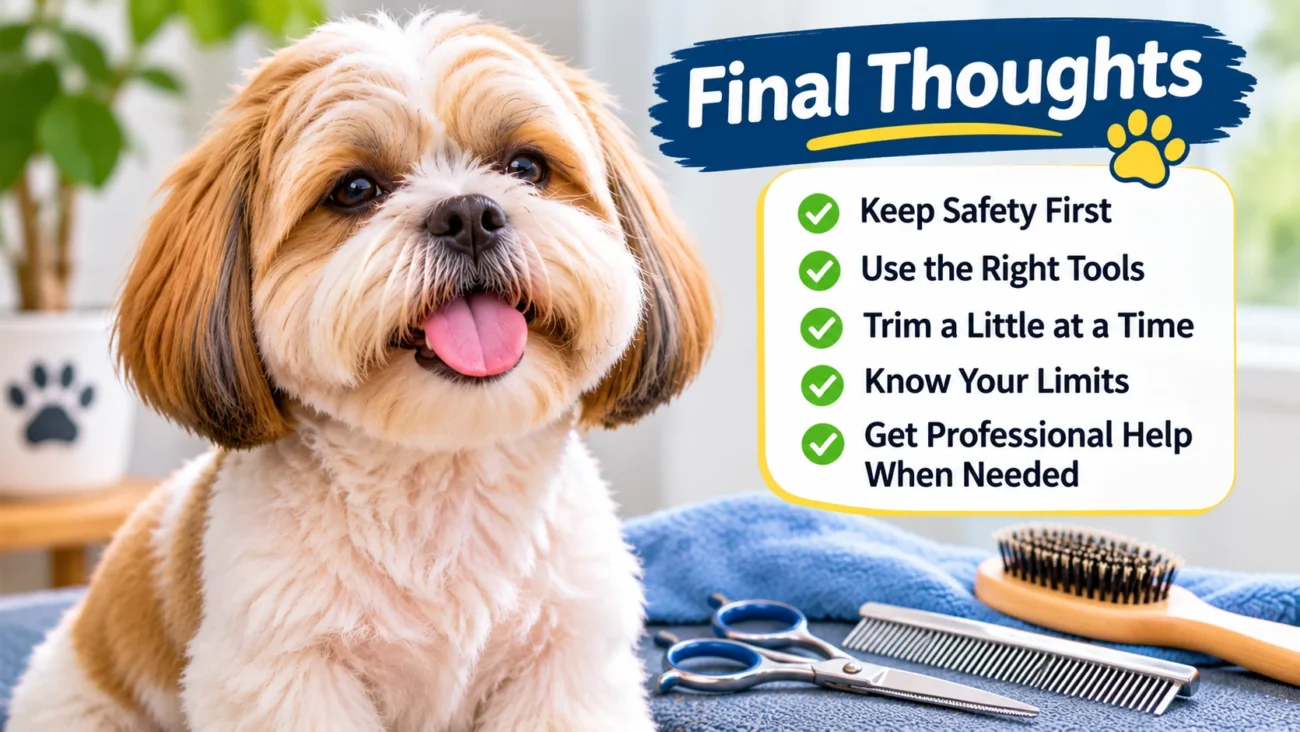
Learning how to trim a dog’s face with scissors starts with understanding when cutting is appropriate and when it is too risky.
Choose calm handling, proper grooming tools, clear visibility, and the smallest necessary trim. Leave precise eye-area work, severe matting, and complicated facial shaping to trained professionals.
A comfortable dog with a slightly imperfect haircut is a better outcome than a perfectly styled face achieved through unsafe trimming.


