
Quick Answer
The best soft dog coat haircut depends on whether your dog has continuously growing hair, a short smooth coat, or a double coat with a soft undercoat. A rounded puppy cut, practical teddy bear trim, or tidy maintenance cut may suit soft hair that needs regular clipping. Short-coated dogs usually need brushing rather than haircuts, while double-coated dogs should generally not be shaved for cosmetic reasons. Always remove tangles safely and choose a length that protects the skin and remains manageable.
A soft coat may feel easy to maintain, but its texture can hide important differences. Some dogs have fine hair that grows long and tangles quickly. Others have plush undercoats beneath protective guard hairs. Both may feel soft, yet they need very different grooming approaches.
The goal of a good haircut is not simply to make the coat shorter. It is to keep the dog comfortable, prevent painful matting, and preserve the coat’s natural function.
What Makes a Dog’s Coat Soft, and Does It Need Cutting?
A dog’s coat feels soft because of characteristics such as hair thickness, density, structure, and the proportion of fine undercoat hairs. However, softness is a texture description, not a complete grooming classification.
A Maltese may have soft, continuously growing hair that benefits from periodic clipping. A Pomeranian also has a soft-feeling coat, but much of that softness comes from its insulating undercoat. Cutting these coats in the same way would be inappropriate.
The following distinctions help determine the safest grooming approach.
| Coat type | Typical characteristics | Grooming approach |
|---|---|---|
| Soft, continuously growing hair | Lengthens over time and may form tangles | Regular brushing and periodic haircuts |
| Fine or silky hair | Smooth, delicate strands that may knot | Gentle combing and controlled trimming |
| Soft double coat | Insulating undercoat beneath outer guard hairs | Brushing, undercoat maintenance, limited shaping |
| Short, smooth coat | Short hairs with relatively little length to trim | Gentle brushing and routine hygiene |
| Soft curly or wavy coat | Hair can form hidden tangles close to the skin | Thorough combing and coat-appropriate clipping |
The important distinction is whether the coat naturally requires length reduction or whether removing loose hair is the main maintenance task.
Which Haircut Styles Work Best for Soft-Coated Dogs?
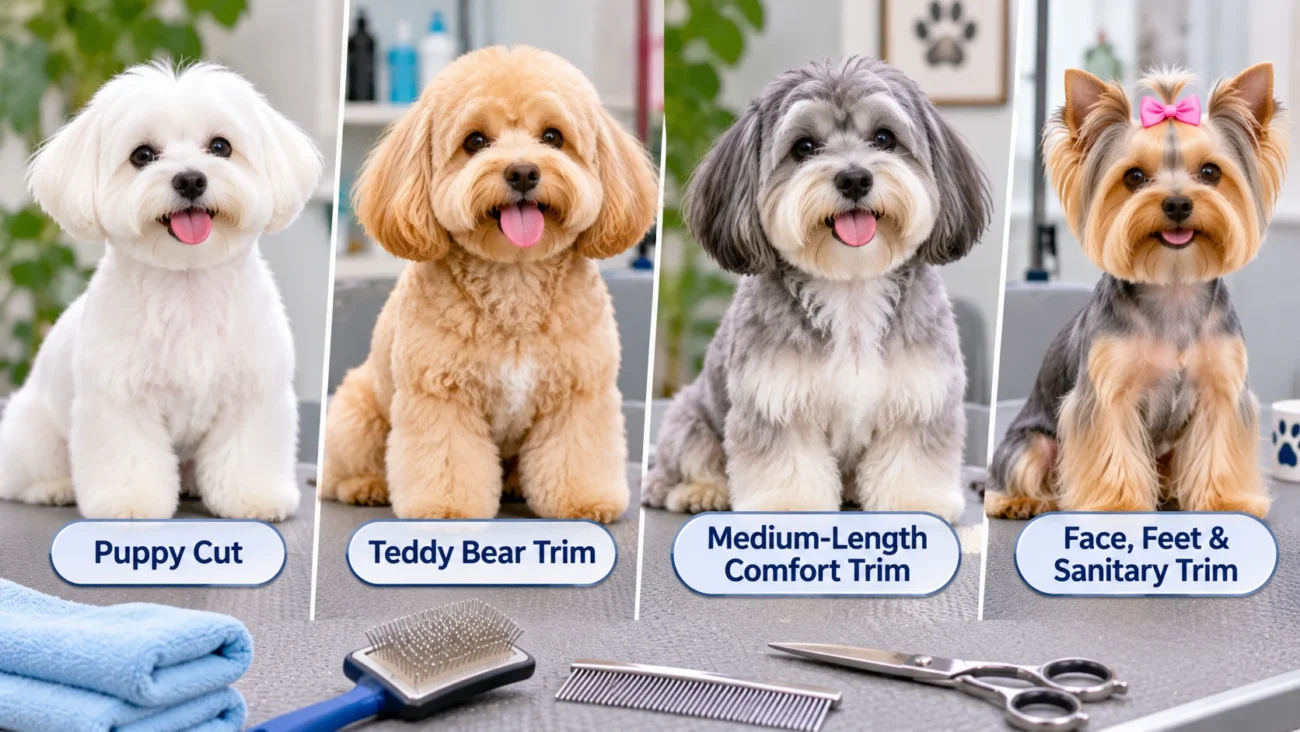
For soft-coated dogs whose hair grows continuously, practical haircuts keep the coat manageable without unnecessarily exposing the skin. The best style depends on hair density, daily brushing habits, the dog’s comfort, and the amount of maintenance the owner can provide.
1. Rounded Puppy Cut
A puppy cut maintains a relatively even, manageable length across much of the body, with gentle shaping around the face, legs, and feet.
It is a practical option for many companion dogs with soft hair, including Maltese, Shih Tzus, and some Poodle mixes. The exact length should be discussed with the groomer because “puppy cut” does not specify one universal measurement.
Best for: Owners who want a neat, easy-to-maintain appearance without keeping a long coat.
2. Soft Teddy Bear Trim
A teddy bear trim emphasizes a rounded face, softly shaped legs, and a balanced body outline.
This style works particularly well on certain wavy or curly coats with enough volume to support the rounded shape. Very fine, flat hair may not hold the same appearance.
Best for: Dogs with suitable coat volume whose owners can maintain the facial hair and legs between appointments.
3. Medium-Length Comfort Trim
A medium-length trim reduces bulk while keeping enough hair for a softer, fuller appearance.
It is useful when an owner prefers more coat length but wants to reduce tangling around the chest, belly, and legs.
Best for: Dogs that tolerate brushing and have coats suitable for clipping.
4. Face, Feet, and Sanitary Trim
Some dogs need only targeted maintenance rather than a full haircut. A groomer can tidy hair that obstructs vision, collects dirt around the feet, or becomes soiled around the rear.
These areas are sensitive, so precise trimming is especially important.
Best for: Dogs with an otherwise manageable coat that needs occasional hygiene maintenance.
5. Natural Outline Trim
A natural outline trim preserves the dog’s overall silhouette while selectively tidying longer furnishings and stray hairs.
This approach may be appropriate for some soft-feeling, feathered coats where extensive clipping is unnecessary. It is not the same as shaving down a double coat.
Best for: Dogs whose natural coat structure should be preserved.
Key Insight
A haircut style that looks attractive on a soft, single-coated dog may be unsuitable for a plush double-coated breed. Choose the grooming method based on coat structure before choosing the appearance.
How Can You Safely Trim a Soft Dog Coat at Home?
At-home maintenance is safest when limited to brushing, combing, bathing, and small, low-risk grooming tasks. Full-body clipping requires proper equipment, restraint skills, and an understanding of how easily moving blades can injure delicate skin.
The RSPCA’s dog grooming guidance recommends using a qualified groomer for clipping because electric clippers require skill to operate safely.
Step 1: Identify the Coat Before Preparing to Cut
Check whether your dog has continuously growing hair or a double coat. Look for an obvious layer of shorter, fluffy hair beneath longer guard hairs.
If you cannot confidently identify the coat type, ask a qualified groomer or veterinarian before attempting a full haircut.
Step 2: Inspect the Coat and Skin
Gently separate the hair with your fingers and check for tangles, redness, tenderness, lumps, scabs, or unusual skin changes.
Pay attention to the areas behind the ears, beneath the collar, under the legs, around the groin, and near the tail.
Do not clip over irritated or damaged skin without professional guidance.
Step 3: Brush and Comb the Coat Thoroughly
Use a brush appropriate for the coat’s length and thickness. Work gently in small sections, starting near the hair ends and gradually moving toward the base.
Follow with a metal comb to check for hidden knots. Do not pull forcefully against the skin or repeatedly brush a painful tangle.
For very fine hair, a light touch is more useful than aggressive brushing.
Step 4: Bathe and Dry When Appropriate
If the coat is free of significant matting, wash it with a dog-appropriate shampoo and rinse thoroughly.
Dry the coat completely before any professional-style clipping. Damp, clumped hair can make an even finish more difficult.
Avoid directing excessive heat at the skin, particularly on dogs with fine hair or sensitive skin.
Step 5: Limit Home Trimming to Tasks You Can Perform Safely
Small maintenance trims may be reasonable when the dog is calm, the hair is clearly visible, and the person handling the tools has been shown the correct technique.
Use only grooming tools designed for dogs. Never cut blindly into dense hair or attempt to remove a tight mat with scissors.
For complete body haircuts, facial clipping, and trimming close to skin folds, professional grooming is the safer choice.
Step 6: Check Comfort After Grooming
Inspect the coat and skin for irritation, redness, accidental scratches, or discomfort.
Allow the dog to rest and avoid further brushing over an irritated area. Persistent redness, pain, or broken skin should be assessed by a veterinarian.
Warning
Never use scissors to cut tightly matted hair close to a dog’s skin. Mats can pull loose folds of skin into the tangled hair, making serious accidental cuts possible. A qualified groomer or veterinarian can determine how to remove the coat safely.
Which Grooming Tools Are Suitable for Soft Dog Hair?
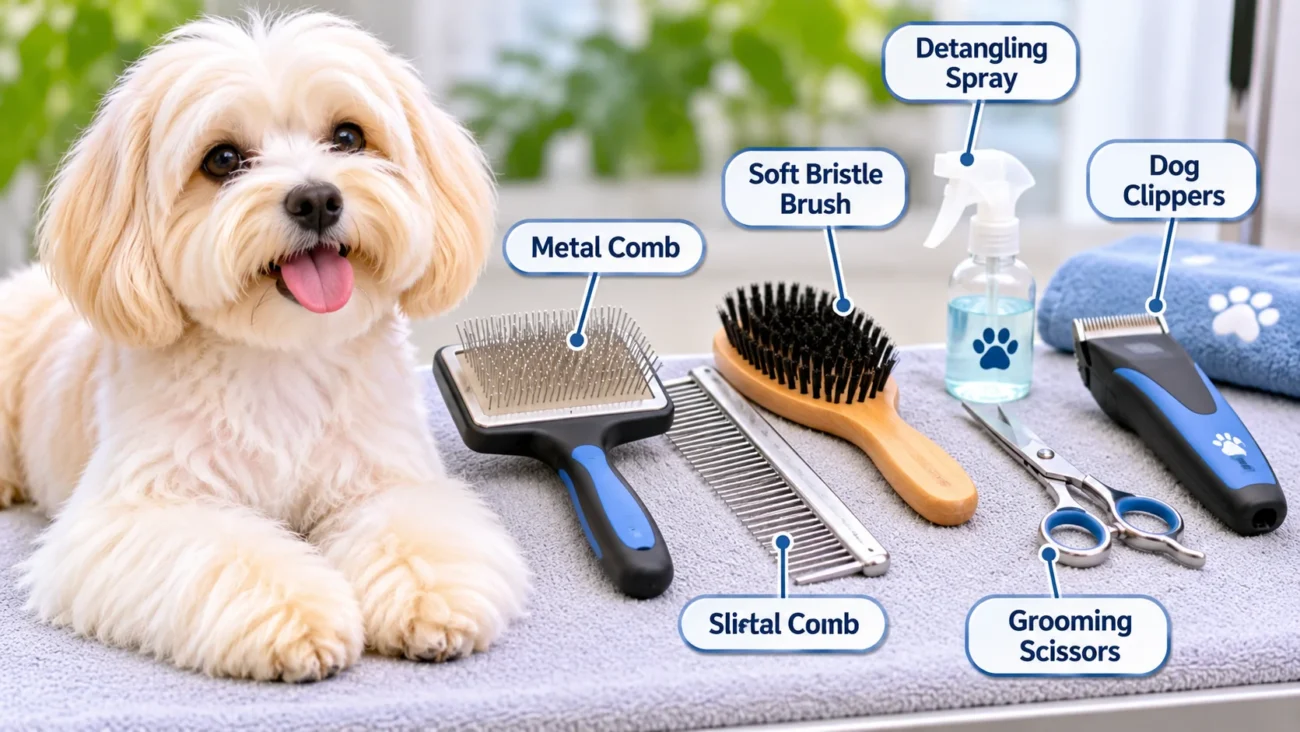
The right tool should match the coat’s length, density, and sensitivity. A tool intended for a dense undercoat may be unnecessarily aggressive on fine, silky hair.
- Soft slicker brush: Useful for many longer, wavy, or curly coats when used gently and with appropriate pressure.
- Metal grooming comb: Helps identify small tangles that a brush may miss.
- Soft bristle brush: Often suitable for smoothing short, fine coats and removing loose surface hair.
- Dog-safe detangling spray: May improve combing on suitable coats when used according to its instructions.
- Dog grooming clippers: Appropriate for certain coats that require clipping, but best used by someone trained in safe handling.
- Grooming scissors: Useful for trained groomers performing precise shaping, but risky around moving dogs, skin folds, and mats.
The American Kennel Club’s home grooming guide recommends choosing tools according to the dog’s particular coat type and consulting a groomer or veterinarian when necessary.
Should You Shave a Dog With a Soft Coat?
Not simply because its coat is soft. Shaving may be appropriate for some continuously growing coats under professional care, but it is generally unsuitable as a routine cosmetic treatment for double-coated breeds.
Dogs such as Pomeranians, Siberian Huskies, and many retrievers have undercoats that contribute to insulation. Removing both coat layers can compromise natural protection and sometimes lead to abnormal or delayed regrowth.
The AKC’s guidance on double-coated breeds explains why routine shaving is generally discouraged.
There are exceptions. Severe matting, certain medical procedures, or a veterinarian’s treatment plan may justify close clipping even when preserving the coat would ordinarily be preferable.
For a dog with soft, continuously growing hair, a shorter professional trim may make routine maintenance easier. The ideal length should still be selected according to skin condition, coat characteristics, and the owner’s ability to brush regularly.
How Often Does a Soft-Coated Dog Need a Haircut?
Haircut frequency depends on growth rate, desired length, grooming habits, and how quickly tangles develop.
Many continuously growing coats benefit from professional grooming approximately every four to eight weeks, although this is a planning range rather than a fixed requirement for every dog.
A dog kept in a longer style may need more frequent brushing and maintenance than one with a shorter, practical trim.
Dogs with short smooth coats usually do not need routine body haircuts. Double-coated dogs generally need coat maintenance and removal of loose undercoat rather than repeated short clipping.
Watch for practical signs that the grooming schedule needs adjustment:
- Hair regularly falls across the eyes or becomes dirty around the feet.
- Small tangles return quickly after brushing.
- The coat becomes difficult to comb all the way through.
- Hair around hygiene-sensitive areas needs attention.
- The dog becomes uncomfortable during normal coat maintenance.
If matting repeatedly develops before the next appointment, consider a shorter coat style or a more frequent grooming schedule.
How Can You Prevent Tangles After a Soft Dog Coat Haircut?
Preventing tangles requires consistent maintenance, especially where soft hair rubs against collars, harnesses, bedding, and moving body parts.
The VCA Animal Hospitals coat-care guide recommends daily brushing for long, silky, and curly coats that are prone to tangling.
Brush According to Coat Length and Tangle Risk
Long or easily matted hair may require daily brushing. Short, low-maintenance coats may need less frequent attention.
Use a comb afterward on longer coats to confirm that the hair is separated rather than merely smoothed on the surface.
Pay Attention to High-Friction Areas
Check behind the ears, around the neck, under the front legs, inside the hind legs, and beneath harness straps.
Small tangles are easier to manage before they tighten into painful mats.
Keep the Coat Clean Without Overwashing
Dirt and debris can make brushing more difficult. Bathe as needed with products appropriate for the dog’s skin and coat, and rinse thoroughly.
Avoid excessive bathing with harsh products, which may contribute to dryness and irritation.
Choose a Sustainable Haircut Length
If daily brushing is difficult to maintain, a shorter professional haircut may be more comfortable for a continuously growing coat.
Keeping a long style is not automatically better if the hair repeatedly becomes tangled close to the skin.
Tip
After brushing a long, soft coat, gently pass an appropriate metal comb through several small sections, including behind the ears and under the legs. If the comb repeatedly catches close to the skin, more careful detangling or professional assessment may be needed.
What Grooming Mistakes Can Damage a Soft Dog Coat?
Most avoidable grooming problems arise from using an unsuitable technique, applying too much force, or choosing a haircut without identifying the coat structure.
- Shaving solely to reduce shedding: This may remove protective coat layers without addressing the underlying shedding cycle.
- Brushing too aggressively: Excessive pressure can irritate sensitive skin and make grooming uncomfortable.
- Ignoring hidden mats: Surface brushing may leave tight tangles near the skin.
- Using unsuitable clippers: Incorrect equipment or handling can cause uneven cutting, pulling, or skin injury.
- Cutting near skin folds: Thin or folded skin is particularly vulnerable to accidental injury.
- Keeping hair longer than can be maintained: A decorative style should never take priority over comfort.
- Continuing when the dog is distressed: Fear, struggling, or pain increases the risk of accidents.
A calm grooming routine with appropriate tools is more valuable than trying to achieve a perfect finish in one session.
When Should You Choose a Professional Groomer or Veterinarian?
A professional groomer is the better option when your dog needs full-body clipping, complex coat shaping, close facial trimming, or removal of significant tangles.
Choose veterinary assessment when grooming reveals:
- Red, inflamed, bleeding, or painful skin.
- Severe matting associated with discomfort or restricted movement.
- Sudden hair loss or an unexplained change in coat quality.
- Persistent itching, sores, or unusual skin odor.
- Signs of injury following a haircut.
These problems may require medical evaluation rather than another grooming treatment.
For dogs that become extremely frightened or cannot tolerate necessary grooming, a veterinarian can help determine how to manage the process safely.
Frequently Asked Questions
Can a soft-coated puppy get its first haircut?
Yes, when its coat type and grooming needs justify trimming. Early appointments should emphasize gentle handling and positive experiences. The timing and amount of cutting should suit the puppy’s age, coat development, health, and tolerance.
Will a soft dog’s hair grow back after clipping?
Hair commonly regrows after clipping, but the pattern and speed vary. Some plush double-coated breeds can experience delayed or abnormal regrowth, so cosmetic shaving is generally discouraged.
Does a soft coat mean a dog sheds less?
No. Softness does not determine shedding level. Some soft-haired dogs shed relatively little, while dogs with dense, soft undercoats may shed considerably, particularly during seasonal coat changes.
Can grooming make a dog’s coat feel softer?
Appropriate brushing, bathing, and conditioning may help a coat feel smoother by removing debris and reducing tangles. Persistent dryness or changes in texture may reflect underlying skin or health concerns and deserve veterinary assessment.
Is a puppy cut the same as a teddy bear cut?
Not necessarily. A puppy cut generally describes a manageable, relatively even trim, while a teddy bear cut emphasizes rounded facial and body shaping. Neither name has one universally fixed length, so show your groomer a reference photograph.
What if my dog dislikes being brushed after a haircut?
Start with short, gentle sessions and reward calm behavior. Check that the brush is appropriate and that the skin is not irritated or tender. If brushing seems painful or your dog shows persistent distress, stop and ask a groomer or veterinarian for guidance.
Final Thoughts
A suitable soft dog coat haircut should make grooming easier without compromising the coat’s protective function. For continuously growing hair, a well-planned puppy cut, teddy bear trim, or practical maintenance style can reduce tangling and simplify daily care.
For short or double-coated dogs, regular brushing and selective tidying are often more appropriate than clipping. Identify the coat type first, keep the skin comfortable, and choose a grooming routine that can be maintained consistently.


