
Quick Answer
A scissors dog haircut can safely tidy loose, unmatted hair when the dog is calm, the coat is clean and combed, and the person trimming has learned proper handling. Use dog-specific grooming shears, remove only small amounts of visible hair, and keep the blades away from skin folds and sensitive areas. Leave tight mats, extensive haircuts, and difficult face, paw, or sanitary trimming to a trained professional.
Giving your dog a haircut with scissors may sound simpler than using electric clippers. There is no noisy motor, and scissors allow you to work on a small section of fur at a time.
However, scissors are sharp tools, and a dog’s skin can be surprisingly difficult to see beneath a thick or fluffy coat. Even a small movement can change where the blades land.
The safest approach is to learn basic grooming techniques first, start with minor maintenance trims, and avoid attempting a full haircut before you have the necessary skills.
Can You Give a Dog a Haircut Using Only Scissors?
Yes, some dogs can receive a haircut using scissors alone. Scissor trimming is particularly useful for shaping longer hair and tidying an already maintained coat. However, it is not the easiest or safest method for every dog or coat condition.
A scissors-only haircut is more practical when:
- The coat is clean, dry, thoroughly combed, and free of tight mats.
- The dog is comfortable being handled and can remain reasonably still.
- The haircut involves a modest trim rather than removing substantial coat length.
- The person grooming has been shown safe scissor technique.
- The intended cutting area is clearly visible and away from delicate skin.
Scissors become a poor choice when the fur is tightly matted, the dog repeatedly jerks away, or the haircut requires working close to sensitive skin.
Professional groomers may use scissors, clippers, or a combination of both depending on the coat, desired finish, and dog’s tolerance.
Which Scissors and Tools Do You Need?
Proper grooming equipment makes trimming more controlled, but no type of scissors eliminates the risk of injury.
For a basic maintenance trim, the following tools are useful:
| Tool | Main Purpose | Important Consideration |
|---|---|---|
| Straight grooming shears | Trimming visible excess hair and refining straight lines | Best used on accessible areas after learning safe blade control |
| Rounded-tip grooming scissors | Controlled maintenance trimming | Rounded tips reduce some puncture risk but do not prevent cuts |
| Thinning or blending shears | Softening abrupt transitions in longer coats | Still sharp; suitable only with proper technique |
| Grooming comb | Checking tangles and lifting hair for assessment | Never force it through painful knots |
| Coat-appropriate brush | Removing loose fur and preparing the coat | Choose a brush suited to the dog’s coat type |
| Non-slip grooming surface | Providing secure footing | A stable floor-level surface is preferable when fall risk exists |
For beginners, a comb and a suitable pair of dog grooming shears are more useful than collecting numerous specialized cutting tools.
Avoid using ordinary household scissors for coat trimming. They may be poorly suited to grooming and can make controlled cutting more difficult.
How to Prepare Your Dog Before Cutting Hair
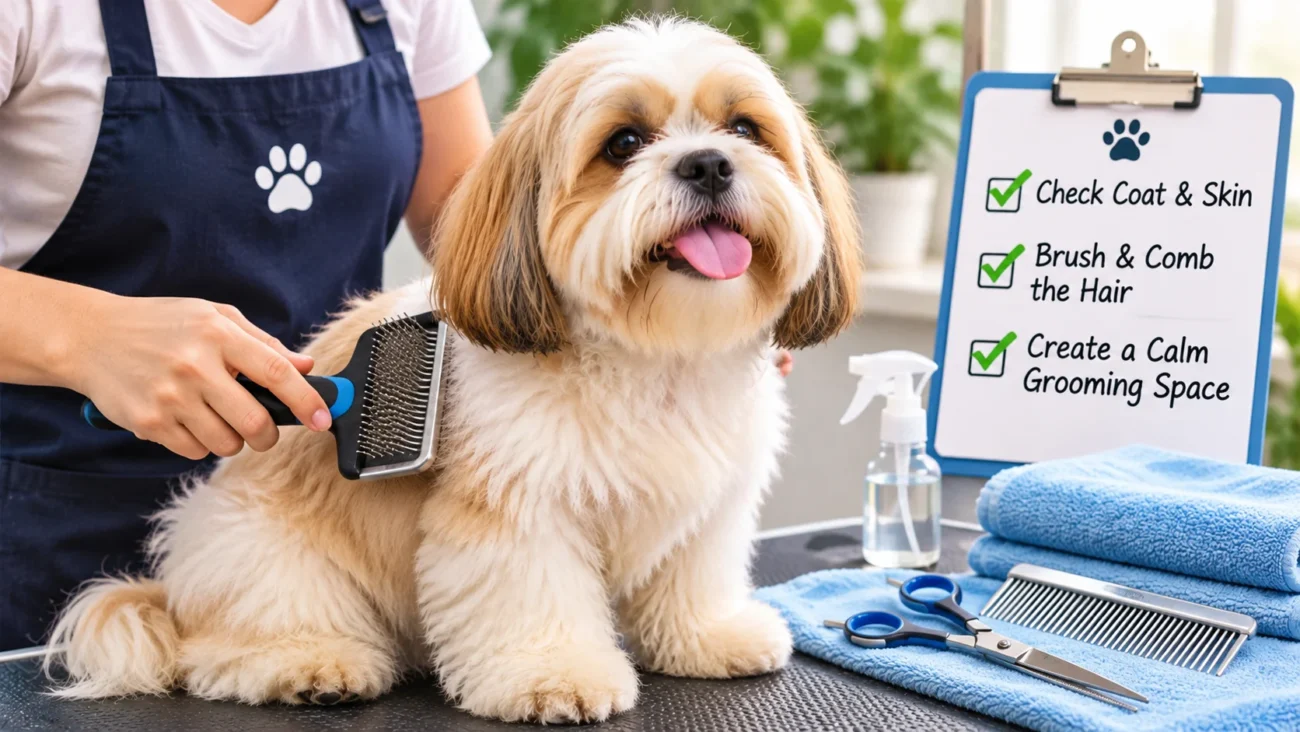
Preparation is essential because scissors should never be used to compensate for inadequate brushing or to cut through knots that conceal the skin.
Check the Coat and Skin
Part the hair and examine the areas you intend to trim. Look for mats, irritated skin, bumps, wounds, and areas where the skin folds beneath the coat.
If you discover a tight mat, do not insert scissors beneath it. The ASPCA recommends that mats close to the skin be handled using suitable grooming methods or by a professional.
See the ASPCA’s pet grooming guidance for brushing and matting precautions.
Brush and Comb the Hair
Use the appropriate brush to remove loose hair and gently work through manageable tangles. Follow with a comb to identify any remaining resistance.
If a section cannot be combed without pulling or causing discomfort, do not treat it as ready for a scissors haircut.
Create a Calm Grooming Space
Choose a quiet area with bright lighting and secure footing. Place your tools within reach so you do not need to leave the dog unattended.
Allow the dog to inspect the closed scissors from a safe distance. Reward calm behavior and practice gentle handling before attempting any cutting.
Only proceed if the dog willingly tolerates the process. Grooming should not require forcing an anxious dog to remain still.
How to Cut Dog Hair With Scissors: Step by Step
For a beginner, the most reasonable goal is a small maintenance trim on an accessible section of longer, unmatted hair—not a complete transformation.
Ideally, have a professional groomer demonstrate the technique for your dog’s coat and the specific area you intend to maintain.
Start with a small, low-risk section.Choose an accessible area of loose outer coat where you can clearly identify the hair to be shortened. Avoid the face, ears, paws, armpits, groin, and skin folds.
Comb the hair into its natural position.Work gently until the hair lies smoothly. Assess how much length actually needs removing rather than choosing an arbitrary cutting line.
Establish a safe distance from the skin.Only cut free hair that is clearly separated from the body. Never push a scissor blade beneath dense fur when you cannot see the underlying skin.
Make a small, controlled trim.Keep the blades directed away from the dog’s body, work slowly, and remove very little hair at a time. Stop cutting whenever the dog changes position.
Comb again and reassess.Allow the hair to settle naturally. Check whether another minor adjustment is genuinely necessary before making additional cuts.
Finish while your dog remains comfortable.End the session before the dog becomes tired or restless. Reward calm cooperation and save further tidying for another session if needed.
Safety Warning
Never attempt to cut through a mat, follow an unseen body contour with open scissors, or continue trimming while your dog is moving unpredictably. Rounded-tip scissors are not injury-proof. If you cannot confidently see and control the cutting area, stop.
How Should You Handle the Face, Paws, and Tail?
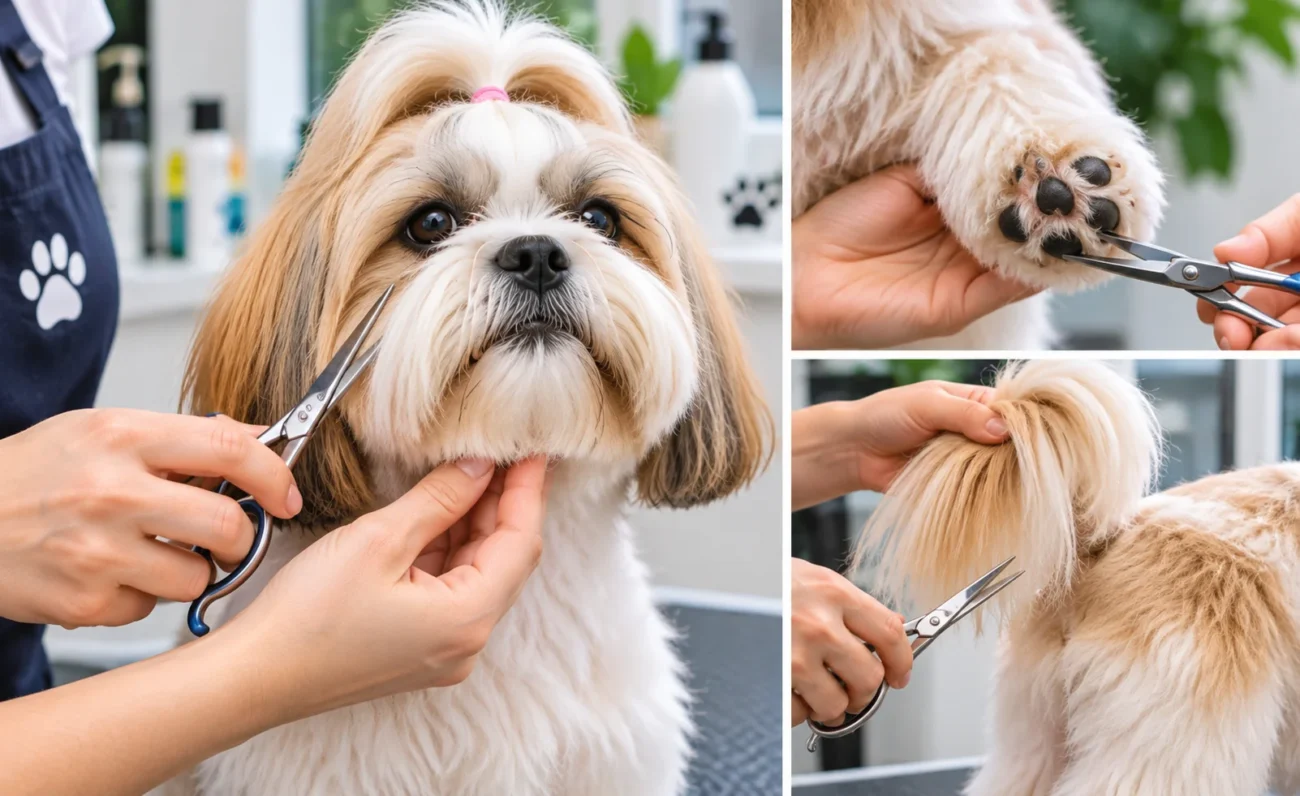
These areas require greater care because they contain delicate structures, irregular contours, or skin that may move unexpectedly.
Hair Around the Eyes and Muzzle
Long facial hair may interfere with vision or collect food, but cutting close to the eyes, lips, or nose presents a significant risk.
Do not point scissors toward an eye or attempt a facial trim while the dog is turning its head. If hair around the eyes requires cutting, ask a trained groomer to demonstrate the appropriate method or perform the trim.
In the meantime, gently cleaning the facial hair with a suitable damp cloth can help with ordinary surface dirt.
Hair Around the Paws
Excess hair around the feet can collect debris, and some dogs develop tangles between their toes.
However, the skin between toes and around paw pads is especially vulnerable to accidental cutting. The American Kennel Club’s home grooming guidance advises owners to learn appropriate procedures before trimming these areas.
Do not insert scissors between paw pads or cut into fur that hides the skin. Professional assistance is preferable if the hair needs close removal.
Tail and Rear Areas
The tail may contain a mixture of long hair and thinner skin, depending on the breed. The rear and sanitary areas add risks from hidden folds and sudden movement.
For an inexperienced owner, these areas are better maintained by a groomer rather than trimmed closely at home.
Does Scissor Grooming Work for Every Coat Type?
No. Coat structure affects whether scissors are useful, how much hair should be removed, and whether the dog needs a different grooming technique.
| Coat Type | Role of Scissors | Key Consideration |
|---|---|---|
| Long, continuously growing hair | Useful for shaping and maintenance trims | Hair must be thoroughly detangled first |
| Curly or wavy coats | Can refine a professionally maintained haircut | Uneven trimming and hidden mats are concerns |
| Double coats | May have a limited role in breed-appropriate tidying | Avoid indiscriminate shortening of protective coat layers |
| Wire-haired coats | May be used selectively | Hand stripping may be appropriate for preserving coat texture |
| Short, smooth coats | Usually unnecessary for general coat maintenance | Brushing is typically more useful than cutting |
A Poodle-type coat and a Labrador-type coat should not automatically receive the same haircut. Their hair growth patterns, coat functions, and maintenance needs differ.
If your dog has a double coat or a specialized wire coat, get breed-appropriate guidance before changing the coat’s overall length.
Scissors vs. Clippers: Which Method Makes More Sense?
Scissors are useful for precise finishing and selectively shortening longer hair. Clippers are often more efficient for consistent length removal across larger areas, but both tools require training and careful handling.
For small, visible adjustments to a maintained coat, scissors may be sufficient. For substantial coat removal, closely fitted areas, or complicated grooming patterns, a professional groomer can select the appropriate tools.
Neither tool is automatically safer in inexperienced hands. The dog’s movement, coat condition, skin visibility, and operator skill are more important than the tool alone.
Key Insight
The most useful distinction is not scissors versus clippers. It is visible, accessible hair versus hair that conceals skin or requires close cutting. The second situation calls for professional skill regardless of which tool is used.
What Are the Most Common Scissor-Grooming Mistakes?
Most home scissor-trimming problems can be reduced by choosing a smaller task and stopping whenever the conditions become unsafe.
- Cutting too much at once: Large cuts are difficult to correct and may bring the blades unnecessarily close to the body.
- Trimming tangled hair: Knots can pull skin upward, making the cutting boundary difficult to identify.
- Working on a restless dog: Sudden head, body, or paw movement increases injury risk.
- Using unsuitable scissors: Household or poorly maintained blades may reduce cutting control.
- Trying to make both sides perfectly even: Repeated corrections can shorten the coat far more than intended.
- Ignoring coat type: A haircut appropriate for one breed may be unnecessary or unsuitable for another.
- Continuing too long: Fatigue and frustration can make both handling and precision worse.
A minor uneven spot is generally a cosmetic issue. An accidental cut is a health issue. Prioritize the dog’s comfort and safety over a perfectly symmetrical finish.
When Should You Stop and Visit a Professional Groomer?
Stop scissor grooming when the dog cannot remain calm, the cutting area becomes difficult to see, or the coat needs work beyond a simple maintenance trim.
Professional assistance is especially appropriate when:
- The coat has tight, extensive, or painful mats.
- The dog snaps, struggles, trembles, or repeatedly tries to escape.
- Hair needs removal directly beside the eyes, ears, genitals, or paw pads.
- The dog has significant skin folds or delicate, loose skin.
- A full-body haircut or specific breed style is needed.
- You are unsure whether cutting will interfere with the coat’s natural function.
If grooming reveals sores, bleeding, swelling, painful skin, or an unexplained lump, contact a veterinarian rather than attempting to cut around or treat the problem yourself.
If the skin is accidentally cut, stop grooming immediately. Apply gentle pressure with clean gauze for minor bleeding and seek veterinary care, particularly for deep wounds, wounds near sensitive structures, or bleeding that does not promptly stop.
How Can You Maintain the Haircut Between Grooming Sessions?
Consistent brushing and regular coat checks can make future trims simpler and reduce the need for extensive hair removal.
For practical maintenance:
- Brush and comb according to your dog’s coat type and tendency to tangle.
- Inspect friction areas such as behind the ears, under collars, and beneath the legs.
- Remove surface dirt with appropriate pet-safe grooming methods.
- Reward relaxed behavior during short handling and brushing sessions.
- Arrange professional grooming before knots become painful or difficult to manage.
The correct grooming interval varies. Dogs with continuously growing, tangle-prone coats may need much more frequent attention than dogs with short, smooth fur.
Regular coat maintenance is usually more valuable than trying to correct several months of overgrowth with one difficult scissors haircut.
Frequently Asked Questions
Can I cut my dog’s hair with regular scissors?
Regular household scissors are not recommended for dog grooming. Use appropriate grooming tools and learn safe techniques before trimming. Even pet grooming scissors can cause injuries if used incorrectly.
Can scissors give a dog a complete haircut?
Yes, scissors-only haircuts are possible for certain coats, but full-body scissoring requires considerable control and grooming skill. Beginners should start with minor maintenance trims and leave extensive styling to professionals.
Should I cut my dog’s hair wet or dry?
For basic scissor trimming, clean, fully dried, thoroughly combed hair is generally easier to assess. Wet hair can hang differently and make the finished length less predictable.
How do I avoid uneven scissor marks in dog hair?
Comb the coat into its natural position, remove small amounts of hair, and reassess before making another cut. Experienced groomers may use blending shears, but beginners should prioritize safe handling over correcting every uneven section.
How often should I trim my dog’s hair with scissors?
There is no universal schedule. Coat growth, tangling, breed requirements, and the desired length determine the interval. Some dogs benefit from occasional maintenance, while others need regular professional haircuts.
Is it safe to cut matted dog hair with scissors?
No. Do not cut tight mats with scissors, particularly when they sit close to the skin. Mats can conceal or pull up skin, increasing the risk of injury. Ask a professional groomer or veterinarian to assess safe removal.
Final Thoughts
A scissors dog haircut can be useful for maintaining longer fur, but the safest results come from proper preparation, professional instruction, and modest trimming goals.
Start with clearly visible, unmatted hair, work only while your dog is comfortable, and stop whenever precise cutting becomes difficult. A neat coat is worthwhile, but protecting your dog’s skin and preserving a positive grooming experience matter much more.


