
Quick Answer
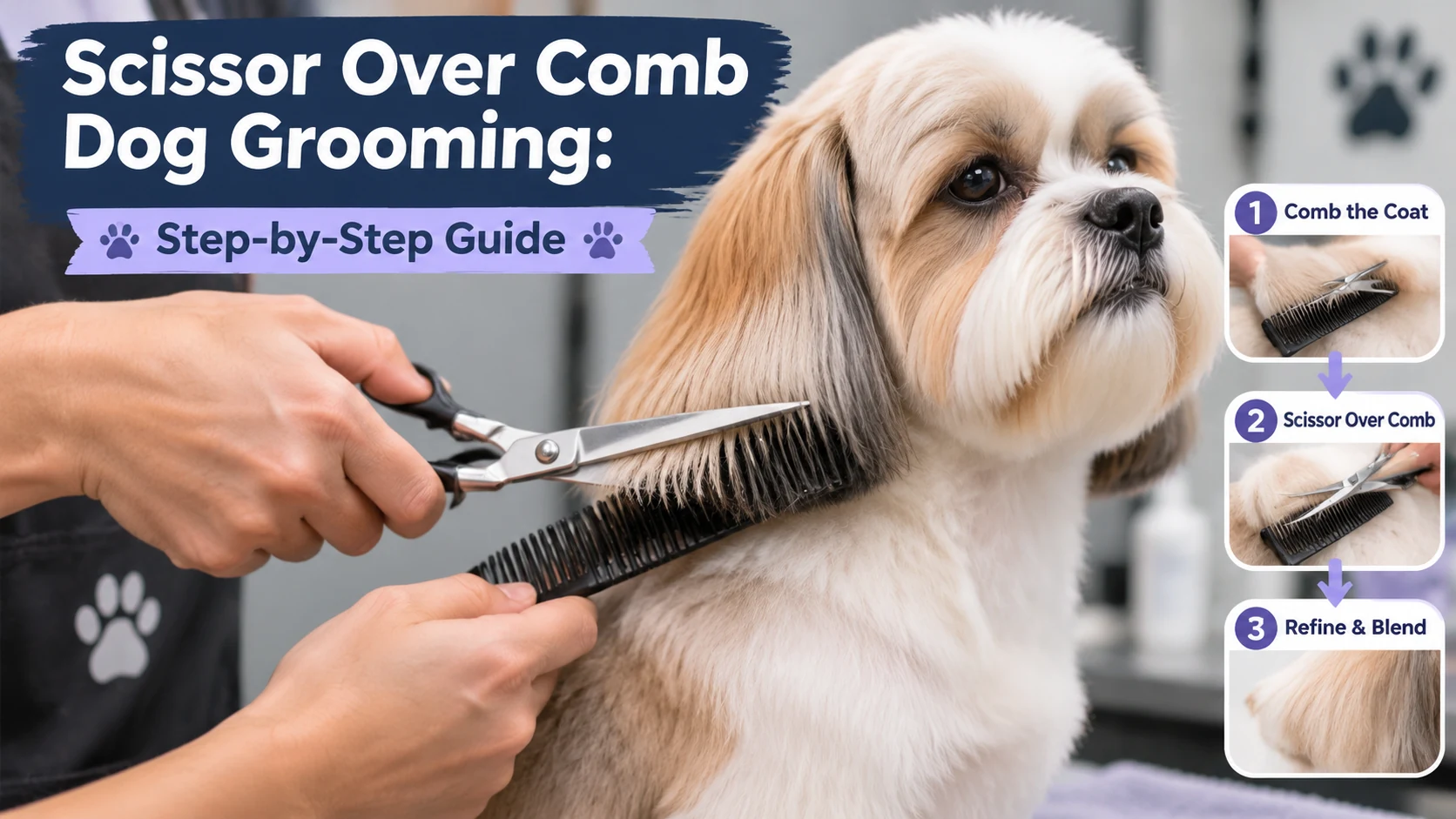
Scissor over comb dog grooming is a trimming technique in which a groomer lifts and positions the dog’s coat with a comb, then cuts the hair extending beyond the comb using grooming shears. The technique helps create controlled, even shapes and smooth transitions. It requires a clean, tangle-free coat, steady positioning, and practiced scissor control. Beginners should learn under professional supervision before using sharp shears on a dog.
Scissor-over-comb grooming is especially useful for refining a dog’s outline when freehand cutting would make it difficult to maintain a consistent length.
The technique looks simple, but the result depends on how the comb lifts the coat, how the scissors follow its working plane, and how calmly the dog remains positioned.
This guide explains the equipment, preparation, working sequence, common mistakes, and safety limits that matter when learning this professional grooming skill.
What Is the Scissor Over Comb Dog Grooming Technique?
Scissor over comb is a technique that uses a comb to present a controlled layer of hair for cutting. The groomer lifts or positions the coat, establishes the intended cutting line, and trims the hair projecting beyond that line.
Instead of judging every cut entirely by eye, the groomer uses the comb as a consistent reference for the surrounding coat.
The technique can help with:
- Refining the shape of legs and other coat-covered areas.
- Blending transitions between different coat lengths.
- Removing small sections of uneven hair.
- Creating a smoother outline on appropriately prepared coats.
- Finishing areas that need more precise shaping than broad clipper passes provide.
The comb is a guide, not a guarantee against injury. Its position must be controlled, and the groomer must know where the skin and underlying anatomy are before cutting.
How Is It Different From Freehand Scissoring?
With freehand scissoring, the groomer shapes the coat primarily by following its visible outline. With scissor over comb, the comb lifts and presents hair at a selected angle, providing a reference for the cut.
Both methods require trained hand control. Experienced groomers may combine them, using comb-guided cutting to establish an even surface and freehand finishing to refine the final silhouette.
What Tools Do You Need for Scissor Over Comb Grooming?
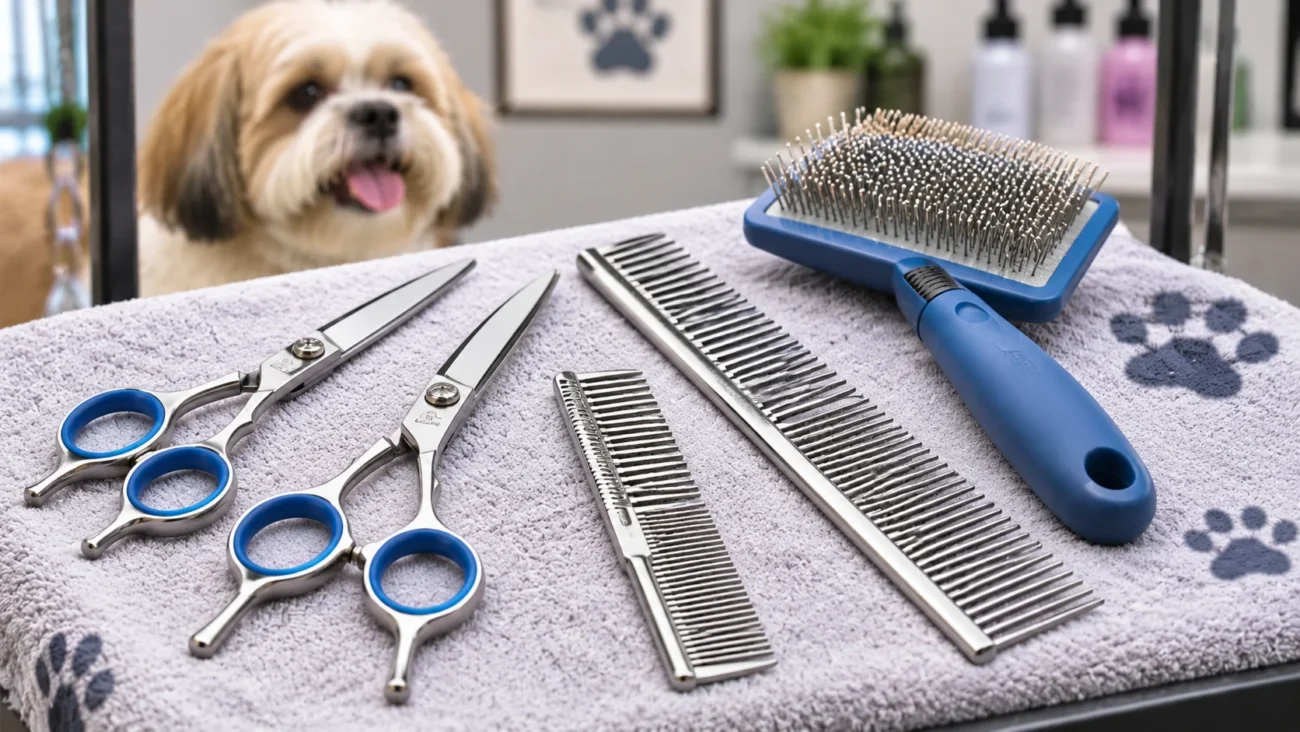
A basic setup uses grooming shears, a suitable metal comb, coat-preparation tools, and a safe grooming surface. Tool choice should match the dog’s coat and the groomer’s training.
| Tool | Purpose | Important Consideration |
|---|---|---|
| Metal grooming comb | Lifts and organizes hair | Choose teeth suitable for the coat’s density and texture. |
| Straight grooming shears | Establishes and refines cutting lines | Use properly maintained shears that fit the hand. |
| Curved grooming shears | Shapes rounded contours | Requires careful control of blade direction. |
| Thinning or blending shears | Softens selected transitions | Repeated cuts can remove more coat than intended. |
| Coat-appropriate brush | Prepares and separates coat | Avoid painful pulling or scraping the skin. |
| Stable grooming surface | Supports controlled positioning | Prevent slipping and never leave a dog unattended on a raised table. |
A metal comb is particularly useful because it allows the groomer to repeatedly lift, inspect, and reposition the coat. Its teeth should move through prepared hair without snagging.
The American Kennel Club’s grooming tools guide provides additional background on choosing grooming equipment.
How Should You Prepare a Dog Before Scissor Over Comb Grooming?
Begin only when the coat is clean, dry, thoroughly brushed, and free of problematic tangles. The dog must also be comfortable with handling and able to remain sufficiently still for controlled work.
Preparation is not separate from the technique. A tangled coat cannot be lifted consistently, making the cutting line difficult to judge.
- Check the skin and coat. Look for matting, irritated areas, wounds, and anything that could make grooming painful.
- Brush appropriately. Work through manageable sections without pulling harshly on the skin.
- Check with a comb. Gently confirm that the areas to be trimmed can be combed without resistance.
- Prepare the coat’s finish. When bathing and drying are appropriate, complete them before precision trimming.
- Set up a secure workspace. Use good lighting, stable footing, and handling that does not place the dog under unnecessary strain.
- Check the dog’s behavior. Do not begin sharp-scissor work if the dog is struggling, twisting, or repeatedly moving unexpectedly.
Warning
Never use scissors to cut out tight mats against a dog’s skin. Mats can pull skin into the hair, making accidental cuts more likely. The ASPCA advises against removing mats with scissors. Ask an experienced groomer or veterinarian to assess difficult matting.
For further guidance, see the ASPCA’s advice on preventing coat matting.
How Do You Perform Scissor Over Comb Dog Grooming Step by Step?
The basic sequence is comb, establish the cutting plane, trim conservatively, recomb, and inspect. The following process describes the technique for training purposes. Beginners should practice first on artificial grooming fur and progress to supervised work.
Step 1: Choose a Suitable Area and Set the Shape
Start by identifying the outline you want to create and the amount of coat that should remain. A broad, accessible section on a calm dog is more manageable than a sensitive area with folds or abrupt changes in anatomy.
For practical training, use a model coat or practice fur before working on a live animal.
Do not start near eyes, ears, armpits, groin, skin folds, or other delicate areas without direct professional instruction.
Step 2: Lift the Hair With the Comb
Use the comb to raise a manageable layer of hair away from the coat surface. The direction of the lift should suit the intended shape and the coat’s natural growth.
A consistent presentation matters more than lifting a large amount of hair at once.
Keep the movement gentle. If the comb catches or pulls, stop and reassess the coat rather than forcing it through.
Step 3: Establish a Controlled Cutting Plane
Position the comb so that the hair projecting beyond it represents the section intended for removal. The comb acts as a visual reference for the cutting plane.
The cutting angle should follow the desired outline rather than an arbitrary fixed angle.
On rounded contours, the working plane changes progressively. Sudden angle changes can produce flat patches, grooves, or uneven transitions.
Step 4: Trim Small Amounts With Controlled Shear Movements
With trained, supervised handling, trim only the hair clearly extending beyond the established guide. Use controlled movements rather than large cuts that remove too much coat at once.
Keep the position of the dog’s skin in view and never assume that a comb makes any cutting position safe.
If the dog changes position, stop cutting immediately. Re-establish the dog’s comfort and the working plane before continuing.
Step 5: Recomb and Check the Shape
After a small section has been trimmed, release the coat and comb it again. This reveals hairs that were lying in a different direction during the first pass.
Inspect the outline from a suitable viewing angle rather than immediately making more cuts.
Repeatedly removing hair without checking the overall silhouette can gradually change the intended shape.
Step 6: Blend Adjacent Sections
Work gradually into the neighboring coat without abruptly changing the established length. The objective is a smooth visual transition, not simply making each isolated section appear flat.
Where appropriate, a trained groomer may use thinning or blending shears to soften visible transitions.
Recomb after blending to assess the actual result before removing additional hair.
Step 7: Inspect the Finished Outline
Allow the coat to settle naturally, then examine it from multiple angles.
Look for:
- Obvious shelves or abrupt length changes.
- Uneven patches that appear after recombing.
- Areas where the coat was lifted inconsistently.
- Changes in shape that do not match the intended outline.
- Signs that the dog is uncomfortable or needs a break.
Finishing should be conservative. Do not continue trimming simply because a tiny difference is visible from one angle.
Training Tip
On practice fur, repeat the sequence of lifting, making a small controlled cut, releasing, recombing, and inspecting. Learning to maintain a consistent plane before increasing speed is more useful than trying to complete a whole haircut quickly.
How Do Cutting Angles Affect the Finished Coat?
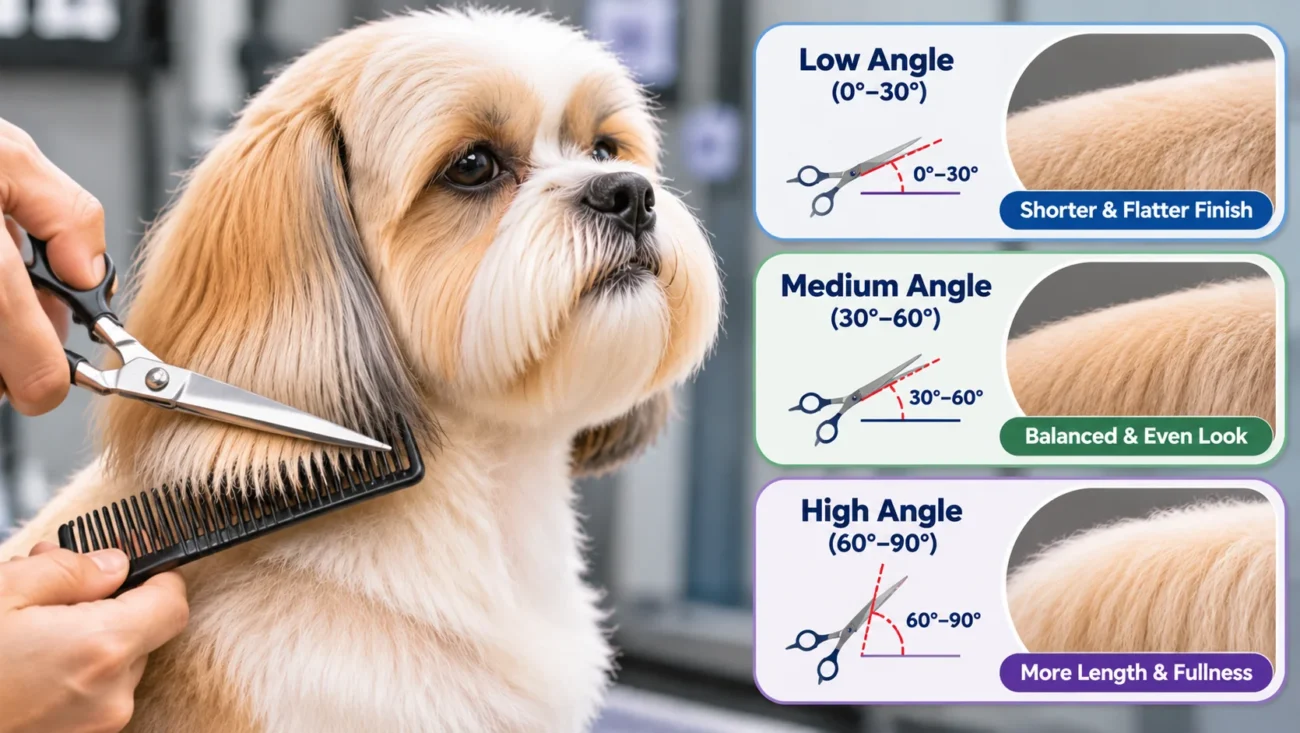
The angle of the comb determines how the hair is presented, while the shear position determines which exposed hairs are removed. Inconsistent angles change the shape even when individual cuts look neat.
The appropriate angle depends on the dog’s anatomy, coat texture, intended style, and the surface being shaped.
| Grooming Goal | Working Principle | Common Problem |
|---|---|---|
| Even surface | Maintain a consistent cutting reference. | Unexpected short patches. |
| Rounded outline | Adjust the plane gradually along the contour. | Angular or flattened edges. |
| Smooth transition | Blend neighboring lengths progressively. | A visible shelf or step. |
| Final refinement | Recomb and remove only clearly uneven tips. | Over-trimming an otherwise balanced area. |
There is no single cutting angle that works across every dog and body area. Following the coat’s shape while maintaining safe clearance is the essential principle.
Which Dog Coats Are Suitable for Scissor Over Comb?
Scissor over comb is most useful when the coat has sufficient length and structure to be lifted, controlled, and shaped with a comb.
Curly and wavy coats, including many Poodle-type and mixed-breed trims, may be suitable for this kind of finishing after appropriate preparation.
Some straight or drop coats can also be refined with comb-guided scissoring, but coat behavior and the intended style change how the technique is applied.
What About Double-Coated Dogs?
Double-coated breeds require a coat-specific grooming plan. Removing large amounts of coat simply to produce a shorter appearance may interfere with the coat’s protective function and natural appearance.
For example, a Golden Retriever or another double-coated breed may need selective tidying rather than an all-over scissor-over-comb haircut.
See the AKC’s guidance on shaving and double-coated dogs for further explanation of why coat type matters.
The right question is not only whether the coat can be cut with shears. It is whether the proposed haircut is appropriate for that dog’s coat and condition.
What Are the Most Common Scissor Over Comb Mistakes?
Most visible mistakes come from inconsistent coat preparation, changing cutting references, or removing hair before checking the previous pass.
1. Cutting Without Recombining
Hair can settle differently after it has been released from the comb. If the groomer keeps cutting without checking, uneven patches become harder to identify.
Better approach: Recomb and inspect after small sections rather than making continuous corrective cuts.
2. Changing the Comb Angle Unexpectedly
A change in the comb’s position changes the length and shape being presented to the scissors.
Better approach: Establish the intended contour first and make gradual, deliberate changes along the body.
3. Taking Large Cuts Too Early
Removing a significant amount of coat before checking the outline leaves little room for correction.
Better approach: Establish the shape conservatively, then refine it after the coat settles.
4. Working Through Tangled Hair
A comb that catches in the coat cannot reliably present an even cutting surface. Pulling at tangles can also cause discomfort.
Better approach: Address coat condition before trimming. Refer difficult matting to a trained professional.
5. Trying to Correct Every Small Imperfection
Repeated corrections can gradually make one area much shorter than the rest.
Better approach: Assess the overall silhouette and stop when the intended shape has been achieved.
6. Continuing When the Dog Moves
Unexpected movement creates a direct injury risk during precision cutting.
Better approach: Stop, lower the shears, and reassess whether it is safe to continue. Never use force to hold a struggling dog in position for scissor work.
How Can You Fix an Uneven Scissor Over Comb Finish?
An uneven finish should be corrected by reassessing the coat’s natural fall and intended shape before removing more hair.
- Stop cutting. Assess the uneven area without making another immediate correction.
- Recomb the coat. Lift it gently, release it, and observe how it settles.
- Check the surrounding sections. Determine whether the problem is an isolated longer patch or a section that has already been cut too short.
- Restore a consistent reference. On practice fur or during supervised grooming, align the working plane with the intended outline.
- Refine conservatively. Remove only clearly excessive length when the dog, coat, and working position are safe.
- Know when to stop. A short patch cannot be repaired by cutting the entire surrounding area shorter without changing the overall haircut.
If the unevenness is caused by short patches, allowing the coat to regrow may produce a better result than repeated cutting.
Key Insight
A smooth grooming finish depends on consistent coat preparation and controlled presentation, not simply on making more scissor cuts. Recombining often reveals whether additional trimming is actually necessary.
Is Scissor Over Comb Dog Grooming Safe for Beginners?
It is suitable for beginners to study and practice on artificial fur, but cutting a live dog’s coat with sharp shears should be learned through hands-on professional instruction.
The American Kennel Club advises that owners should use grooming scissors or narrow clipping tools only after learning appropriate procedures from a groomer, breeder, or veterinary professional.
Read the AKC’s home dog grooming safety guidance before attempting a new trimming procedure.
Scissor work is especially challenging when a dog has:
- Sudden or unpredictable movements.
- Tight matting or painful tangles.
- Thin, loose, or folded skin.
- Skin irritation, wounds, or suspected infection.
- Anxiety or discomfort during handling.
- Hair covering sensitive anatomical areas.
Even rounded-tip grooming scissors can cut skin. Their rounded ends may reduce some puncture hazards, but they do not eliminate the risk created by sharp blades.
Professional assistance is the safer option for difficult coat conditions, delicate trimming, and dogs that cannot comfortably tolerate the procedure.
How Can Beginners Improve Scissor Over Comb Technique?
Beginners improve by developing consistent comb control and deliberate shear movements before attempting complex shapes or increasing their speed.
A useful training progression is:
- Practice tool handling. Learn comfortable shear positioning and controlled opening and closing away from animals.
- Work on artificial grooming fur. Practice lifting the fibers and following an established cutting plane.
- Inspect between passes. Train yourself to evaluate the shape before removing additional material.
- Practice simple contours. Move from relatively flat surfaces to rounded forms once basic consistency improves.
- Seek supervised instruction. Learn anatomical awareness, coat assessment, restraint safety, and proper tool positioning from a qualified grooming instructor.
- Prioritize accuracy over speed. Speed should develop only after safe handling and reliable control.
The AKC’s professional dog grooming educational standards demonstrate why coat assessment, animal handling, equipment knowledge, and safety are important parts of grooming education.
For beginners, a well-controlled practice session that removes very little material can teach more than attempting a complete haircut before the underlying movements are reliable.
Frequently Asked Questions
Can you learn scissor over comb dog grooming without professional training?
You can learn the basic principles and practice the movements on artificial fur independently. However, working with sharp grooming scissors on a live dog is best learned through hands-on instruction covering handling, coat assessment, anatomy, and safety.
Can you use a plastic comb for scissor over comb grooming?
A suitable plastic comb may help lift hair during practice, but many groomers prefer a quality metal grooming comb for consistent coat presentation. Whatever the material, the comb must move smoothly through the prepared coat without pulling.
Is scissor over comb suitable for a Poodle’s curly coat?
Yes, comb-guided scissoring can be useful for shaping properly prepared Poodle coats. The coat needs appropriate brushing, drying, and fluffing, and the haircut must suit the dog’s condition and intended style.
Can scissor over comb replace dog grooming clippers?
Not necessarily. Scissor over comb is useful for selected shaping and finishing tasks, while clippers may be more appropriate for other parts of a haircut. The choice depends on the coat, desired result, and groomer’s training.
Should you use thinning shears or straight shears for scissor over comb?
Straight shears are commonly used to establish controlled cutting lines, while thinning or blending shears can soften selected transitions. Neither is automatically safer; both require correct positioning and careful use.
What should you do if your dog moves during scissor over comb grooming?
Stop cutting immediately and move the shears away from the dog. If the dog cannot remain relaxed and sufficiently still, end the session and seek help from an experienced groomer rather than forcing the procedure.
Final Thoughts
Scissor over comb dog grooming is a valuable finishing technique for creating consistent shapes, refining coat length, and blending transitions. Its effectiveness depends on proper coat preparation, a controlled cutting plane, and repeated inspection.
For beginners, the safest path is to develop comb and shear control on practice material, learn directly from a qualified groomer, and treat the dog’s comfort and safety as more important than achieving a perfect haircut.


