
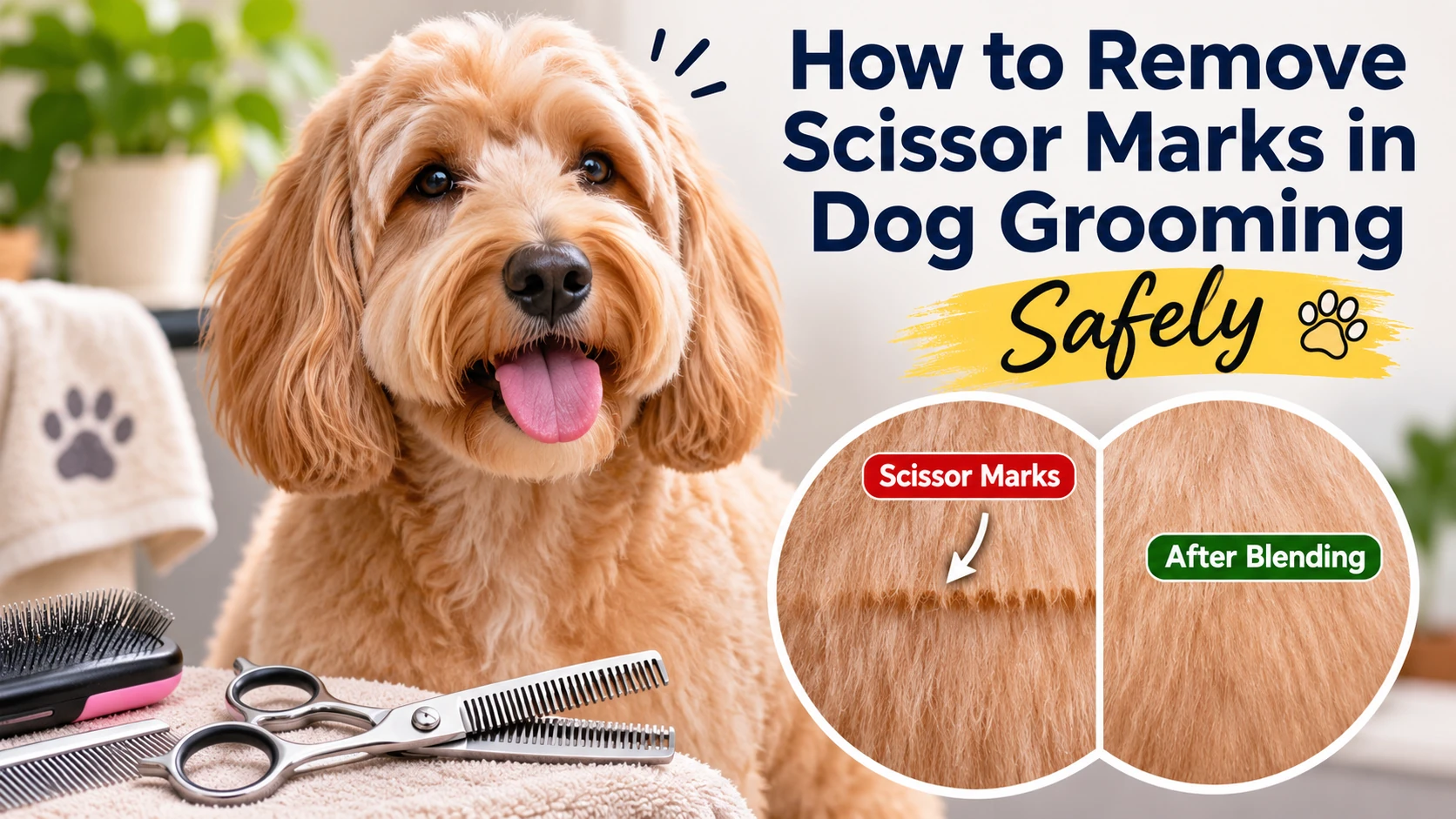
Quick Answer
To remove scissor marks in dog grooming, first brush and comb the coat thoroughly, then use suitable blending or thinning shears to soften visible lines with small, controlled cuts. Comb and reassess after each pass. Avoid cutting deeper into short areas, and leave sensitive, matted, or difficult-to-see areas to a professional groomer.
Scissor marks can make a freshly groomed dog look uneven, even when most of the haircut is well shaped. Straight lines, small ridges, and patches of different lengths are particularly noticeable on fluffy, curly, or carefully sculpted coats.
The solution is not necessarily to cut more hair. Often, the better approach is to identify what caused the line, prepare the coat properly, and gently blend the surrounding hair.
This guide explains how to correct minor scissor marks, choose an appropriate finishing technique, recognize problems that cannot be fixed immediately, and prevent visible lines during future grooming sessions.
Why Do Scissor Marks Appear in Dog Grooming?
Scissor marks appear when sections of hair are cut at noticeably different lengths or angles. Instead of flowing smoothly into the surrounding coat, the trimmed area forms a visible line, ridge, or step.
Several common grooming issues can contribute to this appearance:
- Large, straight cuts: Removing too much hair in one movement can create a sharp edge.
- Uneven coat preparation: Tangled, damp, or poorly combed hair may settle into a different shape after trimming.
- Changing cutting angles: Inconsistent scissor positioning can create ridges across a rounded surface.
- Inadequate blending: Abrupt transitions between shorter and longer sections remain visible.
- Working against the coat’s natural fall: Hair may look even while lifted but uneven when it settles.
- Repeated cutting in one area: Trying to correct every small imperfection can produce an increasingly short patch.
Professional grooming guidance emphasizes consistent scissoring technique and blending tools for achieving smoother transitions. However, not every visible line can be corrected simply by removing more hair.
How to Remove Scissor Marks From a Dog’s Coat Step by Step
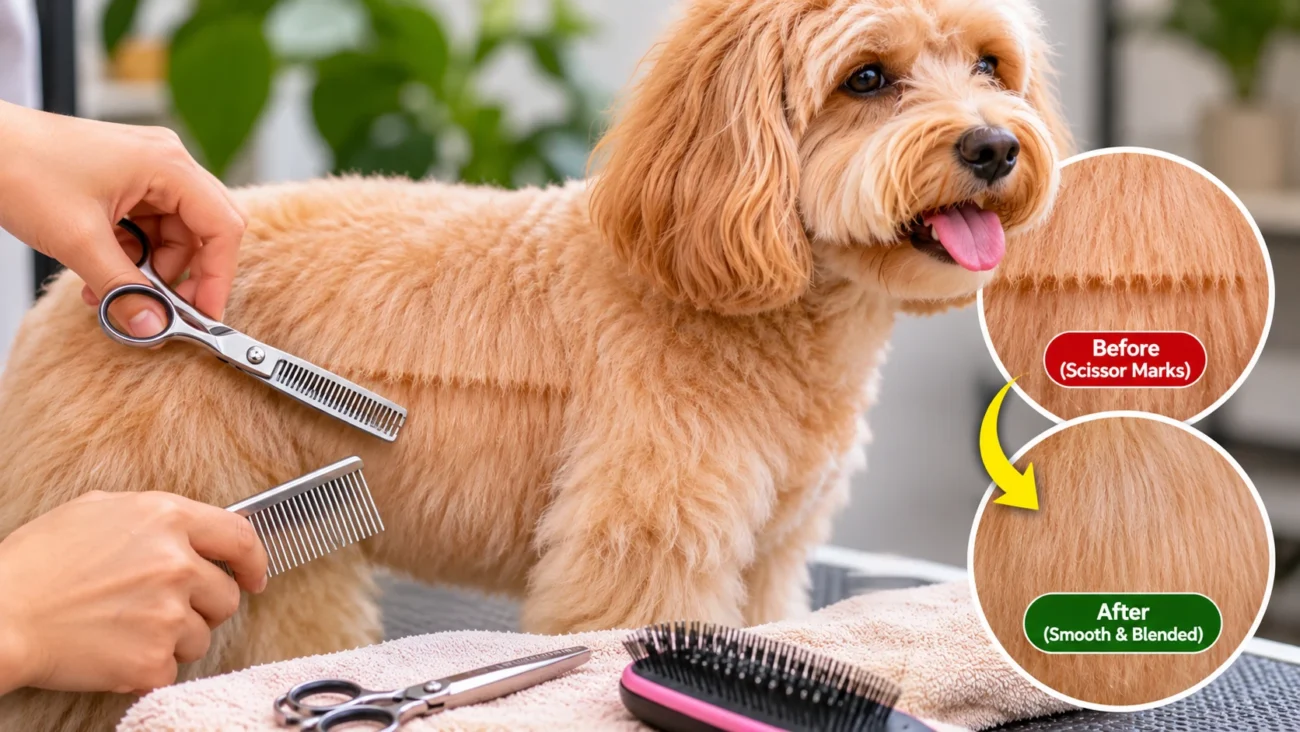
Minor surface-level marks can sometimes be improved through careful preparation and light blending. These steps apply primarily to accessible areas of a healthy, unmatted coat where the skin remains clearly separated from the cutting zone.
Step 1: Brush and Comb the Coat Thoroughly
Begin with a brush appropriate for your dog’s coat, followed by a grooming comb. Work gently through the area until loose hair and minor tangles are removed.
Allow the coat to fall naturally, and examine it from different angles. Some marks become less noticeable after proper combing because the hair was simply lying unevenly.
If you encounter a tight mat, do not cut through it with scissors. Skin can be pulled into mats and accidentally injured.
Step 2: Identify the Exact Type of Mark
Before trimming again, determine whether the mark is a raised ridge, an abrupt change in length, or a genuinely short patch.
- Raised ridge: Longer hair protrudes above the surrounding surface.
- Hard transition: Two coat lengths meet at a noticeable boundary.
- Short patch: Hair has already been removed below the intended length.
The distinction matters because a raised ridge may be softened, while a short patch cannot be restored by cutting.
Step 3: Choose a Suitable Blending Tool
Blending or thinning shears can soften the appearance of a hard line by removing selected hairs rather than cutting every strand to the same length.
These tools are especially useful for transitions between slightly different coat lengths. They are still sharp cutting instruments, however, and require careful handling and adequate distance from the skin.
If you are unfamiliar with blending shears, have a groomer demonstrate the technique before attempting it on your dog.
Step 4: Make Small, Controlled Blending Cuts
On a calm dog, work only in a clearly visible, accessible area with sufficient hair length to blend safely.
Position the shears so the blades work on the outer coat rather than toward the skin. Make a small cut in the longer hair bordering the visible line.
Avoid repeatedly closing the shears in exactly the same place. The objective is to soften the transition gradually, not remove a large amount of hair in one pass.
Do not attempt this around the eyes, ear edges, skin folds, groin, or other sensitive areas without appropriate professional training.
Step 5: Comb, Check, and Repeat Only If Necessary
After a small amount of blending, comb the hair into its natural position again. Check the result under even lighting and view the coat from the front and side where possible.
If the line is less noticeable, consider stopping. If it remains visible, determine whether a little longer hair can safely be softened without creating another short patch.
Do not keep cutting simply because the coat is not perfectly symmetrical.
Step 6: Let the Coat Settle and Reassess
Finish by gently brushing or combing the area. Allow the dog to move naturally, then reassess the coat when the hair has settled.
Sometimes an apparent imperfection comes from the way the coat is positioned rather than an actual length difference. Additional cutting may make a minor problem worse.
Grooming Tip
Use a comb between blending passes. Rechecking the coat frequently helps reveal whether you are improving the transition or unintentionally removing too much hair.
Which Grooming Scissors Work Best for Removing Scissor Lines?
Blending shears are generally the most relevant finishing tool for softening visible scissor lines. Straight shears, curved shears, thinning shears, and chunkers each affect the coat differently.
| Tool | Main Purpose | Scissor Mark Correction |
|---|---|---|
| Straight shears | Establishing length and clean outlines | Can reshape longer areas but may create hard lines |
| Curved shears | Shaping rounded contours | Useful for controlled shaping, not necessarily blending |
| Thinning or blending shears | Softening transitions and selectively removing hair | Often suitable for minor visible lines |
| Chunkers | Removing more bulk and creating texture | Useful in experienced hands but can remove too much hair |
For minor finishing imperfections, a controlled blending technique generally makes more sense than aggressively reshaping the entire coat.
Professional grooming guidance from Groomers Limited’s explanation of blending and thinning shears describes how these tools differ in their finishing applications.
Can You Fix Scissor Marks Without Cutting More Hair?
Yes, sometimes. If the marks result from flattened, clumped, or unevenly positioned hair, brushing and proper coat preparation may improve their appearance without further cutting.
Try gently combing the coat in its normal direction and checking whether the line changes when the hair settles.
A bath followed by coat-appropriate drying may also help reveal the coat’s true shape, provided the dog is not tightly matted and washing is appropriate for its condition.
However, when hair has genuinely been cut too short, brushing cannot replace the missing length. The safest cosmetic solution may be to allow the area to grow before making additional adjustments.
How Does Coat Type Affect Scissor Mark Removal?
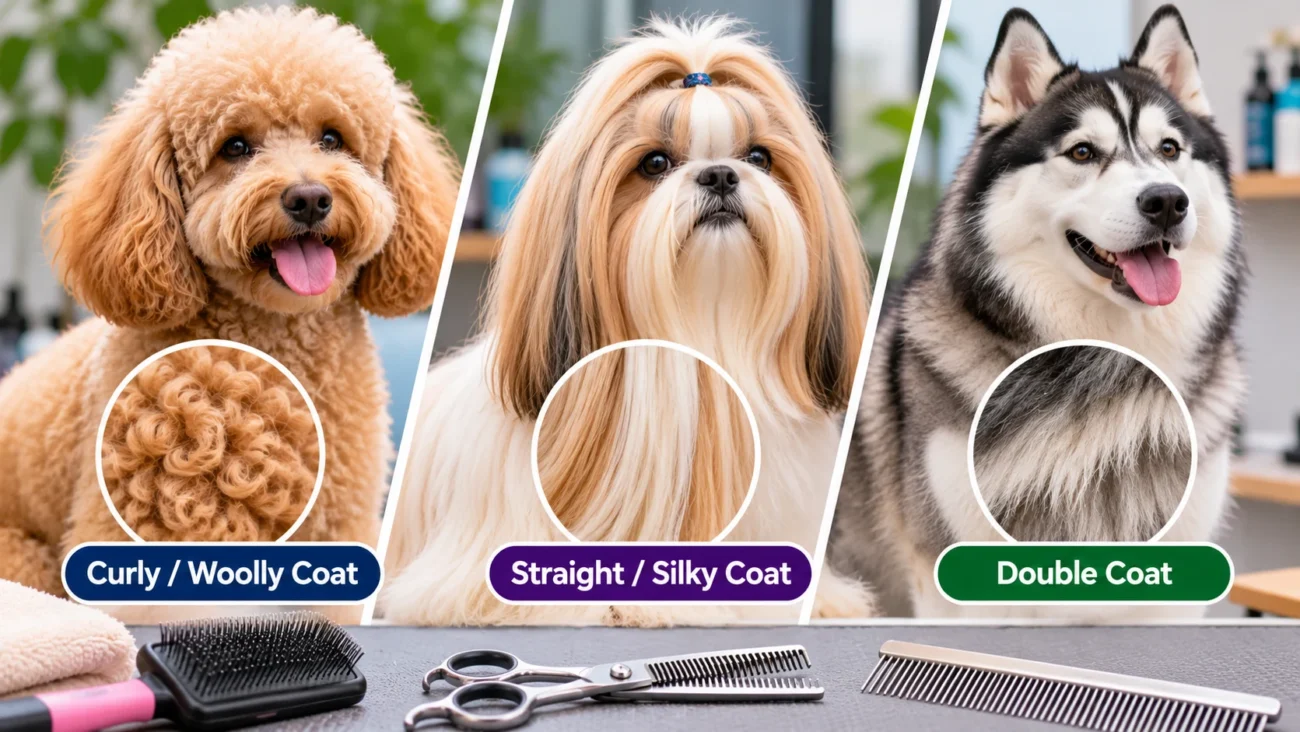
Different coat textures respond differently to trimming and blending. A technique that works on a dense, curly coat may be inappropriate for a smooth or double-coated dog.
Curly and Woolly Coats
Curly coats, including many Poodle-type coats, often require careful preparation because unevenly lifted curls can produce an irregular silhouette.
Thorough combing and appropriate drying help reveal the overall shape. Controlled blending may soften small ridges, but avoid repeatedly shortening an already uneven area.
Straight and Silky Coats
Straight, flowing coats may reveal blunt cutting lines more clearly. Removing additional length across a broad section can make the problem more noticeable.
Selective blending of longer sections may help, although preserving the natural fall of the coat is important.
Double-Coated Dogs
Double-coated dogs require particular care because their topcoat and undercoat perform different functions. Broad cutting or thinning can alter the appearance of the coat and may not suit the dog’s grooming needs.
For breeds with substantial undercoats, prioritize appropriate brushing and coat maintenance. Ask a breed-knowledgeable professional before attempting significant blending or shortening.
The VCA Animal Hospitals guide to canine coat care explains why grooming methods should match a dog’s coat and skin condition.
What Mistakes Make Scissor Marks Worse?
The most common correction mistake is trying to make every uneven section match the shortest part of the haircut.
This may temporarily remove one visible line while creating a larger patch of excessively short hair.
Other mistakes to avoid include:
- Making repeated cuts without combing and checking the result.
- Cutting into a tightly matted section to reach an apparent ridge.
- Using large chunking shears without understanding their cutting action.
- Working while the dog is moving, resisting, or becoming distressed.
- Attempting precise cosmetic corrections close to sensitive body parts.
- Assuming that every visible mark requires more trimming.
Safety Warning
Never use scissors to cut through tight mats close to your dog’s skin. Mats can conceal skin folds, making accidental injuries more likely. If the dog has painful matting, irritated skin, or cannot remain still, stop and seek professional assistance.
The American Kennel Club’s home grooming advice recommends learning proper trimming procedures from knowledgeable professionals before using scissors in sensitive areas.
How Can You Prevent Scissor Marks During Future Grooming?
Preventing scissor marks begins before the first cut. Good coat preparation and consistent technique reduce the need for corrections afterward.
- Prepare the coat: Brush, comb, and use coat-appropriate drying methods before detailed finishing work.
- Establish the intended shape: Decide which areas should remain longer before removing hair.
- Work gradually: Avoid cutting large sections simply to save time.
- Maintain a consistent cutting angle: Follow the desired body contour rather than changing direction unpredictably.
- Comb frequently: Allow the hair to return to its natural position before judging the result.
- Blend transitions carefully: Soften hard lines without repeatedly shortening the surrounding coat.
- Stop when the coat looks balanced: A natural finish is often preferable to excessive correction.
Sharp, well-maintained grooming equipment also matters. Shears that fold or pull hair rather than cutting cleanly can make precise finishing more difficult.
When Should You Leave Scissor Mark Correction to a Groomer?
Professional help is the safer choice when correcting a line requires working close to the skin, dealing with significant matting, or reshaping an area that has already been cut too short.
Consider stopping and booking a professional grooming appointment when:
- The uneven area is near the eyes, ears, paws, or skin folds.
- The dog struggles, moves suddenly, or becomes stressed.
- You cannot clearly distinguish coat from skin.
- The coat has severe tangles or painful mats.
- Repeated trimming is creating additional uneven patches.
- The desired correction requires breed-specific coat knowledge.
If the skin has been cut, is bleeding, or appears painful or irritated, prioritize veterinary advice rather than further cosmetic grooming.
A professional may also recommend leaving a short section alone until more hair grows. That can preserve the surrounding coat and prevent an unnecessary full-body correction.
Frequently Asked Questions
What is the easiest way to remove scissor marks on a dog?
Start by thoroughly brushing and combing the coat. If a visible line remains in an accessible, unmatted area, carefully applied blending shears may help soften it. Inexperienced owners should seek a groomer’s demonstration before cutting.
Do thinning shears remove scissor marks?
Thinning shears can reduce the appearance of scissor marks by selectively removing hair and softening transitions. They cannot restore hair that has already been cut too short.
Can brushing remove scissor lines?
Brushing may improve marks caused by hair lying unevenly, especially after grooming. It will not fully correct a genuine difference in hair length.
How long does it take for scissor marks to grow out?
There is no universal timeline. Regrowth depends on the dog’s breed, coat type, hair-growth cycle, and how much hair was removed. Some unevenness may soften as the coat grows, while deeper patches can remain noticeable longer.
Should I use chunkers or blending shears?
Blending shears are generally more suitable for small finishing corrections. Chunkers remove more hair and create texture, making them better suited to experienced groomers working on appropriate coats.
Can scissor marks be removed completely?
Some superficial marks can be blended until they are barely noticeable. Deep cuts and short patches cannot always be corrected immediately without shortening more of the coat. Allowing regrowth may produce a better result.
Final Thoughts
Removing scissor marks in dog grooming requires patience, proper coat preparation, and restraint. Gentle blending can improve minor lines, but continuing to cut a short or uneven area often makes the problem worse.
Brush and assess first, blend only when it is safe, and allow the coat to grow when too much hair has already been removed. A comfortable dog and a healthy coat matter more than a perfectly even haircut.


