

Quick Answer
To trim your dog’s face with clippers, start with clean, dry, brushed hair and a quiet pet grooming trimmer fitted with an appropriate guard. Work slowly on the cheeks and other broad, safe areas while keeping the tool away from the eyes, nostrils, lips, and loose skin. Stop if your dog moves suddenly or becomes distressed. The American Kennel Club’s grooming guidance recommends professional training before clipping sensitive areas.
Six quick steps for safer facial trimming
- Prepare the coat: Clean, dry, and gently comb your dog’s facial hair.
- Choose a guard: Start with a longer attachment instead of a bare, close-cutting blade.
- Introduce the sound: Let your dog become comfortable with the switched-on trimmer before touching the coat.
- Trim the cheeks: Use short, controlled strokes following the hair’s natural direction.
- Protect sensitive areas: Keep clippers away from the eyeballs, eyelids, nostrils, lip folds, and whisker roots.
- Inspect and reward: Stop, check for irritation, and reward calm behavior.
Safety reminder: Beginners should leave close trimming around the eyes and mouth to a professional groomer.
Learning how to trim a dog face with clippers can make routine grooming easier, especially for dogs with long facial hair. However, the face needs a different approach from the body because sensitive skin, eyes, and moving lips increase the risk of injury.
In this guide, I’ll explain the tools, preparation, trimming sequence, and mistakes worth avoiding. The goal is comfortable facial maintenance, not achieving a show-quality cut at your dog’s expense.
Can You Safely Trim a Dog’s Face With Clippers at Home?

Yes, some facial hair can be trimmed safely at home when your dog remains calm and you use appropriate equipment. However, trimming close to the eyes, mouth, or loose facial folds requires extra skill.
Facial clipping means shortening the hair on areas such as the cheeks and upper muzzle using an electric pet trimmer. It differs from shaping the entire head with grooming scissors or shaving the skin closely.
The safest home approach depends on several factors:
- Coat type: Curly, silky, wiry, and double-coated dogs have different grooming needs.
- Face shape: Flat-faced dogs may have prominent eyes and deeper skin folds.
- Behavior: Dogs that suddenly turn or snap are harder to trim safely.
- Hair condition: Thick mats can hide sensitive skin and should not be clipped blindly.
- Experience: Beginners should focus on accessible areas rather than close facial styling.
For example, a calm adult poodle may tolerate cheek maintenance, while a nervous Shih Tzu may need professional help. The dog’s behavior matters more than finishing the haircut.
What Tools Do You Need to Trim a Dog’s Face?
A small, quiet pet trimmer with a suitable guard is generally easier to control than a large body clipper. You’ll also need basic preparation tools and rewards.
- Pet grooming trimmer: Choose a lightweight model designed for animal grooming.
- Compatible guard combs: Use attachments that maintain a longer cutting length.
- Metal grooming comb: Gently separate facial hair and identify tangles.
- Soft brush: Smooth the coat before clipping.
- Rounded-tip grooming scissors: Use only after learning safe handling around the face.
- Soft towel: Clean away loose hair and surface debris.
- High-value treats: Reward calm behavior throughout the process.
- Good lighting: Make facial contours and skin folds easier to see.
Should You Use Regular Clippers or a Small Facial Trimmer?
Small facial trimmers usually provide better maneuverability around narrow facial areas. Full-size clippers are more useful for larger sections of coat.
| Feature | Small Detail Trimmer | Full-Size Dog Clipper |
|---|---|---|
| Cutting head | Narrow | Wider |
| Main purpose | Small-area detail work | Body and broader coat clipping |
| Maneuverability | Better in tight spaces | Better on open surfaces |
| Guard options | Model-dependent | Often more attachment choices |
| Best home use | Carefully controlled maintenance | Broad cheek areas and body coats |
Neither tool automatically makes trimming near the eyes safe. Blade design, guard fit, handling, and your dog’s behavior remain essential.
How Should You Prepare Your Dog Before Trimming Its Face?
Preparation matters because tangled hair and sudden movement can make facial clipping dangerous. Start only when your dog is relaxed, and the coat is completely dry.
1. Choose a Quiet, Well-Lit Location
Work somewhere without loud televisions, running children, or other distractions. Use a secure, non-slip surface at a comfortable height.
Never leave your dog unattended on a raised grooming surface. Floor-level grooming may be safer for some dogs.
2. Clean and Dry the Face
Use a pet-safe damp cloth to remove loose dirt from the facial hair. Avoid allowing water or cleaning products to enter the eyes and nostrils.
Let the hair dry before using ordinary electric clippers. Wet hair can be harder to cut evenly and may interfere with tools not designed for wet use.
3. Brush and Comb the Facial Hair
Gently comb the cheeks, beard, and accessible portions of the muzzle. Stop if you find tightly matted hair near the skin.
The RSPCA’s dog grooming guidance emphasizes gentle brushing and stopping when an animal becomes stressed.
4. Introduce the Trimmer Gradually
Let your dog inspect the switched-off device, then reward calm curiosity. Next, switch it on at a comfortable distance and offer another reward.
Move closer only when your dog remains relaxed. If your dog freezes, pulls away, growls, or repeatedly turns its head, end the exercise.
How to Trim a Dog’s Face With Clippers: 8 Safe Steps
The safest beginner sequence starts with larger, less sensitive facial areas. Avoid attempting a complete close facial clip without professional instruction.
Step 1: Check the Skin and Facial Features
Look for redness, bumps, warts, cuts, swelling, and irritated skin folds. Do not clip across anything that might catch in the blade.
Identify the ears, cheek contours, lip folds, and natural direction of hair growth. Any suspicious skin condition deserves veterinary advice before grooming.
Step 2: Select a Suitable Guard and Cutting Length
Start with a longer compatible guard rather than choosing a very short cutting length. A longer attachment provides more room for adjustment.
Verify that the guard locks securely onto the specific trimmer. Never assume attachments from different brands fit correctly.
Step 3: Establish a Comfortable Head Position
Ask your dog to sit or stand naturally while keeping all four feet supported. Use rewards to encourage brief periods of stillness.
Do not clamp the muzzle, force the head backward, or restrict breathing. Stop whenever your dog struggles or attempts to escape.
Step 4: Begin With the Broad Cheek Areas
Start on an accessible cheek section, away from the eyelids and mouth. Guide the guarded trimmer gently in the direction the hair naturally grows.
- Keep the cutting surface aligned with the facial contour.
- Use light pressure and slow, controlled movements.
- Keep loose skin from folding into the path of the tool.
- Avoid repeated strokes on the same sensitive area.
- Stop before approaching the outer eye corner or lips.
Short, calm passes are more useful than rushing through the entire face. Reward your dog between sections.
Step 5: Shorten Accessible Outer Muzzle Hair
Some dogs have longer hair extending across the upper muzzle. Only trim broad, visible sections that are safely separated from the nostrils and lips.
Keep the trimmer away from whisker roots and skin folds. If hair grows close to the mouth, leave that area for someone trained in facial grooming.
Step 6: Leave Close Eye-Area Trimming to a Professional
Hair near the eyes requires particular care because a sudden head movement can cause serious injury. Do not guide an electric blade toward the eyeball or eyelid.
For overgrown eye-area hair, ask a groomer or veterinarian to demonstrate a safe technique. Veterinary ophthalmology guidance recommends careful handling and professional instruction for this area.
You can read more about eye health in the ASPCA’s dog grooming and eye-care advice.
Step 7: Check Symmetry Without Over-Trimming
Switch off the trimmer and gently comb the trimmed sections. Compare the cheeks and outer facial hair from the front.
Small differences are normal during beginner grooming. Avoid repeated clipping just to achieve perfect symmetry.
Step 8: Remove Loose Hair and Reward Your Dog
Brush away loose clippings using a soft grooming brush. Keep hair out of the eyes, nostrils, and mouth.
Inspect the skin for redness, scratches, or discomfort. End the session with praise and a reward.
How Do You Trim Around a Dog’s Eyes Without Hurting It?
The safest option for inexperienced owners is to avoid using clippers immediately beside the eyes. Even a quiet, narrow trimmer can injure an eyelid or cornea if the dog moves unexpectedly.
Hair that obstructs vision may need shortening, but the technique should first be demonstrated by a veterinarian or qualified groomer.
Consider these precautions:
- Never point clipper teeth toward an eyeball.
- Do not trim when your dog is shaking or turning its head.
- Avoid pressing attachments against the eyelids.
- Do not pull hardened discharge from hair around the eye.
- Never use sharp household scissors near the eye.
- Seek veterinary care if the eye becomes red, watery, cloudy, or painful.
Hair around the eyes can affect comfort and visibility. However, a slightly uneven haircut is preferable to risking an eye injury.
What About Trimming the Beard, Chin, and Mouth Area?
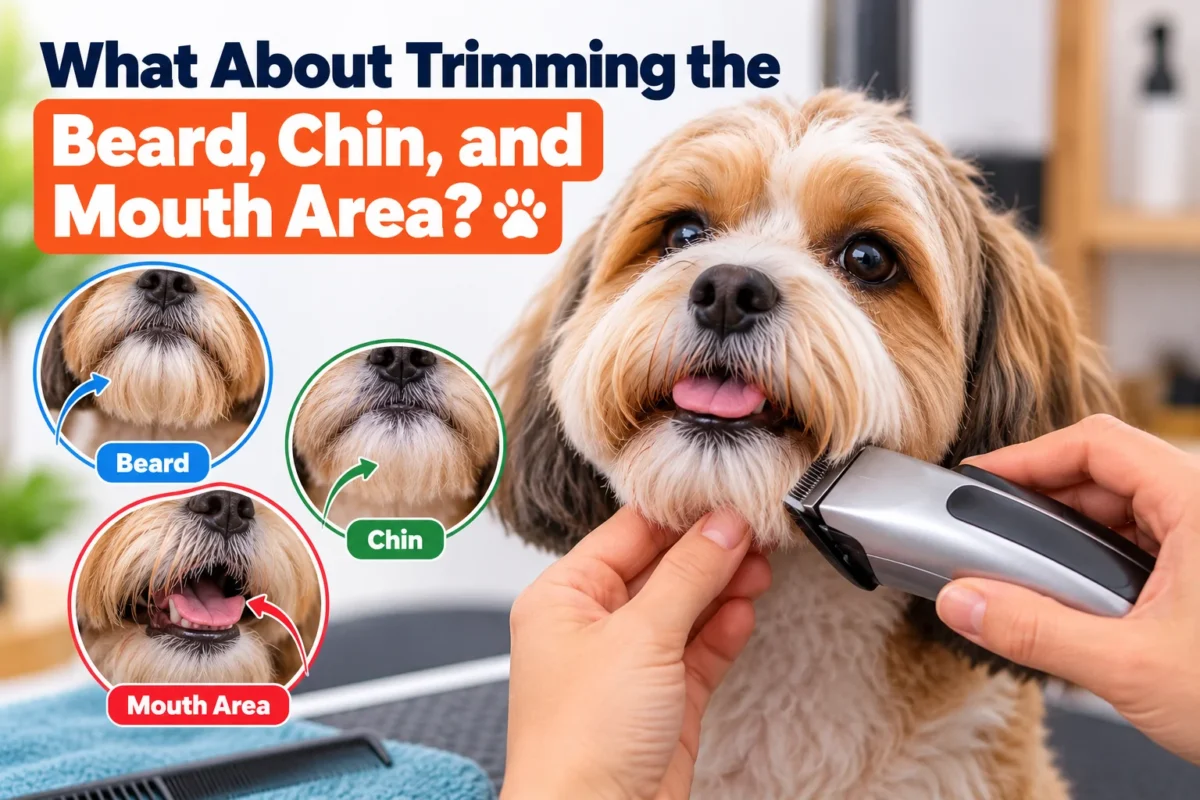
The beard and chin often collect food, saliva, and debris, particularly in dogs with longer facial coats. Regular combing and gentle cleaning may reduce the need for frequent close trimming.
Keep electric blades away from moving lips, the tongue, and skin folds. A dog may lick or open its mouth unexpectedly.
Safe Beard Maintenance
- Comb accessible beard hair gently downward.
- Remove surface debris with a damp, pet-safe cloth.
- Allow the hair to dry before attempting clipping.
- Trim only outer, clearly visible hair when your dog remains still.
- Leave close work along the lips and chin folds to a professional.
For breeds with pronounced wrinkles, cleaning and drying skin folds may be more important than shortening the hair. Ask your veterinarian how to maintain the specific folds safely.
Which Dog Breeds Need Facial Trimming?
Facial grooming requirements vary with coat growth, texture, and breed-specific styling. Not every dog benefits from having facial hair clipped.
| Dog Type | Typical Facial Grooming Need | Important Caution |
|---|---|---|
| Poodle | Regular curly-coat maintenance | Close face styles require training |
| Shih Tzu | Managing long facial hair | Prominent eyes require extra protection |
| Maltese | Eye-area and muzzle coat management | Fine hair may tangle around sensitive areas |
| Schnauzer | Beard and eyebrow maintenance | Preserve the intended breed style |
| Golden Retriever | Usually limited facial tidying | Routine facial shaving is generally unnecessary |
For dogs with flat faces, prominent eyes, or substantial facial folds, professional guidance is particularly valuable. These features make routine clipping less forgiving.
What Are the Biggest Mistakes When Trimming a Dog’s Face?
The most common avoidable mistakes involve rushing, using unsuitable equipment, and continuing after the dog becomes uncomfortable. A safe session should remain predictable and gentle.
1. Starting With a Very Short Blade
A close-cutting blade leaves less room for error around facial contours. Begin with a longer compatible guard and avoid bare-blade detail work without training.
2. Trimming Too Close to the Eyes
Eye injuries can happen in a moment. Leave close eye-area clipping to an experienced groomer rather than trying to follow complicated blade movements from a video.
3. Clipping Matted Hair Without Checking the Skin
Severe mats can pull delicate skin into folds and conceal injuries. Don’t force a clipper through thick facial mats.
Professional removal is safer when matting sits tightly against sensitive skin.
4. Using Hot or Dull Blades
Hot blades may irritate or burn skin, while dull blades can pull hair. Follow the manufacturer’s cleaning, cooling, lubrication, and replacement instructions.
5. Forcing a Nervous Dog to Remain Still
Physical restraint can increase stress and the chance of sudden movement. Instead, shorten the session or arrange professional grooming support.
6. Cutting Against Hair Growth Without Experience
Trimming against the natural growth direction can produce a closer cut than expected. Beginners should generally follow the coat’s direction on accessible areas.
7. Prioritizing Appearance Over Comfort
Trying to achieve perfect symmetry can lead to unnecessary repeated passes. Stop once the essential, safe maintenance is complete.
What Should You Do If Clippers Irritate or Cut Your Dog’s Face?
Stop clipping immediately if you notice redness, a cut, swelling, or unusual sensitivity. Turn off the device and prevent your dog from rubbing the affected area.
Different problems require different responses:
- Mild redness: Stop grooming and monitor the skin. Contact your veterinarian if irritation persists or worsens.
- Bleeding cut: Apply gentle pressure using clean gauze if it is safe to do so, then contact a veterinarian.
- Possible eye injury: Seek prompt veterinary attention. Do not apply creams or attempt further grooming.
- Swelling or severe pain: Arrange veterinary evaluation rather than attempting home treatment.
- Repeated scratching: Prevent further irritation and request veterinary advice.
Avoid human painkillers, alcohol, peroxide, and unapproved skin creams. Products suitable for people may be harmful to pets.
The American Kennel Club advises contacting a veterinarian when grooming reveals wounds or other injuries.
How Often Should You Trim a Dog’s Facial Hair?
There is no universal facial trimming schedule. The right interval depends on coat growth, visibility, hygiene, and your dog’s tolerance for grooming.
Dogs with continuously growing coats may need more regular maintenance than short-coated breeds. Daily brushing may keep some facial areas tidy between professional appointments.
Use these practical checks:
- Hair repeatedly falls into the dog’s eyes.
- Beard hair traps food or moisture.
- Facial hair begins forming tangles.
- The coat becomes difficult to clean.
- Your groomer recommends maintenance between full appointments.
If hair touches the eyeball or causes squinting, don’t simply wait for the next haircut. Ask a veterinarian to assess possible eye irritation.
How Can You Keep Your Dog Calm During Facial Grooming?
Gradual training is more effective than insisting on a complete facial trim in one sitting. Build positive associations with the grooming area and trimmer.
Practice Short Grooming Sessions
Begin with brief exercises that don’t involve cutting hair. Reward your dog for calmly seeing and hearing the tool.
Progress toward gentle contact only when your dog feels comfortable. End the practice before stress increases.
Recognize Stress Signals
Watch for head turning, repeated lip licking, freezing, trembling, growling, or attempts to escape. Any of these can mean the session needs to stop.
Don’t punish your dog for communicating discomfort. Reassess the approach or consult a qualified professional.
Know When to Ask for Help
A professional groomer can demonstrate appropriate equipment, handling, and coat maintenance. Dogs with biting behavior, severe anxiety, or medical problems may need veterinary-supported grooming plans.
Which Dog Grooming Clippers Are Worth Considering?
For facial maintenance, prioritize a controllable cutting head, suitable attachments, easy cleaning, and your dog’s tolerance. Product suitability doesn’t replace safe grooming technique.
Here are three real grooming tools worth comparing for different needs. The suitability ratings below are editorial assessments, not verified customer review averages.
🏆 Versatile grooming option
Wahl Bravura Lithium Ion Clipper
★★★★☆ 4/5 — Editorial suitability
This cordless pet clipper offers an adjustable cutting system and versatility for routine coat maintenance. I would consider it for owners wanting one tool for broader grooming tasks, with professional instruction for close facial work.
💰 Small-area grooming option
oneisall Dog Paw Trimmer
★★★★☆ 4/5 — Editorial suitability
The narrow cutting head on this type of detail trimmer is intended for small grooming areas. I’d compare the exact model’s guard options before considering it for accessible facial hair, and avoid using an unguarded blade near the eyes.
🐩 Multi-area coat maintenance
Wahl ARCO Cordless Pet Clipper
★★★★☆ 4/5 — Editorial suitability
This cordless clipper is designed for trimming and light grooming tasks. I’d compare its size and available attachments with smaller detail trimmers before choosing it for routine facial maintenance.
Affiliate disclosure: This article contains affiliate links. Qualifying purchases may earn a commission at no extra cost to you.
Frequently Asked Questions About Trimming a Dog’s Face
Can I use human hair clippers on my dog’s face?
Pet-specific clippers are generally preferable because they are designed for animal coats and grooming needs. Human clippers may struggle with dense fur or have unsuitable cutting heads, attachments, and performance. Even pet-specific tools require careful handling around sensitive facial areas.
What clipper blade should I use on my dog’s face?
Professional groomers select blade sizes according to coat type, facial structure, and desired style. Beginners should generally start with a longer, compatible guard rather than a close-cutting bare blade. Ask a groomer to demonstrate the right equipment before clipping delicate facial areas.
Can I trim my dog’s face if it keeps moving?
No, not while the dog is moving unpredictably. A sudden head movement can bring the eyes, lips, or skin folds into the cutting blade. Stop the session and use gradual reward-based grooming practice, or arrange professional help.
Is it safe to shave a dog’s whiskers?
Dogs use whiskers as sensitive touch sensors that help them detect nearby objects. Avoid deliberately cutting or shaving whiskers during routine facial grooming. If a particular breed style requires trimming close to whisker areas, discuss the implications with an experienced professional first.
Should I trim my dog’s face before or after bathing?
Clean, fully dry, detangled hair is generally easier to clip evenly. If bathing is needed, use pet-safe products and dry the coat completely before ordinary electric clipping. Dogs with severe matting, skin disease, or unusual grooming requirements may need a professional plan.
Final Thoughts: Trim Slowly and Put Safety First
Learning how to trim a dog’s face with clippers begins with preparation, suitable tools, and understanding which areas are safe to maintain at home. Broad cheek areas are generally easier than delicate features surrounding the eyes and mouth.
Start with a longer guard, use light strokes, and reward calm behavior. Never sacrifice comfort or safety for a more precise haircut.
My recommendation: Ask a professional groomer to demonstrate your dog’s facial trimming pattern before attempting it independently. A manageable routine that your dog tolerates is more valuable than an ambitious haircut.


