
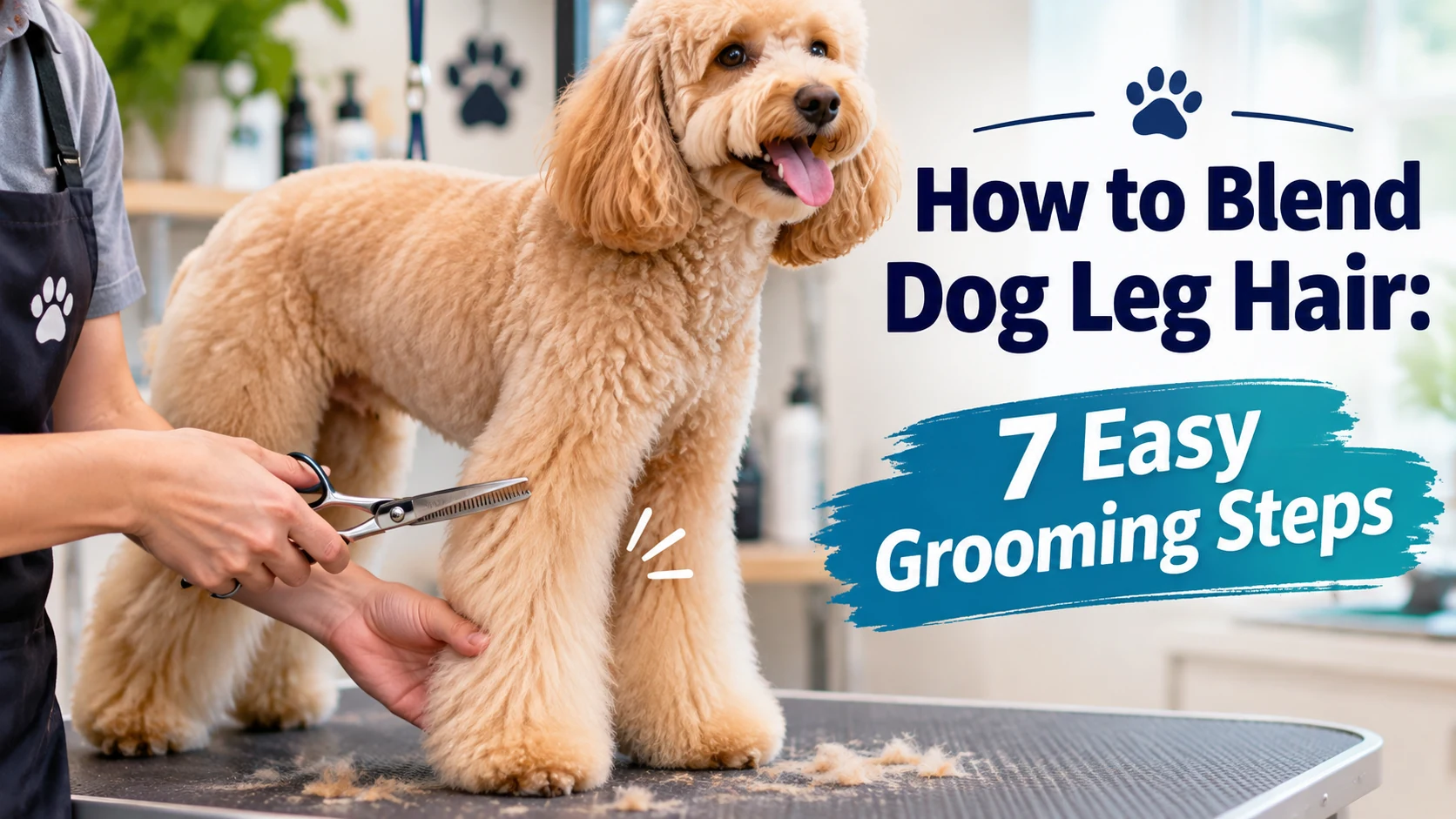
Quick Answer
To blend dog leg hair, brush and comb the coat thoroughly, identify where the shorter body hair meets the longer leg hair, and soften that transition gradually using appropriate grooming tools. Work from the shoulders and hips toward the legs, removing small amounts of hair and checking the shape frequently. Never cut into matted hair or work close to skin you cannot clearly see.
A dog’s legs can look bulky, uneven, or disconnected from the body after a haircut. This happens especially when the body coat has been clipped shorter while the legs are intentionally left fluffy.
Learning how to blend dog leg hair helps create a softer transition without sacrificing the leg shape. The important skill is not cutting more hair. It is recognizing which hair creates the unwanted line and removing only enough to make that line disappear.
This guide explains the basic grooming approach for dogs with coats suitable for trimming, including many Poodle mixes and curly-coated companion dogs. It also explains when the work is better handled by a professional groomer.
What Does Blending Dog Leg Hair Mean?
Blending dog leg hair means gradually connecting the shorter body coat with the longer hair on the legs so there is no obvious step, ridge, or shelf between them.
For example, a dog may have closely trimmed hair across its shoulders but noticeably longer hair below the elbows. Without blending, the legs can look like separate furry tubes attached to a short-haired body.
Blending changes the transition, not necessarily the overall leg length. The upper leg should flow naturally into the shoulder or thigh while the lower leg retains the fullness required for the haircut.
Professional groomers generally approach this as a matter of proportion. The front legs should visually connect with the chest and shoulders, while the rear legs should complement the hips and natural hind-leg angles.
A successful blend remains smooth when the dog stands normally, not just when someone holds the hair in a particular direction.
What Tools Help Blend Dog Leg Hair?
The appropriate tools depend on coat texture, grooming experience, and the amount of hair that needs shaping. You do not need every tool used in a professional salon.
- Metal grooming comb: Separates the coat, finds remaining tangles, and lifts hair to reveal uneven sections.
- Coat-appropriate brush: Prepares curly, wavy, or long hair before trimming.
- Blending or thinning shears: Help soften visible cutting lines by removing some hair rather than creating a solid straight edge.
- Straight or curved grooming scissors: Used by trained groomers to establish or refine the leg outline.
- Clippers with suitable guide combs: Can help maintain consistent coat lengths when used correctly on a prepared coat.
- Non-slip grooming surface: Helps the dog stand securely while its coat is examined.
For a beginner, brushing, combing, and learning to recognize the correct leg outline are more important than attempting complicated scissor work immediately.
Blending shears are not automatically safe just because they remove less hair. Their cutting edges can still injure skin, particularly around joints, loose skin, and moving paws.
How to Blend Dog Leg Hair in 7 Steps
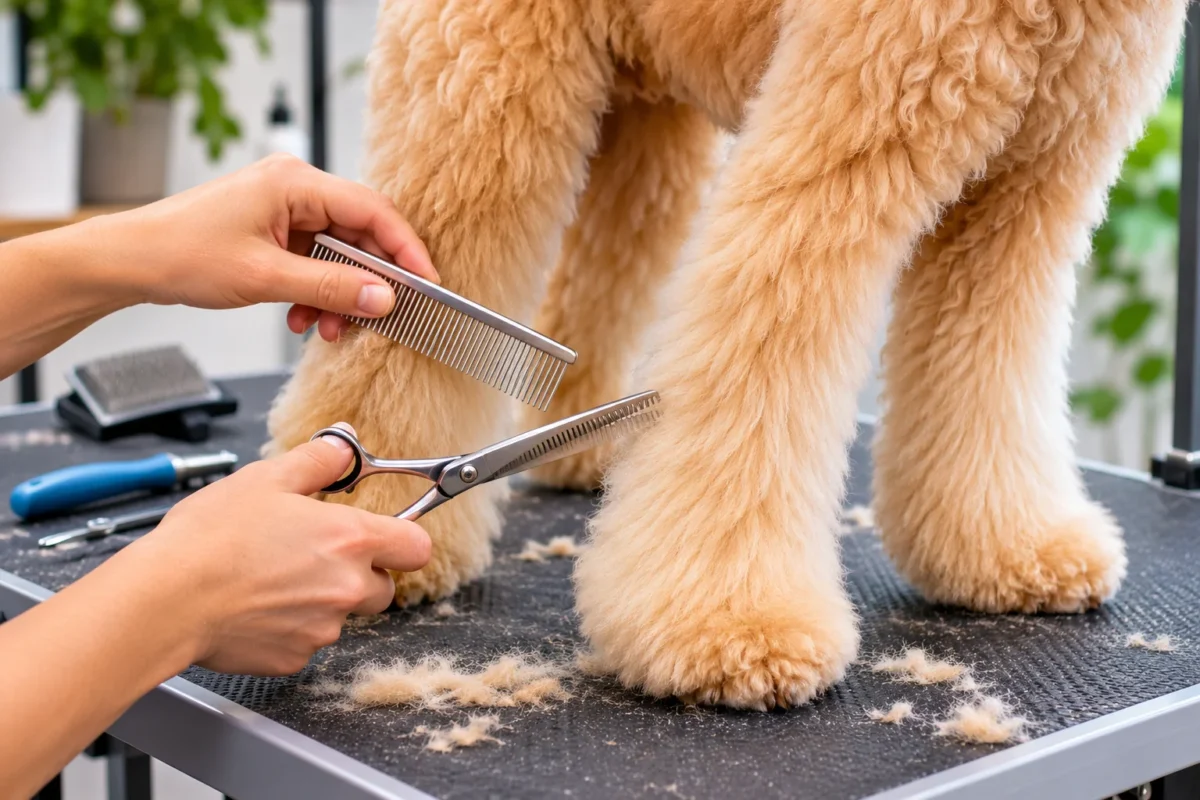
The following workflow is most suitable for a calm, cooperative dog with a healthy, clean, untangled coat. The cutting portions should be performed only by someone confident in safely handling grooming equipment. Beginners can use the preparation and assessment steps before arranging a professional demonstration.
Step 1: Brush and Comb the Legs Completely
Start by gently brushing the coat in manageable sections. Pay attention to the armpits, elbows, inner thighs, and areas around the hocks where tangles may hide.
Follow with a metal comb to check whether the hair is separated and free of knots. Do not force the comb through resistance or pull against the skin.
This preparation matters because tangled hair can appear shorter, thicker, or uneven. Cutting before the coat is properly prepared can leave unexpected gaps after the tangles are removed.
If the hair is tightly matted, stop the blending process. Mat removal requires a different safety approach and may need professional clipping.
Step 2: Identify the Transition Between Body and Legs
Stand the dog naturally and examine where the short body coat meets the longer leg hair.
On the front legs, this is commonly around the shoulder and upper-leg area. On the rear legs, examine the connection between the hips, thighs, and longer leg furnishings.
Look for horizontal bands, protruding tufts, or sudden changes in hair length. These are the areas that may need softening.
Do not assume that the entire leg needs shortening. Often the visible problem is concentrated in a comparatively narrow transition area.
Step 3: Establish a Balanced Leg Shape
Before blending, decide what shape the finished legs should have.
For a fluffy companion-dog trim, the objective may be a softly rounded, relatively even leg outline. For a breed-specific trim, the required proportions and coat distribution may differ.
Examine the dog from the front, side, and rear. Compare the apparent fullness of the left and right legs.
The objective is visual balance, not forcing every part of the coat to an identical measured length. A dog’s underlying anatomy naturally changes the silhouette.
Step 4: Soften the Shoulder-to-Leg Transition
The front-leg blend should connect the body coat with the upper foreleg without leaving a bulky shoulder pad.
A trained groomer may lift and comb the hair outward, identify the excess coat at the transition, and make limited blending-shear cuts through the outer hair ends.
The coat is then recombed to see how the newly shortened hairs settle against the longer surrounding hair.
Avoid cutting repeatedly in one spot. Taking too much hair from the shoulder can create a hollow patch that becomes more noticeable once the dog moves.
Never point cutting edges toward the armpit or work blindly around the skin folds behind the front leg.
Step 5: Connect the Rear Legs With the Hips
The rear-leg blend follows a similar principle, but the natural shape of the thigh and hock requires different visual judgment.
Examine the transition where the clipped body and rump meet the longer thigh hair. The goal is to avoid an abrupt shelf while preserving the rear-leg shape.
Experienced groomers may use light blending work at the upper thigh, comb the coat back into position, and reassess the silhouette from the side and rear.
Do not remove fullness indiscriminately. Excessive cutting near the thigh can make the rear legs appear narrow, while too much retained bulk can produce a rounded lump at the hip.
The hock, groin, and inner thigh require particular care because movement, skin folds, and changing body angles increase the risk of accidental injury.
Step 6: Comb, Recheck, and Refine
After any small adjustment, comb the hair back into its natural position and allow it to settle.
Check the dog’s outline without holding the fur up. A transition that looks smooth while the hair is lifted may reveal a line once it falls naturally.
Compare both sides before making more changes. Look for an isolated tuft rather than continuously shortening an entire section.
Use natural lighting where possible, as shadows can exaggerate or conceal uneven coat lengths.
Step 7: Check the Finished Shape While the Dog Stands
The final check is about the overall silhouette.
Look at the dog from the front to see whether the forelegs appear reasonably balanced. From the side, inspect how the shoulder and thigh hair flows into the legs.
From behind, check for uneven protrusions or obviously mismatched leg shapes.
Allow the dog to reposition naturally before evaluating the result. Hair that looks even in one stance can change appearance when the dog shifts its weight.
Stop when the transition looks harmonious. Repeatedly correcting tiny differences can remove more coat than intended.
How Should You Blend Different Dog Coat Types?
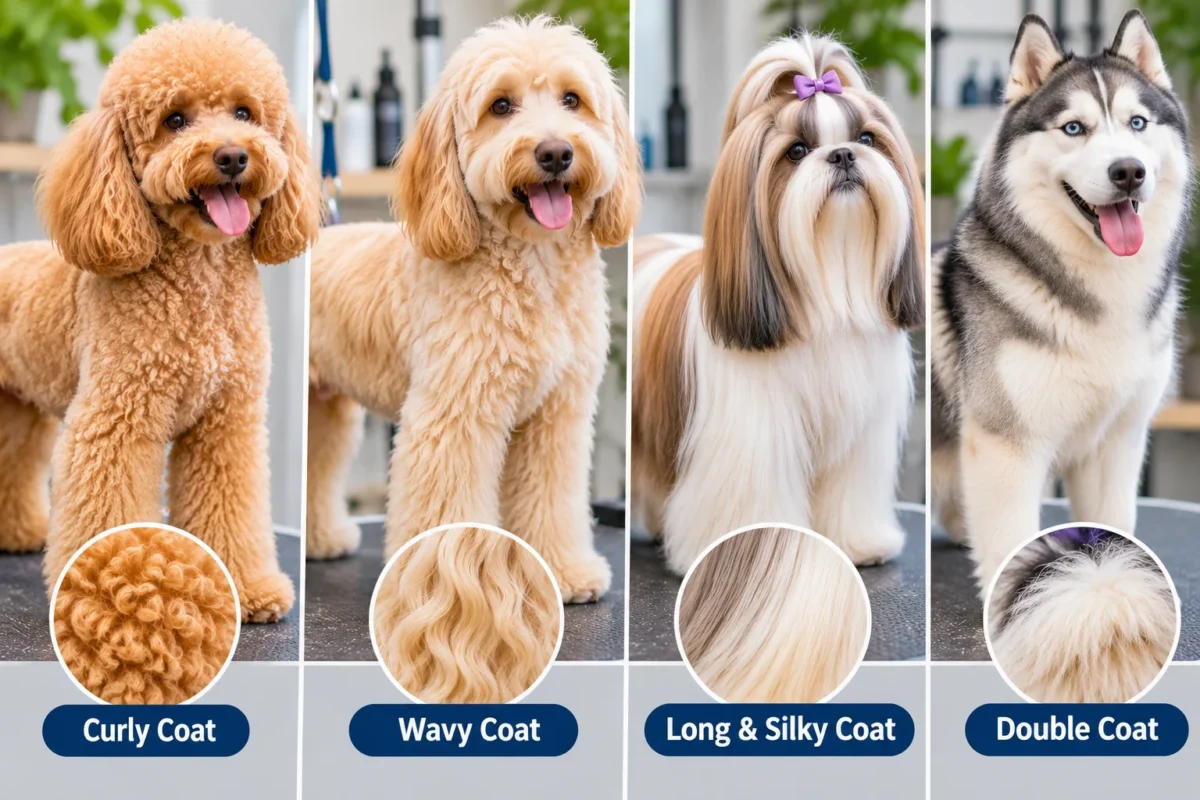
Not all dogs should receive the same leg-trimming technique. Coat structure determines whether shaping, light tidying, or simple brushing is appropriate.
| Coat type | Practical approach |
|---|---|
| Curly Poodle-type coat | Thorough preparation followed by careful shaping and gradual transitions. |
| Wavy Doodle-type coat | Comb fully and check how the hair falls before deciding where blending is needed. |
| Long, silky coat | Preserve the natural coat flow and avoid unnecessary thinning or blunt lines. |
| Dense double coat | Prioritize coat maintenance and seek breed-appropriate guidance before cutting. |
| Short, smooth coat | Usually requires brushing rather than leg-hair blending. |
These are general categories, not fixed rules for every breed or mixed-breed dog. In particular, clipping or substantially shortening a double coat can be inappropriate for its normal structure and function.
What Common Mistakes Make Dog Leg Hair Look Uneven?
Most visible blending problems come from removing hair without regularly reassessing the complete leg shape.
- Cutting too much at once: Can create holes, flat patches, or abrupt changes that cannot be corrected immediately.
- Working on tangled hair: Makes it difficult to judge actual coat length and consistency.
- Ignoring body proportions: May leave the legs too narrow or too bulky compared with the torso.
- Using blunt, unsuitable tools: Can pull hair or make precise control more difficult.
- Trying to fix every small difference: Often produces progressively shorter, uneven sections.
- Trimming while the dog is moving: Creates an unnecessary risk of cutting the skin.
A useful visual principle is to preserve enough hair for the transition to remain gradual. The goal is not to erase every difference between the body and legs but to prevent those differences from forming an obvious edge.
How Can You Blend Dog Leg Hair Safely?
Safety should determine whether the haircut proceeds at all. Legs include joints, loose skin, tendons, and areas where a dog may suddenly withdraw its paw.
Important Safety Warning
Never use scissors to cut through tight mats or hair attached closely to the skin. Mats can conceal skin folds, and sudden movement can cause serious cuts. Stop if the dog becomes distressed, painful, or difficult to hold safely.
The ASPCA’s guidance on preventing matting explains why difficult mats should be handled by a professional rather than removed with scissors.
Before attempting light coat maintenance, check for redness, sores, swelling, tenderness, or suspicious lumps. An unusual finding should be evaluated before cutting around it.
For additional coat-care guidance, the VCA Animal Hospitals grooming guide explains the importance of gentle brushing and professional help with extensive matting.
Grooming should also stop if the dog repeatedly pulls away, growls, snaps, or cannot remain comfortably positioned. A professional groomer may be able to manage the haircut more safely; suspected injuries or skin disease warrant veterinary attention.
When Should You Ask a Professional Groomer to Blend the Legs?
Professional help is appropriate when the haircut needs substantial correction, the dog has tight mats, or you cannot safely identify where the hair ends and the skin begins.
A groomer is also the better choice for precise breed-specific styling, difficult-to-handle dogs, sensitive joints, and significant differences between body and leg lengths.
You can ask the groomer to demonstrate the finished leg outline, explain how much fullness to preserve, and recommend a safe brushing routine between appointments.
For home maintenance, keeping the hair clean and untangled is often more valuable than attempting frequent scissor corrections.
Practical Tip
Photograph the finished haircut from the front, side, and rear after a professional grooming appointment. These images can help communicate your preferred leg shape at future appointments without guessing about coat length.
Related Grooming Tool: Dog Blending Shears
Purpose-made blending shears can help trained users soften harsh transitions between different coat lengths. Choose a tool suitable for your dog’s coat and your handling ability, and seek professional instruction before attempting scissor work near the skin.
View Dog Blending Shears on Amazon
As an Amazon Associate, we earn from qualifying purchases.
Frequently Asked Questions
Can I blend my dog’s leg hair without scissors?
Brushing and combing can improve the way longer hair lies and help reveal the natural leg shape, but they cannot permanently remove a distinct cutting line. Actual length correction requires suitable trimming tools and safe handling.
Are thinning shears better than straight scissors for blending?
Thinning or blending shears are generally better suited to softening a hard transition, while straight scissors are more useful for establishing an outline. Both require care and grooming skills to avoid injury.
Should dog leg hair be the same length as body hair?
Not necessarily. Many grooming styles intentionally leave leg hair longer than body hair. The important detail is creating a smooth visual connection and maintaining proportions appropriate to the coat and haircut.
Why does my dog’s leg hair look choppy after grooming?
A choppy appearance may result from uneven cutting, insufficient coat preparation, or trimming different sections without recombing between adjustments. Significant errors are best corrected by an experienced groomer.
Can I blend wet dog leg hair?
For most fluffy scissored finishes, clean, fully dry, properly prepared hair is easier to assess for shape and consistency. Wet hair can settle differently after drying, so follow the grooming method appropriate to the coat.
How often should I blend my dog’s leg hair?
There is no universal interval. The need depends on coat growth, grooming style, and maintenance. Regular brushing can preserve the appearance between professional grooming sessions without unnecessary cutting.
Conclusion
Blending dog leg hair is about creating a natural connection between the body and legs while preserving the shape of the haircut. Thorough brushing, careful coat assessment, small adjustments, and regular visual checks are more useful than removing large amounts of hair.
Different coats need different approaches, and a full, fluffy leg does not automatically mean the haircut is uneven. If the transition looks abrupt, identify the specific problem before deciding whether trimming is necessary.
For beginners, the safest starting point is coat preparation and learning what a balanced finish looks like. Leave advanced scissor work, tight mats, and sensitive areas to a qualified groomer.


