
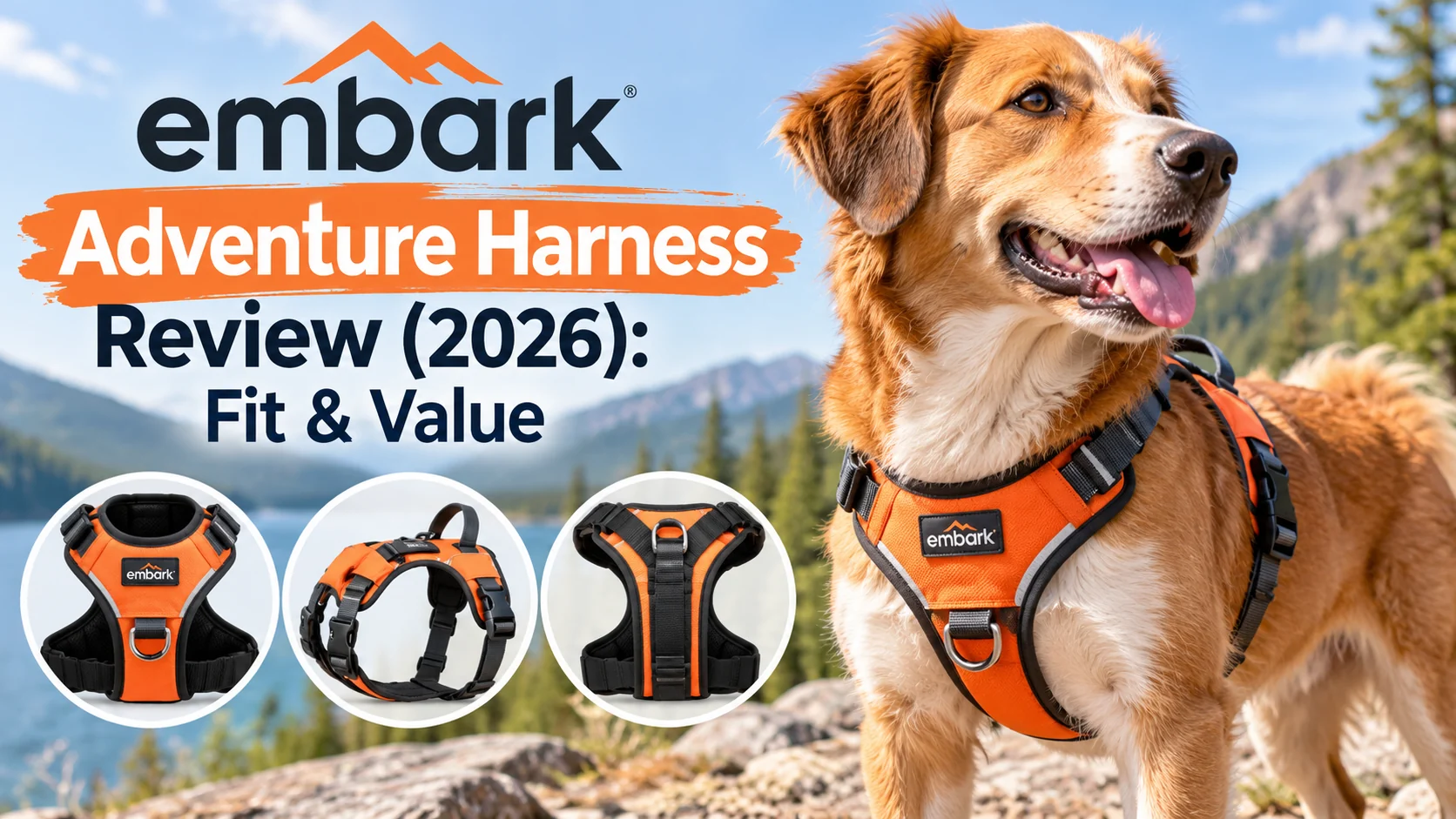
The Embark Adventure No-Pull Dog Harness is a padded, adjustable walking harness with front and rear leash attachment points. It is designed for everyday walks, leash training, and outdoor outings where owners want more control than a conventional collar provides.
This Embark Adventure Harness review covers the Small, Orange listing. Its attractions are dual leash connections, rip-stop nylon, and a control handle; accurate sizing remains essential.
Quick Verdict
Reviewed Product
Embark Adventure No-Pull Dog Harness
Padded, dual-clip everyday harness with a rear control handle.
Rating: ★★★★☆ 4.0/5
Best For: Owners seeking an adjustable daily harness and front-clip training option.
Key Specs
Rip-stop nylon • front/back leash clips • reflective trim • Small: 20–25-inch chest
Key Advantage
Two leash configurations plus a convenient rear handle.
Main Trade-off
No-pull assistance depends on training and a secure fit.
Bottom Line
A practical choice for measured, well-fitting dogs on everyday walks. Look elsewhere if you need escape-resistant construction or crash-tested vehicle restraint.

At a Glance
- Reviewed configuration: Small, Orange, with buckle closures.
- Official Small chart: 20–25-inch chest and 12–18-inch neck.
- Two leash connections: chest for training, back for routine walks.
- Materials and details: rip-stop nylon, padding, and reflective edging.
- Convenience: adjustable straps and a rear control handle.
- Care: hand washing recommended; gentle machine washing has warranty caveats.
Verified Specifications & Buyer Implications
The Small size has defined chest and neck ranges. Compare both measurements against Embark’s current chart.
| Attribute | Verified Detail | Why It Matters |
|---|---|---|
| Exact variant | Small; Orange | This is the specific option linked here. Other colors and sizes may have separate listings, so verify the selection before checkout. |
| Small sizing | Chest 20–25 in; neck 12–18 in | Both measurements matter. A suitable chest circumference cannot compensate for a neck opening that sits too loosely or tightly. |
| Main fabric | Rip-stop nylon | The manufacturer specifies a reinforced textile construction, but material selection alone cannot establish a particular service life. |
| Leash attachment | Front and rear D-rings | The rear point suits routine handling; the front point provides a direction-changing training aid rather than automatic pulling prevention. |
| Additional design | Padding, reflective trim, control handle | These support comfort, visibility when illuminated, and brief close-range guidance; none substitutes for assessing actual fit. |
Design & Build Quality
Embark specifies rip-stop nylon, reinforcement around the leash connections, and soft padding intended to reduce friction. The supplied product photograph also shows contrasting webbing, side buckles, a top handle, and reflective-looking piping.
The manufacturer advertises a high pulling-strength figure, but this is not an independently verified safe working load. Do not use the number as permission to suspend a dog or replace purpose-built lifting or restraint equipment.
The design favors active walking over minimal bulk. Inspect stitching and fasteners regularly; a product listing cannot establish long-term durability.
Setup & Ease of Use
The over-the-head design requires an initial fitting. Proper strap positioning matters more than fastening speed.
- Measure around the widest chest area and the neck before selecting Small.
- Loosen the adjustment straps, pass the neck opening over the head, and secure both side buckles.
- Center the chest piece and tighten gradually without compressing the body.
- Follow Embark’s guidance to leave approximately two fingers of clearance, then check the armpits.
- Walk several steps, turn, sit, and recheck for rotation or rubbing before a longer outing.
If the dog falls between official sizes, Embark recommends considering the larger size. That advice still requires a real fit check; extra strap length cannot always solve a mismatch in body proportions.
How This Review Was Researched
This research-based review uses Embark’s product page, official sizing chart and help center, the specified retailer variant, and manufacturer documentation for alternatives. It does not claim personal use, laboratory testing, or measured long-term durability.
Category-Specific Performance
Leash Control and Pulling
The back ring works as a conventional walking connection, while the front ring can redirect a dog that pulls forward. Embark itself explains that the front attachment is a training tool, not a guaranteed cure for leash pulling.
Use controlled, reward-based leash practice rather than relying on constant tension. The retailer’s product description advises against treating the front ring as the primary attachment for sustained heavy pulling.
Fit Security and Escape Risk
Adjustability lets owners refine the fit around the upper chest and torso. However, a determined backward-moving dog may escape a standard two-buckle harness if the openings are oversized or its body shape does not suit the pattern.
Check security with gentle, supervised movement before trusting the harness near roads. A specialized multi-strap escape-resistant harness deserves consideration for dogs known to reverse out of their gear.
Comfort and Movement
Padding helps separate structural straps from the coat, but comfort is individual rather than guaranteed by fabric alone. The manufacturer’s support team specifically acknowledges that a short chest section or poor fit can contribute to armpit rubbing.
Watch your dog walk naturally and inspect the coat after use. Discontinue wear if irritation develops, even when chest measurements technically match the published size.
Visibility and Outdoor Use
Reflective trim can make the harness more noticeable when headlights or other illumination strike it. It does not provide its own light, and it cannot replace a leash, situational awareness, or an additional visibility aid after dark.
Expert Insight
For this harness, a stable fit and correctly chosen leash ring matter more than promotional strength claims. Evaluate the dog in motion before deciding whether the design is truly suitable.
Key Features Explained
Dual Leash Attachment Points
Switching between the front and back rings offers two different handling approaches without changing equipment. If loose-leash skills are the goal, use the front connection thoughtfully and reassess the dog’s response.
Rear Control Handle
The handle offers a convenient grip when keeping a dog close in a busy setting or assisting over a minor obstacle. It has no verified rescue or full-body lifting certification, so avoid using it to hoist a dog’s complete weight.
Padded, Reflective Construction
Padding and reflective details add practical functions beyond appearance: reducing direct strap contact and improving reflected visibility. Neither removes the need for dry, clean material and consistent pressure checks.
Real-World Usability & Maintenance
Brush away debris and check buckles regularly. Remove the harness when wet or when a dog might chew it.
Embark recommends hand washing with mild, non-irritating soap and air drying. The company’s help center permits gentle machine washing, but warns that machine-washing damage is excluded from warranty coverage.
Check webbing after muddy outings. Replace damaged buckles or frayed attachment points rather than testing their remaining strength.
Pros & Cons
Pros
- Front and rear leash options.
- Padded rip-stop nylon construction.
- Rear control handle.
- Reflective trim for illuminated visibility.
Cons
- Fit depends heavily on body proportions.
- Front clip cannot replace training.
- Not certified for vehicle crash restraint.
Common Issues & Fixes
Rubbing Behind the Front Legs
Cause: Embark notes that incorrect adjustment or insufficient body length can position straps too close to the armpits.
Fix: Refit with appropriate clearance; stop using the harness if irritation persists and ask the manufacturer about sizing.
Chewed or Damaged Straps
Cause: Embark states that its harnesses are not chew-proof and chewing damage is outside its warranty.
Fix: Remove the harness when unsupervised, inspect damaged webbing, and replace compromised equipment before another walk.
What to Know Before You Buy
Check the latest official sizing chart, not only a generic breed recommendation. For this Small version, the published chest range is 20–25 inches and the neck range is 12–18 inches; an older retailer description displays different figures, so prioritize current manufacturer guidance.
Assess the dog’s escape history, training goals, and body shape before choosing a standard harness. Dogs with unusual proportions, strong backing-out habits, or mobility difficulties may need a different design even within the listed measurement range.
Embark says its harnesses have not been specifically crash-tested for car use. For vehicle travel, select a separately documented, appropriately tested restraint rather than assuming a walking harness and seat belt are equivalent.
The manufacturer currently advertises a lifetime warranty and fit support, but terms may depend on purchase channel and damage type. Confirm the terms applicable to your order instead of assuming every form of wear is covered.
Who Should Consider It / Who Should Look Elsewhere
Who Should Consider It
- Everyday walkers seeking two leash positions.
- Owners practicing gentle, consistent loose-leash training.
- Dogs comfortably within both sizing ranges.
Who Should Look Elsewhere
- Dogs that routinely escape standard harnesses.
- Owners needing certified car restraints.
- Dogs requiring dedicated mobility-lifting support.
Alternatives to Consider
The Ruffwear Front Range sizing guide compares measurement approaches. Explore our no-pull harness guide or running harness options for other needs.
Reviewed Product
Embark Adventure Harness
Best For: Everyday walking with a control handle.
Key Specs: Nylon; dual clips; padded construction.
Advantage: Training clip plus rear handle.
Trade-off: Fit-sensitive; no crash certification.
Alternative A
Ruffwear Front Range
Best For: Owners prioritizing fine-tuned everyday fit.
Key Specs: Four adjustments; two leash points; foam padding.
Advantage: Documented adjustment and ID pocket.
Trade-off: No built-in lifting handle.
Alternative B
JULIUS-K9 IDC Powerharness
Best For: Straightforward urban back-clip walks.
Key Specs: Saddle-style body; broad chest strap; rear leash ring.
Advantage: Fast-fitting city-walk design.
Trade-off: No equivalent front training clip.
Is It Worth It?
The Embark earns consideration when one harness must cover both routine walking and structured loose-leash practice. The useful combination is a padded design, two connection positions, and a close-control handle—not a promise that your dog will never pull.
Value is less convincing when the dog cannot maintain a secure, comfortable fit or needs specialist restraint. Compare live prices and return terms, then prioritize function over a small difference in upfront cost.
Final Verdict
For a dog that fits the published measurements, the Embark Adventure Harness is a strong daily-walking option with practical training versatility. Its limitations are fit sensitivity, the need for ongoing leash training, and the absence of vehicle safety certification.
Choose it for ordinary walks and supervised outings; choose a specialist harness for escape prevention, mobility assistance, or crash-tested restraint. Owners who prioritize multiple fitting adjustments can also compare the Ruffwear alternative.
Frequently Asked Questions
What size is the Small Embark Adventure Harness?
Embark’s current chart specifies a 20–25-inch chest and 12–18-inch neck. Measure the actual dog rather than choosing by breed alone.
Does the Embark Adventure Harness stop pulling?
The front connection can help redirect pulling during training. It cannot replace patient leash skills or guarantee that a strong puller will stop.
Is it suitable for puppies?
It may suit a puppy whose current measurements fit the chart securely. Recheck sizing frequently as the puppy grows and never leave a chew-prone dog wearing it unattended.
Can the Embark Adventure Harness go in the washing machine?
Embark recommends hand washing and air drying. Its support guidance allows gentle machine washing but excludes damage caused by machine washing from warranty coverage.
Can I use this harness in the car?
Do not treat it as a crash-tested vehicle restraint. Embark says its walking harnesses have not been specifically tested for that purpose.
Does it come with a warranty?
Embark’s current product page advertises a lifetime warranty. Check the applicable purchase terms; the brand explicitly excludes chewing damage and machine-washing damage.
Affiliate disclosure: Go Pet Zone earns a small commission when you purchase through links on this page — at no extra cost to you. Our editorial process is independent: affiliate relationships never influence which products we recommend or how we rank them.


