
Quick Answer
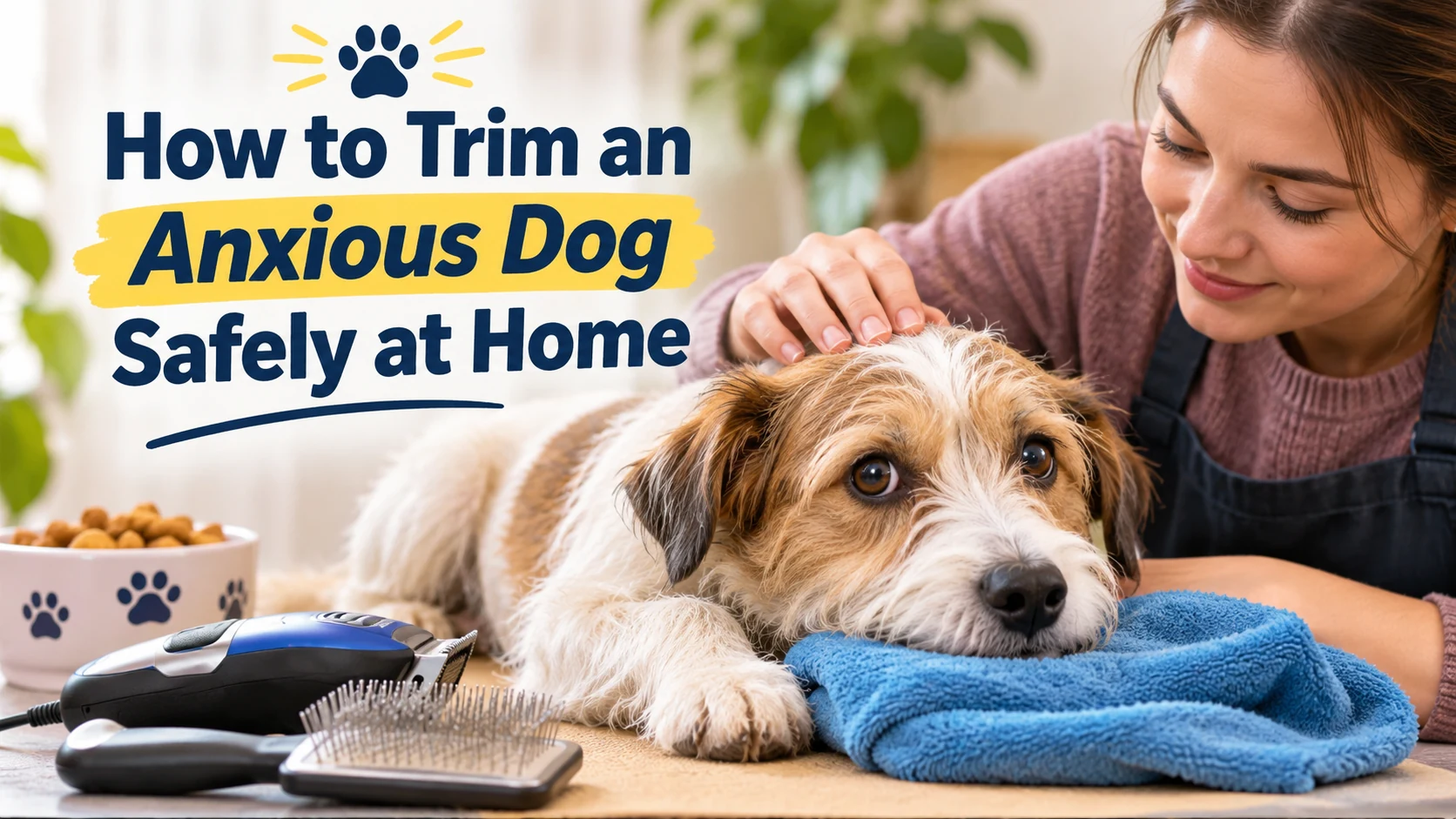
To trim an anxious dog safely, start with short, positive grooming sessions rather than a full haircut. Introduce brushes and clippers gradually, reward relaxed behavior, and trim only when your dog remains comfortable. Stop if your dog becomes frightened, struggles, or shows signs of aggression. Severe anxiety, painful matting, and difficult trimming areas require professional help.
Trying to trim an anxious dog can be stressful for both you and your pet. A dog may pull away from clippers, hide when grooming tools appear, or panic when someone touches its paws or face.
The solution is not stronger restraint or a faster haircut. It is building enough comfort with handling and grooming equipment that your dog can participate without becoming overwhelmed.
This guide explains how to prepare your dog, introduce trimming tools, recognize signs of stress, and decide which grooming tasks are safe to attempt at home.
Why Does Your Dog Become Anxious During Trimming?
Dogs become anxious during trimming for several reasons, including unfamiliar equipment, uncomfortable handling, sensitivity to noise, and previous unpleasant experiences.
Understanding the trigger helps you choose the right approach instead of assuming your dog is simply being difficult.
- Clipper noise and vibration: The sound or sensation of electric clippers may frighten noise-sensitive dogs.
- Unfamiliar handling: Some dogs dislike having their paws lifted, legs extended, or faces touched.
- Past negative experiences: Painful brushing, accidental nicks, or forceful restraint can create unpleasant associations.
- Physical discomfort: Tangled fur, irritated skin, ear problems, or joint pain may make grooming uncomfortable.
- Unfamiliar surroundings: Slippery surfaces, strange equipment, and new people can contribute to stress.
- Limited grooming experience: Dogs that have not gradually learned grooming routines may find the process confusing or frightening.
A dog that previously tolerated grooming but suddenly resists being touched should receive veterinary attention, particularly if the change involves a specific body area.
Veterinary guidance on desensitization and counterconditioning explains how gradual exposure and positive associations can help animals become more comfortable with previously frightening situations.
How Can You Tell If Your Dog Is Too Anxious to Trim?
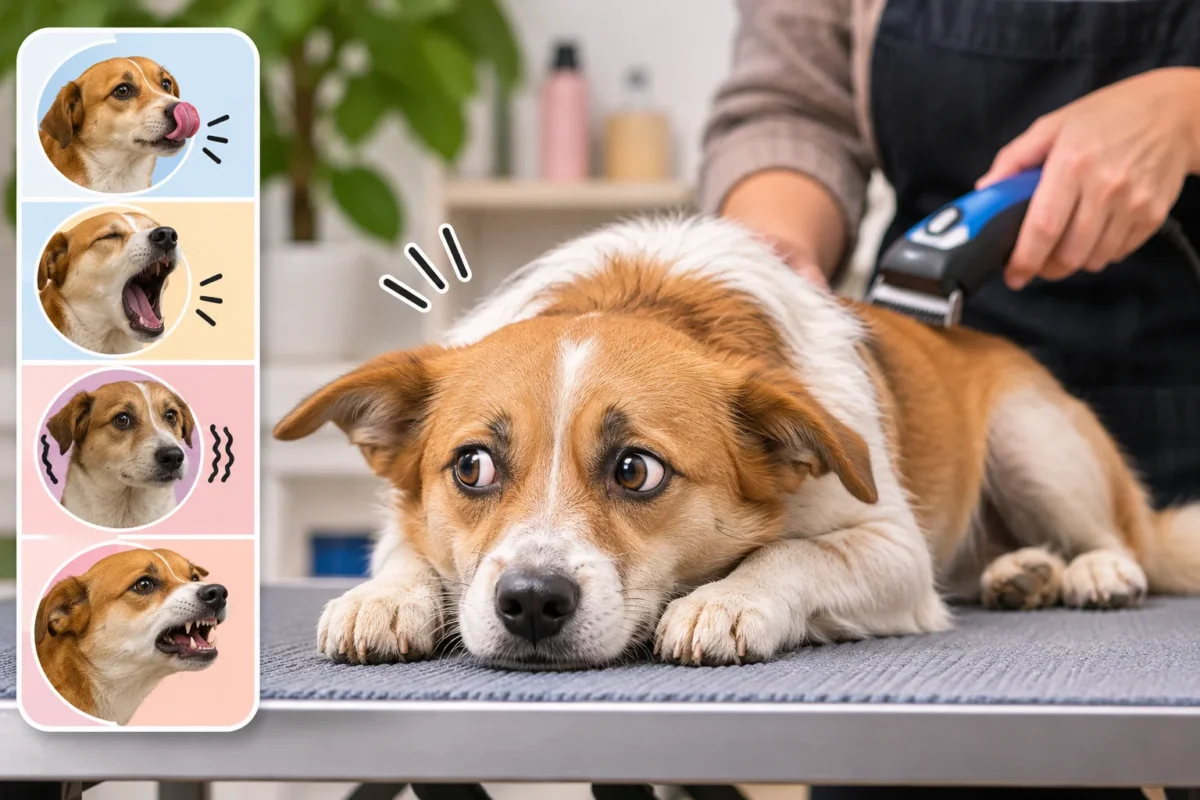
Your dog may be too anxious for trimming if it repeatedly tries to escape, becomes stiff, stops accepting treats it normally enjoys, or reacts defensively to handling.
Recognizing early discomfort is important because a dog does not need to growl or bite to show that grooming has become overwhelming.
| Behavior | Possible Meaning | What to Do |
|---|---|---|
| Relaxed posture and voluntary participation | Comfortable with the current activity | Continue gently with frequent rewards. |
| Lip licking, head turning, yawning, or avoiding contact | Possible early discomfort or stress | Pause and reduce the difficulty. |
| Trembling, repeated escape attempts, or freezing | Significant fear or distress | End the trimming attempt. |
| Growling, snapping, or biting | Defensive behavior and injury risk | Stop and seek qualified help. |
These behaviors must be interpreted in context. For example, a yawn can be ordinary behavior, while repeated yawning combined with avoidance and a tense posture may indicate stress.
Important distinction: A dog that becomes motionless is not necessarily calm. Freezing can be a fear response, especially when the dog is restrained or unable to move away.
What Should You Prepare Before Trimming an Anxious Dog?
Prepare a quiet, secure grooming area, suitable equipment, and small rewards before attempting any trimming. A predictable environment reduces unnecessary distractions and allows you to focus on your dog’s reactions.
Choose a Comfortable Grooming Space
Use a familiar room with good lighting and a non-slip floor or mat. Keep the area comfortably ventilated and avoid sudden noises or interruptions.
For many anxious dogs, a low, stable surface is easier to manage than an elevated grooming table. Never leave a dog unattended on a raised surface.
Gather Appropriate Grooming Tools
- A brush or comb appropriate for your dog’s coat
- Dog grooming clippers with suitable guards, if a haircut is necessary
- Dog nail clippers or a nail grinder for nail maintenance
- Small, high-value treats suitable for your dog
- A non-slip grooming mat
- A towel for gentle cleanup
- Styptic powder for minor nail-cutting accidents
Choose equipment based on the task and your dog’s tolerance. A quieter clipper may help a noise-sensitive dog, but even a low-noise tool requires gradual introduction.
A nail grinder is not automatically less frightening than nail clippers. Some dogs dislike its sound or vibration more than the brief sensation of clipping.
Decide What Actually Needs Trimming
Before starting, identify the essential grooming task. Your dog may need a small coat tidy, nail maintenance, or professional mat removal rather than an entire haircut.
Do not shave a double-coated dog simply to make grooming faster. Coat type, skin health, and the purpose of the trim should guide the grooming plan.
How Do You Trim an Anxious Dog Step by Step?
The safest approach is to teach your dog each part of grooming separately and attempt actual trimming only after the preceding steps are comfortable.
There is no fixed timeline. Some dogs progress through several stages quickly, while others need repeated sessions over days or weeks.
Step 1: Help Your Dog Settle Before Grooming
Begin when your dog is naturally relaxed rather than excited, exhausted, or already frightened.
Let your dog explore the grooming area without pressure. Reward calm approaches to the mat and allow the dog to leave if it becomes uncomfortable.
Do not immediately bring out clippers or attempt to restrain your dog.
Step 2: Introduce Gentle Touch and Handling
Start by briefly touching an area your dog already enjoys having handled, such as the shoulder or upper back.
Reward comfortable responses. Over successive sessions, gradually introduce the types of touch needed for grooming.
For example, touch a leg briefly before attempting to hold a paw. Increase the duration only when your dog remains relaxed and voluntarily participates.
If your dog pulls away, release the contact rather than tightening your grip.
Step 3: Let Your Dog Become Familiar With the Tools
Place the grooming equipment at a comfortable distance where your dog can notice it without becoming frightened.
Reward relaxed behavior while the tool is visible. Gradually move it closer in later sessions without touching your dog.
For electric clippers, introduce the sound separately. Switch them on at a distance, reward your dog if comfortable, and turn them off before stress increases.
Over time, you may introduce brief contact with the switched-off clipper before progressing to its vibration.
The goal is to build a positive association with the equipment, not simply make your dog endure it.
Step 4: Practice Without Cutting Any Hair
Before trimming, rehearse the grooming motion using a safe, switched-off tool. Move it slowly near a less sensitive area while rewarding relaxed behavior.
A useful technique is to teach a voluntary start position, such as resting the chin on a towel or standing on a familiar mat.
If your dog leaves the position, stop the interaction. This creates a predictable way for the dog to indicate that a pause is needed.
Do not interpret the ability to remain still under restraint as consent or comfort.
Step 5: Make One Small, Safe Trim
Once your dog comfortably accepts handling and the equipment, try a very small trim on an accessible coat area using properly guarded clippers.
Choose an area away from the eyes, ears, skin folds, genitals, and other delicate structures.
Keep the clipper positioned correctly, follow the manufacturer’s instructions, and avoid pressing the blade into the skin.
Reward your dog immediately after the brief trim.
If your dog jerks away or appears uncomfortable, stop instead of trying to complete the haircut.
Step 6: End Before Your Dog Becomes Overwhelmed
A successful session might involve only touching the brush, accepting a few strokes, or trimming a tiny section of hair.
End while your dog is still comfortable. This makes the next session easier to approach.
Do not increase the amount of grooming simply because the current session is going well. Gradual progress is generally more useful than attempting too much at once.
Practical Tip
Treat the first few sessions as training rather than haircut appointments. A relaxed dog that accepts a grooming tool for a few seconds has made useful progress, even if no hair is removed.
How Can You Trim an Anxious Dog’s Nails Safely?
Nail trimming requires a separate introduction because paw handling and nail pressure can be especially uncomfortable for some dogs.
Start by teaching your dog to accept brief paw contact. Then introduce the nail tool without using it. Only progress to cutting when your dog remains comfortable throughout the sequence.
- Touch your dog’s shoulder or leg briefly and reward a relaxed response.
- Gradually work toward touching and briefly holding a paw.
- Show the nail clippers or grinder and pair their appearance with rewards.
- Practice positioning the tool near a nail without cutting.
- When your dog is comfortable, remove only a tiny amount from one nail.
- Reward your dog and stop before stress increases.
Avoid cutting the quick, the sensitive inner portion of a nail containing blood vessels and nerves. The quick can be harder to identify in dark nails.
According to VCA Animal Hospitals’ nail-trimming guidance, making small, gradual cuts helps reduce the risk of cutting into the quick.
If you accidentally cut the quick, use styptic powder and gentle pressure as appropriate. Seek veterinary care if bleeding does not stop promptly or your dog has significant pain.
If your dog is frightened by paw handling, do not force the nail trim. A veterinarian or qualified groomer can help you develop a safer plan.
Which Areas Should You Avoid Trimming at Home?
For a dog that is anxious, moves suddenly, or resists handling, avoid attempting detailed trimming around delicate body areas.
These areas include:
- Eyes and face: Unexpected movement can cause serious injury.
- Ear edges: Thin skin can be accidentally caught by cutting equipment.
- Armpits and groin: Loose skin and folds are vulnerable to clipper injuries.
- Paw pads: Tight spaces and sudden paw movement increase the difficulty.
- Tail and sanitary areas: Sensitive structures require careful handling.
- Severely matted areas: Mats may pull skin into the cutting path and conceal irritation.
A cooperative dog may tolerate some of these procedures with a properly trained groomer. That does not make them appropriate beginner tasks for an anxious dog at home.
Safety Warning
Never use scissors to cut tightly matted fur close to the skin, especially on a frightened or moving dog. Skin can become trapped within a mat. Arrange professional removal rather than attempting to cut through it.
What Should You Do If Your Dog Panics During Grooming?
If your dog panics, stop trimming immediately, remove the active tool, and give your dog space to recover in a safe environment.
Do not punish growling, force the dog back into position, or continue trimming while it struggles.
After the session, consider what happened immediately before the reaction:
- Did the clippers make a sudden noise?
- Was the dog uncomfortable when a particular body part was touched?
- Did the session become longer or more demanding than usual?
- Was there pulling from tangled hair?
- Was the dog unable to move away?
Use this information to make future training easier. For example, if your dog reacted when the clipper was switched on nearby, return to rewarding calm behavior while the sound plays at a greater distance.
If your dog continues to become frightened, consult a qualified positive-reinforcement trainer, veterinary behavior professional, or veterinarian rather than repeatedly testing its tolerance.
How Do You Make Future Grooming Sessions Less Stressful?
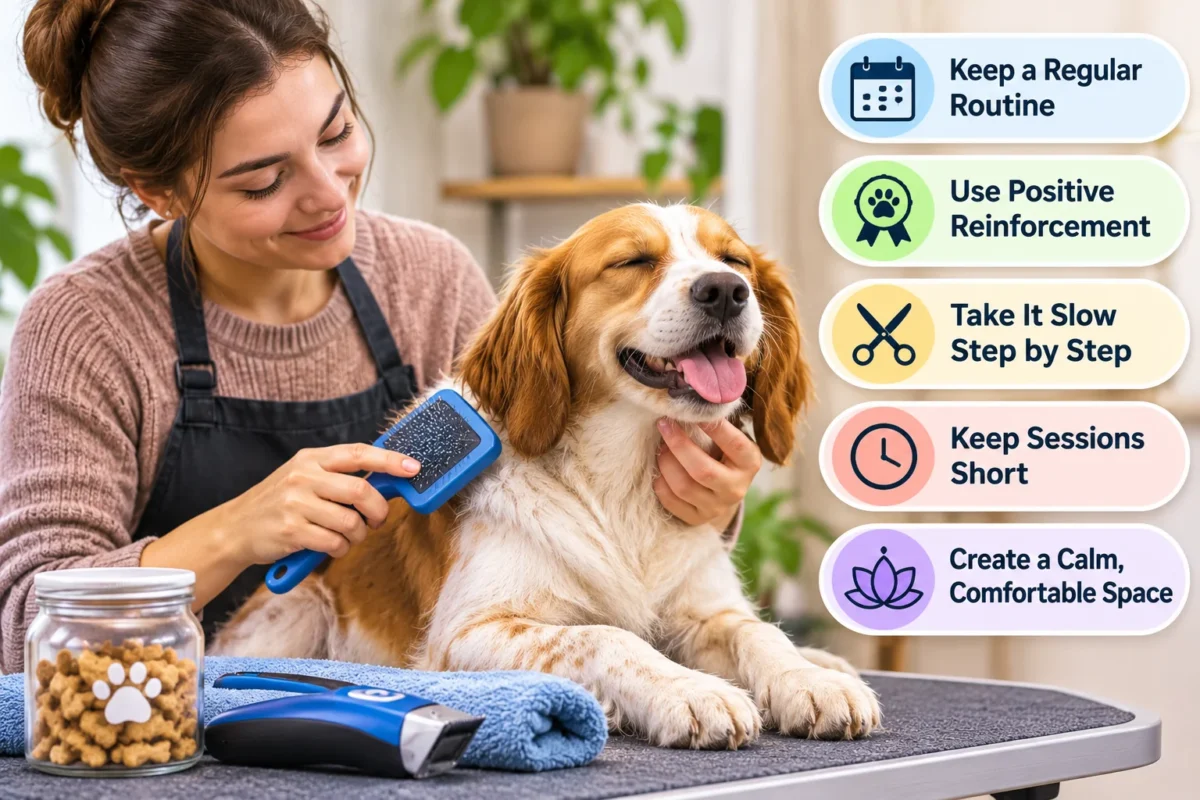
Regular, low-pressure practice is more useful than waiting until an urgent haircut becomes necessary.
Dogs can gradually learn to cooperate with handling when the process is predictable, rewarding, and kept within their comfort level.
Build a Simple Training Routine
Practice one small grooming skill at a time. The following is an example progression, not a strict schedule.
| Training Stage | Practice Activity | Progress When |
|---|---|---|
| Comfort with the space | Explore the grooming mat and receive treats. | The dog approaches voluntarily. |
| Comfort with handling | Practice brief, gentle touch. | The dog remains relaxed. |
| Comfort with equipment | Show tools and introduce sound gradually. | The dog can comfortably remain near them. |
| Comfort with grooming | Attempt a brief brush or small safe trim. | The dog willingly participates. |
Repeat a stage when needed. Progress is not always linear, and an anxious dog may be more sensitive on days when it is tired, unwell, or uncomfortable.
Use Positive Reinforcement Consistently
Offer a valued reward for the behavior you want to encourage, such as approaching the grooming mat or allowing brief contact.
A food reward can be useful, provided your dog is comfortable and willing to eat. Do not use food merely to distract a terrified dog while forcing a haircut.
The VCA handling-exercise guide provides additional examples of gradually teaching dogs to accept routine care.
Maintain the Coat Between Haircuts
Gentle brushing helps prevent tangles from becoming difficult grooming problems. Choose a brush suitable for your dog’s coat and work on small sections without pulling at knots.
Some long or curly coats require frequent maintenance, while short coats often need less intensive brushing. Adapt the routine to the coat and your dog’s comfort.
If brushing reveals painful matting, skin redness, or an area your dog will not let you touch, stop and seek professional advice.
When Should You Choose a Professional Groomer or Veterinarian?
Choose professional help when your dog’s anxiety creates a bite or injury risk, grooming is painful, or important hygiene tasks cannot be completed safely at home.
A groomer experienced with fearful dogs may offer shorter appointments, quiet scheduling, gradual introductions, and modified grooming plans.
Before booking, ask how the groomer handles frightened dogs, whether breaks are possible, and what happens if the dog cannot safely complete the session.
Veterinary assessment is particularly appropriate when:
- Your dog’s grooming resistance begins suddenly.
- The dog reacts painfully to touching a specific area.
- Severe matting is associated with sore or irritated skin.
- Nails are overgrown, injured, or growing into the paw pad.
- Your dog repeatedly panics, growls, snaps, or attempts to bite.
- Previous attempts at gradual training have not made essential care possible.
In some circumstances, a veterinarian may recommend behavior treatment or prescribe medication to reduce distress during necessary grooming. Sedation decisions require veterinary assessment and should never be improvised at home.
Professional discussion of fear-aware grooming and veterinary support emphasizes adapting care to the individual animal rather than relying on forced handling.
Frequently Asked Questions About Trimming an Anxious Dog
Can I Trim My Dog If It Is Shaking?
No. If your dog is shaking from fear, stop trimming and allow it to recover. If trembling is unexplained, persistent, or accompanied by signs of pain or illness, contact a veterinarian.
Are Quiet Clippers Better for Anxious Dogs?
Quiet clippers may help dogs that are sensitive to loud noises, but they do not eliminate grooming anxiety. Introduce any clipper gradually and watch your dog’s response to both its sound and vibration.
How Long Does It Take to Help a Dog Accept Grooming?
There is no universal timeline. A mildly nervous dog may make progress relatively quickly, while a dog with established fear may need weeks or longer of gradual training. Progress should depend on comfort rather than a deadline.
Should I Hold My Dog Still While Trimming?
Use only gentle, necessary positioning with a dog that is comfortable being handled. Do not forcibly restrain a frightened or struggling dog to finish trimming. Stop and seek professional guidance if safe cooperation is not possible.
Can I Use Calming Medication Before Grooming?
Only use calming or sedating medication when a veterinarian recommends it for your individual dog. Never give human sedatives or another pet’s medication to make grooming easier.
Is It Better to Trim an Anxious Dog at Home or at a Salon?
Home trimming may be suitable for simple tasks when your dog is comfortable and cooperative. A patient, experienced professional may be safer for detailed haircuts, severe matting, or tasks your dog cannot tolerate at home. Significant fear or suspected pain warrants veterinary input.
Final Thoughts: Make Comfort the First Priority
Learning how to trim an anxious dog begins with changing the grooming experience, not perfecting the haircut.
Start with calm handling, introduce equipment gradually, reward voluntary participation, and work in small, manageable stages. Never push through panic to finish a grooming task.
If your dog cannot tolerate necessary trimming safely, a qualified groomer or veterinarian can help create a plan that protects both your dog’s welfare and your safety.


