
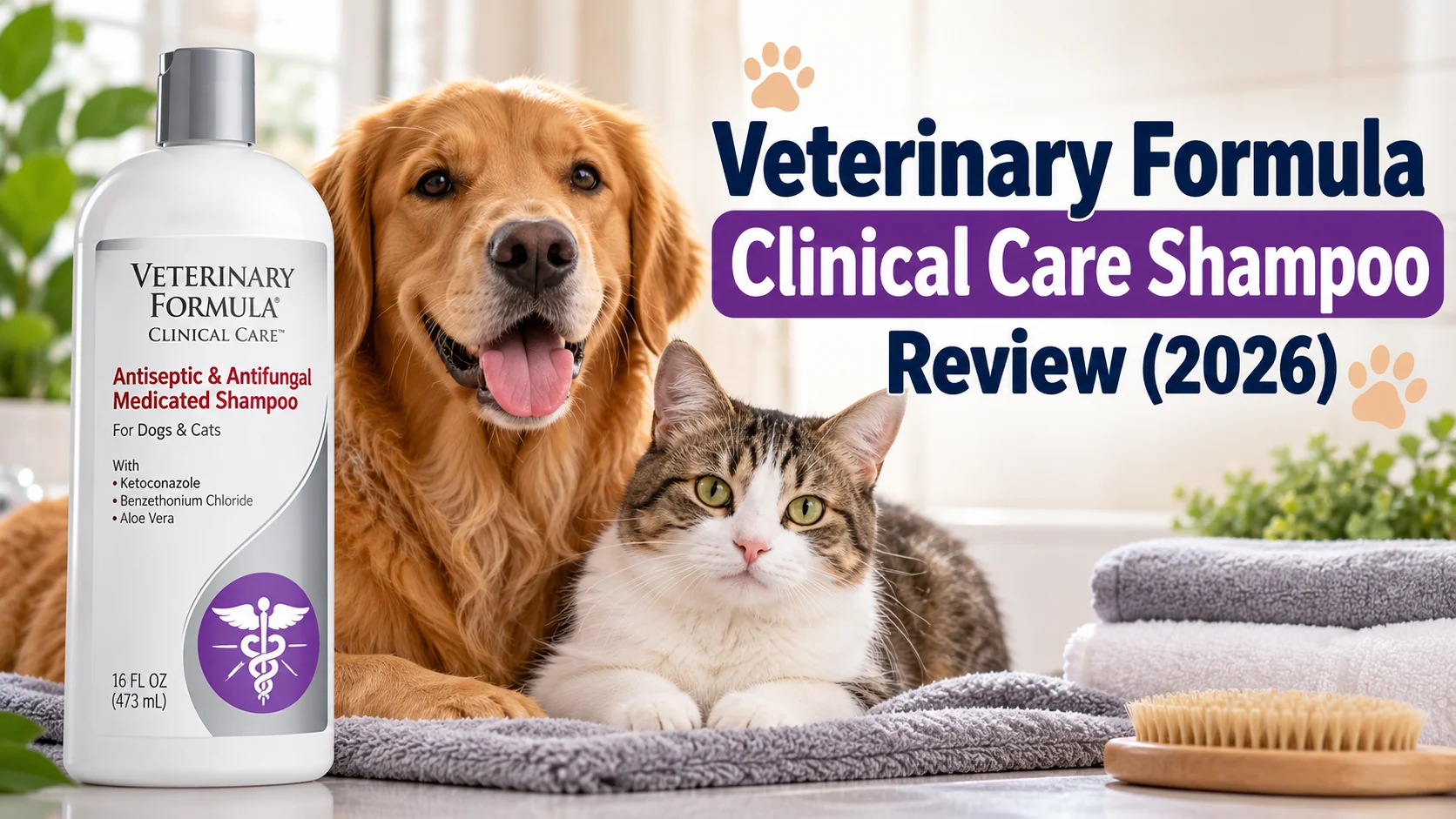
Veterinary Formula Clinical Care Antiseptic & Antifungal Medicated Shampoo is a topical pet shampoo formulated with ketoconazole and benzethonium chloride. It is designed to cleanse dogs’ and cats’ coats while supporting skin affected by yeast-related irritation, odor, scaling, and greasiness.
This Veterinary Formula Clinical Care Shampoo review examines the 16 fl oz Antiseptic & Antifungal version, not the brand’s different antiparasitic shampoo. The important buying question is whether your pet needs medicated antimicrobial bathing rather than an ordinary grooming shampoo.
Quick Verdict
Reviewed Product
Veterinary Formula Clinical Care Antiseptic & Antifungal Shampoo
A rinse-off medicated cleanser for dogs and cats with bacterial- or yeast-associated skin concerns.
Rating: ★★★★☆ 4.0/5
Best For: Owners following a veterinarian’s plan for mild, widespread skin yeast or bacterial concerns.
Key Specs: 16 fl oz (473 mL) • ketoconazole 1% • benzethonium chloride 0.2% • dogs and cats 12 weeks and older.
Combines antifungal and antiseptic ingredients in one wash.
Requires timed contact and is not suitable for every skin problem.
Bottom Line: A sensible, targeted option when medicated bathing is appropriate; recurring or severe symptoms still need veterinary assessment.

At a Glance
- Product: Antiseptic & Antifungal Medicated Shampoo, 16 fl oz.
- Pets: Dogs and cats aged 12 weeks or older.
- Purpose: Support cleansing where bacteria or yeast may contribute to skin problems.
- Contact time: Leave lather on for 5–10 minutes before rinsing.
- Formula: Paraben-, dye-, and soap-free; contains fragrance.
- Boundary: Not a flea, mite, or general-purpose parasite treatment.
Verified Specifications & Buyer Implications
The active ingredient concentrations and directions are documented on the manufacturer’s current product page and the product-label record. These details matter more than broad marketing terms such as “clinical care.”
| Attribute | Verified Detail | Why It Matters |
|---|---|---|
| Active antifungal | Ketoconazole USP, 1% | Ketoconazole targets fungal and yeast organisms. Its inclusion supports a medicated skin-cleansing role, but does not establish that a shampoo alone will cure every infection. |
| Antiseptic ingredient | Benzethonium chloride, 0.2% | This ingredient is included to address bacterial growth on skin. It complements the antifungal ingredient rather than replacing a diagnosis of the underlying condition. |
| Bottle size | 16 fl oz / 473 mL | A defined bottle volume helps owners assess likely bathing needs. Usage per bath will vary considerably with pet size, coat density, and affected area. |
| Application | 5–10-minute lather contact | The shampoo needs time on the skin before removal. Owners unable to keep an animal comfortable and supervised during this interval may prefer another treatment format. |
| Other ingredients | Aloe vera; fragrance | Aloe is included as a supportive skin-care ingredient. Added fragrance is relevant for pets with suspected product sensitivities, so read the current bottle label. |
Design & Build Quality
This is a liquid, rinse-off grooming treatment rather than a leave-on spray or prescription oral medication. Its straightforward bottle format allows application across larger coat areas, although dispensing convenience and bottle durability were not independently tested.
The manufacturer lists aloe vera among the inactive ingredients and describes the formulation as free from parabens, dyes, and soap. Those exclusions do not mean the product is fragrance-free, hypoallergenic, or incapable of causing irritation.
Setup & Ease of Use
No assembly is involved, but successful use requires access to water, complete rinsing, and a pet willing to tolerate a short waiting period. Follow the specific bottle directions and any separate instructions from your veterinarian.
- Wet the coat thoroughly, then apply shampoo to reach the skin.
- Massage into a lather, including affected body areas as appropriate.
- Leave in place for 5–10 minutes without allowing licking.
- Rinse thoroughly and keep shampoo away from eyes and mouth.
- Use twice weekly until improvement, then weekly for maintenance if appropriate.
For practical bathing preparation, see our guide to bathing a dog safely at home. Cats may require particularly careful handling and veterinary guidance before any medicated bath.
How This Review Was Researched
This assessment compares the manufacturer’s ingredient and usage information, published product-label directions, veterinary dermatology guidance, and two documented alternatives. It is research-based; no firsthand bath, lab test, or clinical outcome is claimed.
Category-Specific Performance
Yeast-Related Skin Concerns
Ketoconazole is an antifungal ingredient, making this formula relevant when yeast is part of a veterinarian-identified skin problem. However, itchy paws, odors, and red patches can have several causes and should not be diagnosed by appearance alone.
A rinse-off application provides contact during bathing but does not substitute for treating allergies or other underlying triggers. Persistent yeast problems may need a treatment plan that extends beyond shampoo.
Surface Bacterial Cleansing
Benzethonium chloride provides the antiseptic component of the formula, which distinguishes it from a basic cleansing shampoo. Its concentration is verified, but independent comparative performance testing against stronger chlorhexidine shampoos was not available for this review.
Veterinary guidance emphasizes matching topical treatment to the infection and affected body area. A small localized problem may need a wipe or another targeted treatment rather than a full-body bath.
Oil, Scaling, and Coat Odor
The manufacturer positions the product for scaly, greasy, red, or malodorous skin as well as cleansing the coat. Removing surface debris and oil may improve cleanliness, although coat appearance alone cannot confirm whether an infection has resolved.
For predominantly oily seborrhea without a diagnosed bacterial or yeast component, a different shampoo category may be more appropriate. This product should not be confused with Veterinary Formula’s coal-tar-and-salicylic-acid antiparasitic/antiseborrheic variant.
Contact Time and Bathing Practicality
The specified five-to-ten-minute contact period is a real usability requirement, not an optional marketing detail. Thick coats may take more effort to wet down to the skin and rinse completely.
Expert Insight: Medicated shampoo selection depends on the suspected organism, lesion location, and underlying cause. The Merck Veterinary Manual describes topical therapy as important, but does not establish this particular shampoo as effective for every case.
Key Features Explained
Ketoconazole 1%
The documented antifungal ingredient makes this wash more purpose-specific than ordinary deodorizing shampoo. The number on the label describes concentration, not a guaranteed cure rate or a prediction of how quickly your pet will improve.
Benzethonium Chloride 0.2%
This antiseptic ingredient broadens the formula’s intended role beyond yeast-focused cleansing alone. It does not make the shampoo a replacement for testing, prescription treatment, or assessment of painful and spreading lesions.
Aloe Vera and Soap-Free Cleansing
The manufacturer includes aloe and omits soap, parabens, and dyes, positioning the wash as medicated cleansing with supportive skin care. Owners seeking a truly fragrance-free product should look elsewhere, because fragrance appears in the ingredient list.
Real-World Usability & Maintenance
The biggest ongoing commitment is repeated bathing rather than equipment maintenance. The product label directs twice-weekly use until the condition improves, followed by weekly bathing; your veterinarian may recommend a different schedule.
Keep the original bottle tightly closed in a cool, dry location away from direct sunlight, as the published label advises. Monitor for new redness or discomfort after bathing and stop using the product if irritation increases.
A pet with healthy skin generally does not need ongoing antiseptic treatments simply for odor control. If routine cleaning is the goal, compare a gentler grooming product such as the one discussed in our Earthbath shampoo review.
Pros & Cons
Pros
- Verified antifungal and antiseptic actives
- Suitable for eligible dogs and cats
- Clear contact-time directions
- Soap-, dye-, and paraben-free
Cons
- Contains added fragrance
- Requires repeated, timed baths
- Cannot diagnose or resolve underlying disease
Common Issues & Fixes
Pet Licks During Contact Time
Cause: Shampoo remains on the coat while the active ingredients contact the skin.
Fix: Supervise closely, prevent licking, and rinse fully after the specified interval.
Redness or Irritation Increases
Cause: The skin may react to an ingredient, or the condition may be worsening.
Fix: Discontinue the wash and seek veterinary advice, as the label directs.
Skin Symptoms Return
Cause: An untreated underlying condition can allow skin problems to recur.
Fix: Ask a veterinarian about diagnosis and a long-term plan instead of increasing bathing independently.
What to Know Before You Buy
First confirm the exact name on the bottle: Antiseptic & Antifungal. The similarly branded Antiparasitic & Antiseborrheic shampoo has a different ingredient system, intended use, and species restrictions.
This formula is labeled for dogs and cats at least 12 weeks old, but an age statement does not guarantee suitability for every pet. Animals with open wounds, severe discomfort, widespread hair loss, or persistent lesions warrant veterinary assessment.
It is not formulated to kill or prevent mites and should not replace flea prevention. Suspected ringworm, rapidly spreading infection, or a pet becoming unwell also requires veterinary guidance rather than a trial-and-error shampoo purchase.
Who Should Consider It / Who Should Look Elsewhere
Who Should Consider It
- Owners managing diagnosed yeast-related skin concerns
- Pets prescribed repeated medicated bathing
- Households needing a dog-and-cat-labeled wash
Who Should Look Elsewhere
- Pets needing ordinary routine grooming
- Pets with known fragrance sensitivity
- Owners seeking flea or mite control
Alternatives to Consider
These three shampoos serve overlapping but distinct needs; they are not interchangeable treatments. Ask your veterinarian which active ingredients fit the specific skin findings before switching.
Reviewed Product
Veterinary Formula Clinical Care Antiseptic & Antifungal
Best For: Owners wanting a combined antifungal and antiseptic wash.
Key Specs: Ketoconazole 1%; benzethonium chloride 0.2%; 16 fl oz.
Advantage: Two complementary actives in one product.
Trade-off: Contains fragrance and needs timed baths.
Alternative A
DOUXO S3 PYO Shampoo
Best For: Owners seeking a chlorhexidine-based option with barrier-support ingredients.
Key Specs: Chlorhexidine digluconate 3%; Ophytrium 0.5%; 200 or 500 mL.
Advantage: Manufacturer documents antiseptic and hydrating roles.
Trade-off: Different actives; not an equivalent ketoconazole formulation.
Alternative B
Dechra MiconaHex+Triz Shampoo
Best For: Owners directed toward miconazole-and-chlorhexidine therapy.
Key Specs: Miconazole nitrate 2%; chlorhexidine gluconate 2%; TrizEDTA.
Advantage: Adds ceramide-based skin-barrier support.
Trade-off: Treatment choice should match veterinary findings.
Is It Worth It?
For a pet with an appropriate veterinary indication, the product offers an identifiable combination of antifungal and antiseptic ingredients in a single rinse-off shampoo. That specificity is more valuable than a generic “itch relief” promise when a skin problem has already been assessed.
Value is harder to establish without a reliably comparable current price or independent head-to-head testing. If you need fragrance-free maintenance bathing, parasite control, or a different antimicrobial regimen, the main formula is a poor match regardless of cost.
Final Verdict
Veterinary Formula Clinical Care Antiseptic & Antifungal Shampoo is a strong option for targeted medicated bathing when its documented ingredients align with your pet’s needs. Its limitations are the required contact time, fragrance, and inability to address underlying disease by itself.
Consider it with veterinary guidance for relevant skin concerns; choose a standard shampoo for healthy coats or a different medicated formulation when diagnosis calls for one. Our research-based editorial rating is 4.0/5.
Frequently Asked Questions
Can dogs and cats use this shampoo?
Yes, the product label specifies both species from 12 weeks of age. Check with a veterinarian when your pet has a diagnosed condition, other treatments, or unusual sensitivity.
How long should I leave it on?
Leave the lather on for 5–10 minutes before rinsing thoroughly. Prevent licking and avoid the eyes during application.
How often should I bathe my pet with it?
The published label directs twice-weekly use until improvement, followed by weekly maintenance. Follow individualized veterinary instructions when they differ.
Does it kill fleas or mites?
No, it is not formulated as flea or mite control. Veterinary Formula identifies a different product for parasitic-related concerns, and pets need appropriate parasite prevention.
Can it cure ringworm or a serious skin infection?
Do not rely on this shampoo alone to diagnose or cure either condition. Ringworm can spread between animals and people, and serious infections require veterinary evaluation.
Is the formula fragrance-free?
No, fragrance is listed among the inactive ingredients. Its soap-, dye-, and paraben-free formulation should not be mistaken for a fragrance-free product.
Affiliate disclosure: Go Pet Zone earns a small commission when you purchase through links on this page — at no extra cost to you. Our editorial process is independent: affiliate relationships never influence which products we recommend or how we rank them.


