
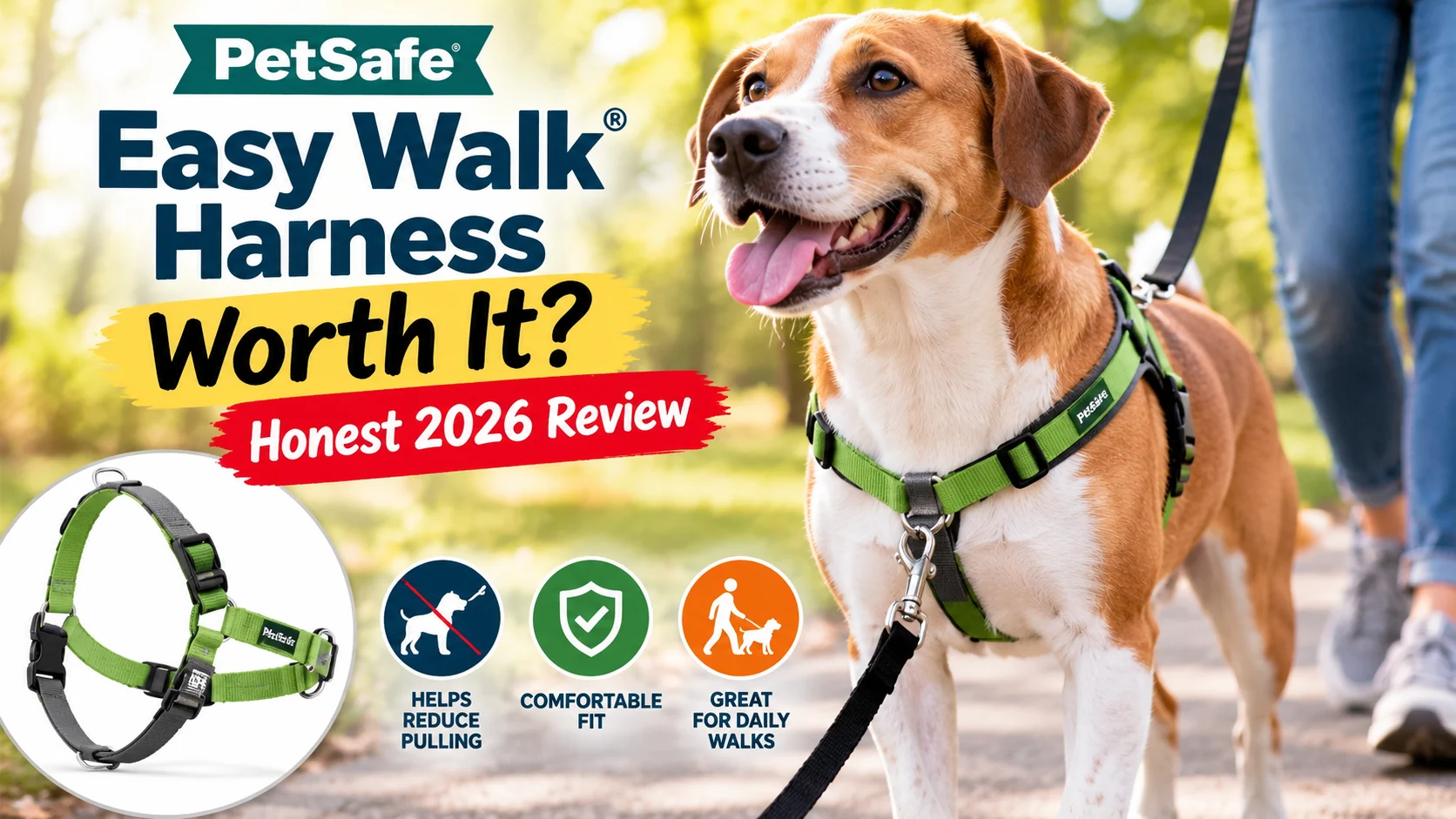
The PetSafe Easy Walk Harness is a front-clip, no-pull dog training harness designed to help handlers redirect dogs that strain against a leash. The specific version reviewed here is the Small/Medium harness in Apple Green/Gray, a lightweight strap-style option for everyday loose-leash practice.
So, is the PetSafe Easy Walk Harness worth it? Its chest attachment helps, but fitting and reward-based training remain essential.
Quick Verdict
REVIEWED PRODUCT
PetSafe Easy Walk Harness — Small/Medium
Front-clip training harness for dogs learning to walk without pulling.
Rating: ★★★★☆ 4.0/5
Best For: Owners practicing controlled, loose-leash walks with dogs that pull.
Key Specs: Front chest attachment • Martingale loop • Four adjustment points • Small/Medium fit
Redirects forward pulling without attaching the leash at the throat.
Fit errors can cause armpit rubbing or strap movement.
Bottom Line: A sensible walking-training tool when the chest and girth measurements match. Choose a different design if shoulder comfort or multiple attachment positions is the priority.

At a Glance
- Exact listing: Small/Medium, Apple Green/Gray; not the Deluxe model.
- Purpose: Discourage leash pulling during guided walking sessions.
- Leash connection: One D-ring on the front martingale loop.
- Adjustability: Four adjustment points and contrasting belly strap.
- Included: Harness and fitting guide, according to PetSafe.
- Biggest purchase risk: Wrong chest width or girth measurement.
Verified Specifications & Buyer Implications
The Small/Medium size has a manufacturer-listed front chest width of 11–13 inches and body girth of 19–26 inches. Choosing by weight alone is unreliable.
| Attribute | Verified Detail | Why It Matters |
|---|---|---|
| Reviewed size | Small/Medium | The stated range applies to this listing, not every Easy Walk size. Measure before ordering because dogs of similar weight can have different chest proportions. |
| Chest width | 11–13 inches | Determines whether the front strap can sit across the chest without being pulled too tight or letting the harness shift. |
| Body girth | 19–26 inches | Helps keep the shoulder and belly straps correctly positioned behind the legs. A loose girth can allow irritating strap movement. |
| Leash hardware | Front D-ring with martingale loop | Provides an angle for redirecting forward movement. It does not offer the back-clip or double-ended leash setup available on some alternatives. |
| Adjustment | Four points; quick-snap straps | Lets the owner refine fit around the dog’s shape. Correct adjustment takes more attention than simply fastening the buckles. |
Design & Build Quality
The original Easy Walk uses a minimal nylon-webbing layout with a chest strap, shoulder strap, belly strap and metal leash ring. It is less bulky than padded harnesses but offers little cushioning.
The chest loop is the functional centerpiece, while contrasting belly-strap coloring helps distinguish the lower strap during dressing. Inspect stitching, buckles and webbing regularly.
Setup & Ease of Use
PetSafe prioritizes proper placement. Fit a standing dog calmly before walking.
- Place the shoulder strap over the head and position its side rings just behind the shoulders.
- Fasten and snug the contrasting belly strap, keeping it clear of the armpits.
- Adjust both sides of the horizontal chest strap equally, centering the martingale loop.
- Check for a secure one-to-two-finger fit and a sideways T shape from the side.
- Attach a standard four-to-six-foot leash to the front D-ring and test movement gently.
Recheck the fit after several minutes because a dog may tense during fitting.
How This Review Was Researched
This research-based review checks the named Amazon variant against PetSafe’s current product page, fitting instructions and training guidance, then compares documented features from alternative manufacturers. No firsthand wear testing, gait testing or long-term durability testing is claimed.
Walking Performance
Pulling Control and Redirection
A front-mounted leash changes the direction of pressure when a dog moves ahead, allowing the handler to guide it back instead of opposing force directly. PetSafe describes its martingale loop as applying gradual shoulder pressure when the leash tightens.
That may interrupt pulling, but training remains necessary. Strong pullers may need professional guidance.
Comfort and Shoulder Movement
The strap crosses the front of the chest rather than lying around the throat, which is a meaningful difference from attaching a leash to a neck collar. However, its placement can affect how comfortable an individual dog feels while moving.
Veterinary guidance cautions that some chest-crossing no-pull styles can press near shoulder joints; fit and gait should be assessed dog by dog. Stop using this setup if you see chafing, an altered stride or repeated discomfort.
Control in Everyday Walking
The single front clip is straightforward, but distractions and handler skill still matter.
The manufacturer’s training guidance recommends a standard four-to-six-foot leash rather than a retractable or bungee model. Sudden jerks undermine the gentle redirection that the front connection is intended to provide.
Expert Insight: Think of the Easy Walk as a communication aid, not a mechanical cure for pulling. Rewarding the dog when leash tension disappears is what turns momentary redirection into a learnable walking habit.
Key Features Explained
Front Martingale Loop
The leash clips to a D-ring on a short sliding front loop, which responds to forward leash tension. Its role is to redirect movement during training, not to squeeze the dog continuously or replace proper leash handling.
Four-Point Adjustment
Multiple strap sliders let handlers correct front-strap centering and body fit independently. Fit flexibility helps, but adjustments cannot rescue a fundamentally wrong size.
Minimal, Two-Tone Strap Layout
The contrasting underside is a practical orientation cue when putting the harness on. Its simple webbing structure also avoids the bulk of a padded vest, though dogs needing extra cushioning may be happier with another construction.
Real-World Usability & Maintenance
PetSafe instructs owners to remove the Easy Walk between walks rather than leaving it on all day. That reduces the opportunity for chewing, catching the harness on objects or repeated rubbing during unsupervised activity.
After a walk, check the underarm area for redness, ensure the front loop remains centered and confirm that adjustments have not slipped. If the harness becomes dirty, follow its care label or current PetSafe support instructions rather than assuming a machine-washing method.
Keep a regular flat leash available and store the harness dry, away from a dog that chews gear. For comparisons, our no-pull dog harness comparison explains why different attachment systems suit different handlers.
Pros & Cons
Pros
- Chest leash point aids controlled redirection.
- Four adjustment positions support precise fitting.
- Lightweight, low-coverage strap design.
- Contrasting belly strap simplifies orientation.
Cons
- Can rub when girth or chest fit is wrong.
- Only one leash attachment position.
- Less cushioning than padded alternatives.
Common Issues & Fixes
Straps Rub Behind the Front Legs
Cause: PetSafe identifies a loose girth or over-tightened chest strap as reasons the belly strap can drift into the armpits.
Fix: Snug the girth, relax the chest strap and verify that the selected size matches both measurements.
Harness Rotates During Walks
Cause: A loose foundation or off-center front loop allows the harness to move when leash pressure changes.
Fix: Readjust the shoulder and belly fit, then center the loop by changing both chest sliders evenly.
Dog Continues Pulling
Cause: A harness changes leverage, but it cannot teach loose-leash behavior without consistent feedback.
Fix: Stop or slow when tension develops, reward loose-leash walking and use short practice sessions.
What to Know Before You Buy
Measure horizontally across the front chest and around the deepest part of the ribcage behind the front legs. For this Small/Medium version, the verified ranges are 11–13 inches across the chest and 19–26 inches at the girth; PetSafe advises sizing up if the dog falls between sizes.
The approximate weight guidance for Small/Medium is 20–30 pounds, but physical measurements take priority. Never assume a breed label will predict body proportions accurately, and do not buy this harness solely because the dog fits its suggested weight band.
Consider how the harness will be used: short leash-training outings are different from all-day hiking, running or prolonged wear. Dogs with pain, mobility problems or persistent shoulder rubbing may benefit from an individualized recommendation from a veterinarian or qualified fitting professional.
Who Should Consider It / Who Should Look Elsewhere
Who Should Consider It
- Owners teaching calmer leash walking.
- Dogs fitting the published chest and girth ranges.
- Handlers wanting a simple front-clip design.
Who Should Look Elsewhere
- Dogs uncomfortable with chest-crossing straps.
- Owners needing a back attachment point.
- Dogs whose measurements fall outside this size.
Alternatives to Consider
Two established alternatives change the fit or leash-handling options rather than simply duplicating the Easy Walk. Our Embark Adventure Harness review also covers a different everyday harness style.
REVIEWED PRODUCT
PetSafe Easy Walk
Best For: Focused leash-pulling practice.
Key Specs: Front chest clip; martingale loop; four adjustments.
Advantage: Straightforward redirecting setup.
Trade-off: No rear leash connection.
ALTERNATIVE A
Blue-9 Balance Harness
Best For: Fit flexibility and movement.
Key Specs: Six adjustments; front/back rings; neck buckle.
Advantage: More adjustment locations.
Trade-off: More fitting decisions.
ALTERNATIVE B
2 Hounds Freedom No-Pull
Best For: Dual-connection leash control.
Key Specs: Front/back rings; rear martingale; velvet lining.
Advantage: Two-point guiding option.
Trade-off: Double-ended leash adds complexity.
Is It Worth It?
Yes, for the buyer who wants a relatively uncomplicated front-attachment training harness and is willing to fit it carefully. The design directly addresses pulling redirection, and the manufacturer’s detailed fit instructions make its intended use unusually clear.
Its value drops when a dog’s build places the strap against the armpits or shoulder area, or when the owner needs a back-clip option. In those cases, the Balance Harness or Freedom Harness may better match the intended routine.
Final Verdict
The PetSafe Easy Walk Harness is a strong option for teaching loose-leash walking, particularly when a dog measures comfortably within the Small/Medium range. Its front martingale attachment is useful, while fitting sensitivity and the single connection point remain its key compromises.
Choose it for supervised walking practice, not as a substitute for patient training or a continuously worn harness. If your dog moves awkwardly in a chest-crossing design, prioritize comfort and choose another fit.
Frequently Asked Questions
Does the PetSafe Easy Walk Harness stop pulling immediately?
It can help redirect pulling, but it does not guarantee instant leash manners. PetSafe recommends rewarding the dog when it returns to your side and the leash becomes loose.
What size is the Small/Medium Easy Walk Harness?
PetSafe lists 11–13 inches of chest width and 19–26 inches of body girth. Take both measurements and use weight only as a rough guide.
Does the Easy Walk Harness clip on the back?
No; the original Easy Walk provides a front chest leash attachment. If you need front and rear points, consider a Balance or Freedom harness.
Can my dog wear this harness all day?
PetSafe advises removing the training harness between walks. Avoid leaving it on an unsupervised dog, especially one that chews equipment.
What leash should I use with the Easy Walk?
PetSafe recommends a standard four-to-six-foot nylon leash. Its training instructions advise against retractable and bungee leashes.
What if the straps rub my dog’s armpits?
Stop and check the girth and chest adjustments. PetSafe notes that a loose belly strap or tight chest strap can contribute to chafing; another size or harness may be needed.
Affiliate disclosure: Go Pet Zone earns a small commission when you purchase through links on this page — at no extra cost to you. Our editorial process is independent: affiliate relationships never influence which products we recommend or how we rank them.


