
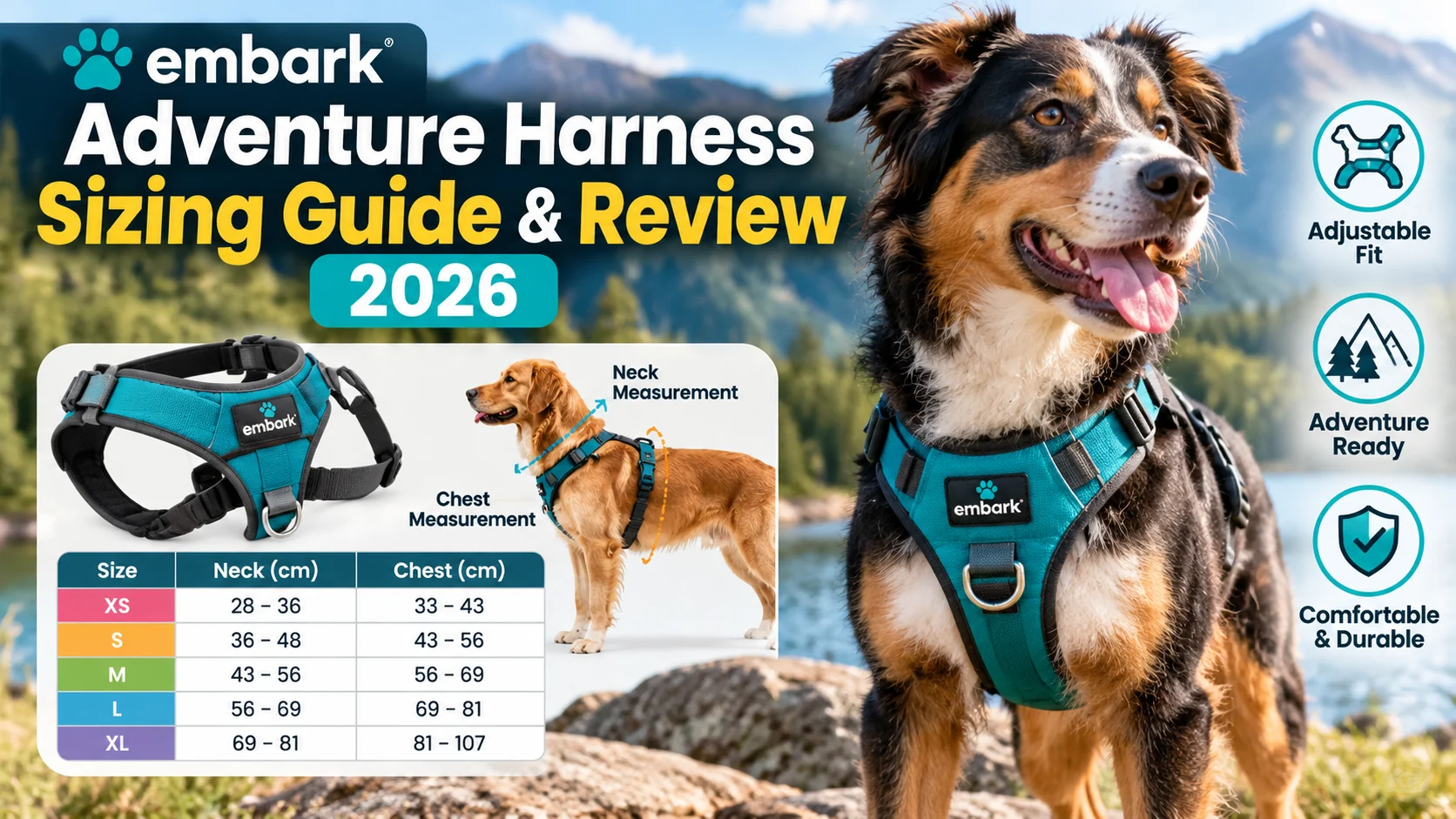
The Embark Adventure Harness is an adjustable, padded dog walking harness with front and rear leash attachments. Choosing the right Embark Adventure Harness size matters because the neck and chest straps must both fit without rubbing or allowing the dog to back out.
This 2026 sizing-focused review uses Embark’s published chart and adjustment guidance to help owners measure, select, and evaluate a size before committing to everyday walks or training.
Quick Verdict
Reviewed Product
Embark Adventure No-Pull Dog Harness
Adjustable everyday harness with two leash attachment options and a control handle.
Rating: ★★★★☆ 4.0/5
Best For: Owners who can match both chest and neck measurements and want a padded daily walking harness.
Key Specs: XS–XL • Adjustable neck and chest • Front/back leash clips • Padded rip-stop nylon
Key Advantage: Separate neck and chest adjustment helps refine the fit.
Main Trade-off: Fit may be difficult for dogs whose proportions fall across sizes.
Bottom Line: A sensible everyday option if the official size chart matches your dog and the fitted harness stays secure during movement.
At a Glance
- Manufacturer size options run from XS through XL.
- Choose using chest and neck girth; weight is supporting guidance.
- Its front clip is intended for leash-training support; the rear clip suits ordinary walks.
- A back handle provides short-range control when needed.
- Adjust the harness before the first full walk and recheck as your dog changes shape.
- Published size ranges differ on some retail pages; use the current maker chart.
Verified Specifications & Buyer Implications
Official Embark Adventure Harness size chart: The table below transcribes the manufacturer’s published sizing graphic; measurements are body circumferences, not harness dimensions.
| Size | Chest | Neck | Weight guidance |
|---|---|---|---|
| XS | 16–19 in (40–48 cm) | 10–17 in (25–43 cm) | 10–19 lb (4.5–9 kg) |
| S | 20–25 in (49–63 cm) | 12–18 in (30–45 cm) | 20–34 lb (9.5–15 kg) |
| M | 26–30 in (64–79 cm) | 15–24 in (38–60 cm) | 35–54 lb (15–24 kg) |
| L | 31–39 in (80–99 cm) | 17–27 in (43–68 cm) | 55–74 lb (25–34 kg) |
| XL | 40–45 in (100–114 cm) | 21–34 in (53–86 cm) | 75+ lb (34+ kg) |
These are the ranges shown in Embark’s sizing graphic, linked from its product page. The stated inch and centimetre boundaries are approximate conversions, so compare measurements in the same unit system.
| Attribute | Verified Detail | Why It Matters |
|---|---|---|
| Sizing system | Chest, neck and weight ranges | A chest-only match is insufficient when the neck opening sits outside its stated range. Check both before deciding whether adjustment can make the harness comfortable and secure. |
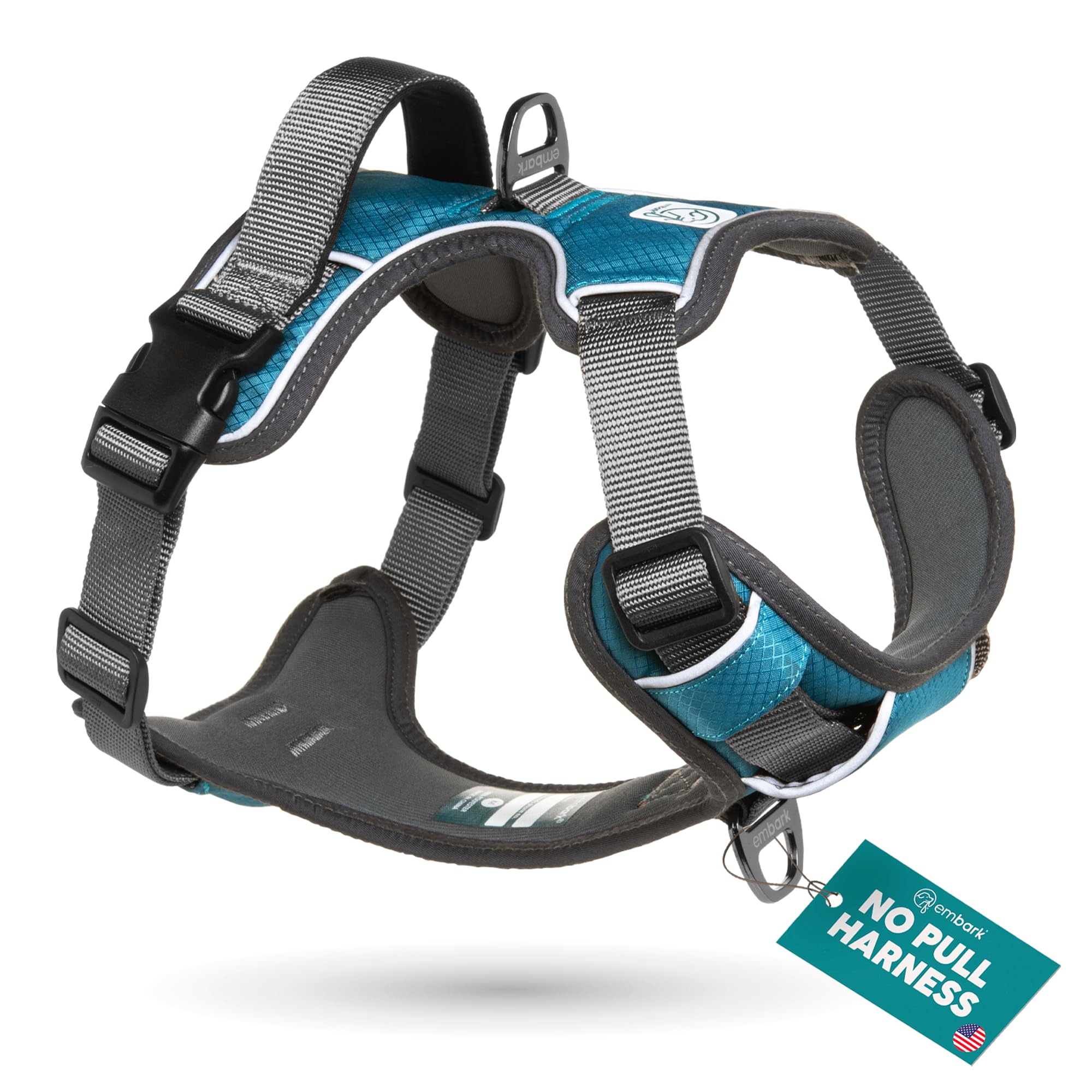
| Adjusters | Neck and chest sliding straps | The separate adjustments let you tune the fit at two body areas. They cannot correct a harness whose padded section is the wrong length or shape. |
| Walking hardware | Front and back lead points; top handle | Two leash positions allow different walking approaches, while the handle adds close control. None of these features eliminates the need for correct sizing. |
| Construction | Rip-stop nylon, padding and reflective trim | The stated materials aim to combine coverage, comfort and visibility. Fabric choice alone does not establish escape resistance or guaranteed long-term wear. |
Design & Build Quality
The Embark Adventure uses padded chest and back sections connected by adjustable straps. This layout can spread contact away from the throat, but panel position matters as much as the softness of the padding.
Embark describes the outer material as reinforced rip-stop nylon and advertises reflective trim. Those are useful construction details, although there is no independently verified fit or durability score for every dog shape.
Setup & Ease of Use
Measure with your dog standing naturally before opening the buckles. Embark’s illustrated adjustment guide shows how to extend the straps first, place the harness correctly, then tighten it.
- Wrap a soft tape around the widest rib-cage area, just behind the front legs.
- Measure the neck at its base where the harness opening rests.
- Compare both measurements with one size row, using weight as a secondary check.
- Loosen all four adjustment areas before fitting the harness over the head and fastening the chest buckles.
- Tighten each side evenly; confirm the chest panel stays centred and the legs move freely.
- Walk indoors, turn, sit, and check again for shifting or pressure points.
How This Review Was Researched
This research-based assessment prioritises Embark’s product documentation, its official size chart, fitting guide, and manufacturer specifications for the alternatives. No hands-on testing is claimed; where retailer dimensions differ, the manufacturer chart takes precedence.
Category-Specific Performance
Size Selection and Body Proportions
For a useful size recommendation, chest and neck must fall within the same size row. A dog with a medium-sized rib cage but a neck outside the medium range needs more scrutiny than a breed-name recommendation can provide.
Embark recommends sizing up when between sizes, but the larger harness still needs to tighten securely at both points. If either strap reaches its limit, a different harness shape may be the better answer.
Freedom of Movement and Chafing
Correct placement leaves the shoulders and front legs moving naturally without a strap cutting into the armpits. Watch for rubbing during turns and changes of pace, not merely while your dog stands still.
Strap Security During Activity
The maker’s guide relies on sliders to set neck and chest tension. Retest the fit after energetic play, particularly if your dog has previously experienced loosening, since secure static fit does not guarantee unchanged tension during movement.
Leash Control and Walking Comfort
The front attachment can redirect a dog that pulls, while the back attachment suits straightforward walking. Neither clip trains loose-leash behaviour automatically, and strong pulling should not be met with sudden jerks.
Expert Insight: A size chart narrows the choice; it cannot validate where a fixed padded panel lands on an individual dog’s chest. That final on-dog check is the real purchase test.
Key Features Explained
Adjustable Neck and Chest Straps
Separate sliders are especially relevant to dogs with a broad chest and slimmer neck. Follow the adjustment diagram rather than leaving long loose strap ends or compensating for a poor chest fit by loosening the neck excessively.
Front and Rear Leash Attachments
The two lead positions make this one harness usable for training practice and routine outings. Choose the point suited to the walk, checking that the harness stays aligned when the lead changes direction.
Padded Body and Control Handle
Padding provides a softer contact surface, and the back handle can help guide a dog through a brief crowded or awkward moment. The handle is not evidence that the harness is suitable for sustained lifting or as a car-restraint device.
Real-World Usability & Maintenance
Start with short, supervised walks after adjustment and inspect skin beneath the harness afterwards. For growing puppies, repeat chest and neck measurements frequently instead of assuming an earlier setting remains appropriate.
Brush away grit, clean the fabric gently according to the relevant care label, and dry it thoroughly before storage. For more context on everyday use, see our Embark Adventure Harness review.
Pros & Cons
Pros
- Manufacturer publishes chest, neck and weight guidance.
- Neck and chest straps adjust separately.
- Front and back leash attachment choices.
- Padded sections, reflective trim and control handle.
Cons
- Overlapping proportions do not guarantee a good panel fit.
- Some retailer sizing charts conflict.
- Fit requires periodic checks during active use.
Common Issues & Fixes
Harness Shifts Sideways
Cause: Uneven strap tension, an oversized selection, or a body shape that does not suit the panel geometry.
Fix: Re-centre the harness, adjust both sides evenly, and change model if it still rotates.
Rubbing Behind the Legs
Cause: A panel or strap may sit too close to the front legs once the dog starts moving.
Fix: Stop using the irritating fit; reposition and reassess before another walk.
Fit Loosens After Running
Cause: Straps can migrate through adjusters under repeated movement; slippage has been reported in reviews.
Fix: Inspect slider position during activity, readjust as instructed, and consider another fit if loosening persists.
What to Know Before You Buy
Do not choose by breed or weight alone. For example, a dog whose chest fits medium but whose neck exceeds medium’s stated maximum should not be forced into that size.
Embark’s official ranges also differ from figures displayed by some third-party sellers. Check the specific listing’s size and colour selection against the manufacturer listing, especially when buying through a marketplace.
Embark advertises a lifetime warranty and a fit-support policy on its own website, but regional eligibility and marketplace purchase terms should be checked before relying on either. A front-clip harness is not a substitute for training or a certified vehicle restraint.
Who Should Consider It / Who Should Look Elsewhere
Who Should Consider It
- Owners with measurements inside one Embark size row.
- Everyday walkers wanting two leash attachment points.
- Handlers who value a short-control back handle.
Who Should Look Elsewhere
- Dogs between incompatible neck and chest ranges.
- Escape-prone dogs needing specialised secure-fit design.
- Owners seeking a crash-tested vehicle harness.
Alternatives to Consider
The following harnesses solve somewhat different fitting or handling problems. Our Ruffwear Front Range sizing guide provides further detail on that alternative.
Reviewed Product
Embark Adventure Harness
Best For: Adjustable daily walking with a handle.
Key Specs: XS–XL; chest/neck chart; dual clips.
Advantage: Separate neck and chest fitting.
Trade-off: Panel geometry may limit fit.
Alternative A
Ruffwear Front Range
Best For: Padded walks using a rib-girth chart.
Key Specs: XXS–L/XL; four adjusters; dual clips.
Advantage: Clearly documented girth sizes.
Trade-off: No integrated assistance handle.
Alternative B
Julius-K9 IDC Powerharness
Best For: Fast fitting and close urban handling.
Key Specs: Chest-girth chart; back ring; handle on applicable sizes.
Advantage: Quick-on design and accessible handle.
Trade-off: Standard model lacks Embark-style front clip.
Is It Worth It?
Yes, if the published size ranges align with your dog’s chest and neck and the harness stays stable during an indoor fit check. Adjustable padding, dual attachment points and a control handle make the feature set relevant to regular walking.
If sizing is the obstacle, do not rely on additional strap tension to fix it. Consider Ruffwear’s girth-led fit or Julius-K9’s alternative construction, and measure again before ordering.
Final Verdict
The Embark Adventure Harness is a practical option for owners seeking an adjustable everyday harness and more than one leash-control method. Its most useful advantage is separate chest and neck adjustment; its biggest limitation is that measurements and panel geometry must both suit the dog.
Choose it when the manufacturer chart and movement check agree. If it shifts, rubs or cannot tighten appropriately, another design is a better investment.
Frequently Asked Questions
How do I measure my dog for the Embark Adventure Harness?
Measure the widest part of the chest and the base of the neck. Compare both measurements with Embark’s chart and treat body weight as supporting information.
What if my dog is between Embark harness sizes?
Embark advises choosing the larger size when between sizes. Verify that it can still be adjusted snugly around the neck and chest.
Does the Embark Adventure Harness fit puppies?
It can suit a puppy whose measurements fall inside a listed size. Re-measure often as the puppy grows, and never rely on expected adult breed size.
How tight should the harness be?
It should sit snugly without pinching or hindering movement. Check that the front legs move freely and the harness does not shift during walking.
Will the front attachment stop my dog pulling?
It may help redirect a pulling dog, but it does not replace training. Correct sizing and patient loose-leash practice remain essential.
Is the Embark Adventure Harness suitable for car travel?
Do not assume it is a crash-tested car restraint. The published walking-harness information does not establish vehicle crash-test certification.
Affiliate disclosure: Go Pet Zone earns a small commission when you purchase through links on this page — at no extra cost to you. Our editorial process is independent: affiliate relationships never influence which products we recommend or how we rate them.


